Choosing a daf wastewater system for Food Processing Plants
Choosing a daf wastewater system for Food Processing Plants
October 22, 2026
Author
Solution Provider, through a professional technical team, we provide customers with targeted equipment selection recommendations and comprehensive after-sales services, winning the trust and recognition of customers.
Sarah M.
This article explains how food processing plants can choose a dissolved air flotation, or DAF, wastewater system. It begins by describing the challenging characteristics of food processing effluent, including high fats, oils, grease, suspended solids, COD, BOD, and variable pH. It then defines DAF, explains how dissolved air flotation works, and lists key components. The article compares DAF with other treatment technologies and outlines conventional, high-rate, circular, and integrated DAF configurations. It details critical selection factors such as wastewater characterization, flow and load variations, pretreatment, chemical dosing, air dissolution, recycle ratio, sludge handling, materials of construction, footprint, automation, and manufacturer support. Design and sizing considerations are covered, including hydraulic loading rate, solids loading rate, air-to-solids ratio, and recycle ratio. Chemical selection, jar testing, and integration with biological treatment, MBR, and RO are discussed. Common operational challenges and solutions are presented, along with cost considerations and sector-specific examples for meat, dairy, beverage, and snack processing. The article highlights HINADA Water Treatment Tech Co., Ltd., a global manufacturer founded in 2012, with products including DAF systems, UF membranes, MBR modules, and RO systems, serving clients in over 75 countries. A procurement checklist, installation and training guidance, and frequently asked questions help plant managers make informed decisions. The conclusion emphasizes that a well-chosen DAF system can improve compliance, reduce costs, protect downstream equipment, and support water reuse and sustainability goals.
Choosing a DAF Wastewater System for Food Processing Plants
Food processing plants operate at the intersection of agriculture, manufacturing, logistics, and public health. Their products feed communities, but their operations also generate wastewater that is rich in organic matter, fats, oils, grease, suspended solids, proteins, carbohydrates, cleaning chemicals, and variable pH. For plant managers, environmental engineers, and sustainability officers, selecting the right treatment train is not merely a compliance exercise. It is a strategic decision that affects operating cost, plant footprint, discharge quality, water reuse potential, and long-term resilience. Among the many technologies available, dissolved air flotation, commonly known as DAF, has become a cornerstone for food processing wastewater pretreatment. This article examines how to choose a DAF wastewater system for food processing plants, what design factors matter most, how DAF integrates with downstream processes, and how manufacturers such as HINADA Water Treatment Tech Co., Ltd. support industrial clients worldwide.
Why Food Processing Wastewater Is Challenging
Food processing wastewater is rarely uniform. A single facility may process different products by campaign, shift, or season. Meat and poultry plants produce blood, fat, and manure-related solids. Dairy plants generate milk fats, proteins, and cleaning agents. Breweries and beverage plants contribute sugars, yeast, hops, and spent grains. Snack and prepared food plants release starches, oils, and particulate matter. These streams can fluctuate in flow rate, organic load, pH, temperature, and toxicity. Such variability makes treatment design difficult, because a system that performs well under average conditions may fail during peak production. DAF systems are often chosen because they can respond to these fluctuations when properly sized and controlled.
Characteristics of Food Processing Effluent
Several characteristics define food processing effluent and influence DAF selection. First, fats, oils, and grease, or FOG, are common and problematic. FOG can coat pipes, clog pumps, reduce oxygen transfer in biological treatment, and increase sludge volumes. Second, suspended solids include food particles, fibers, proteins, and colloidal matter. Third, chemical oxygen demand and biochemical oxygen demand are often high, sometimes ranging from hundreds to tens of thousands of milligrams per liter. Fourth, nutrient levels such as nitrogen and phosphorus may require additional treatment. Fifth, pH can swing widely due to acidic or alkaline cleaning agents. Sixth, temperature may be elevated from cooking, washing, and sterilization. A DAF system must be designed with these realities in mind.
Regulatory and Environmental Pressures
Discharge regulations are tightening in many regions. Municipal treatment plants often impose strict limits on FOG, suspended solids, BOD, COD, and pH. Industrial dischargers may face surcharges, fines, or permit revocation for noncompliance. Some food processors also pursue water reuse goals, which require higher-quality effluent than simple discharge. In addition, corporate sustainability commitments increasingly demand reduced water consumption, lower chemical use, and minimized waste. A well-chosen DAF system can help meet these objectives by removing a large fraction of pollutants before biological treatment or discharge, thereby protecting downstream processes and reducing overall treatment costs.
What Is a DAF System?
Dissolved air flotation is a physical-chemical separation process that removes suspended solids, oils, grease, and other low-density particles from water. The process begins by dissolving air into water under pressure. When the pressurized water is released into a flotation tank, the pressure drops and microscopic air bubbles form. These bubbles attach to particles and droplets, reducing their effective density and causing them to rise to the surface. A sludge blanket forms at the top and is removed by a mechanical skimmer. Clarified water exits from the bottom or side of the tank. DAF is particularly effective for particles that are too light to settle by gravity and for oil droplets that would otherwise remain emulsified.
How Dissolved Air Flotation Works
The classic DAF process includes several steps. Raw wastewater enters a coagulation and flocculation zone, where chemicals are added to destabilize colloidal particles and form larger flocs. A portion of clarified effluent is recycled, pressurized, and saturated with air in a pressure vessel. The air-saturated recycle stream is injected into the flotation tank through a release valve or nozzle system. The sudden pressure drop creates a cloud of microbubbles. These bubbles collide with flocs and oil droplets, forming agglomerates that rise to the surface. The float layer is collected by a skimmer and transferred to sludge handling. The treated water flows to the next treatment stage or discharge point. Modern DAF systems use advanced controls to optimize recycle ratio, chemical dosing, and sludge removal.
Key Components of a DAF Unit
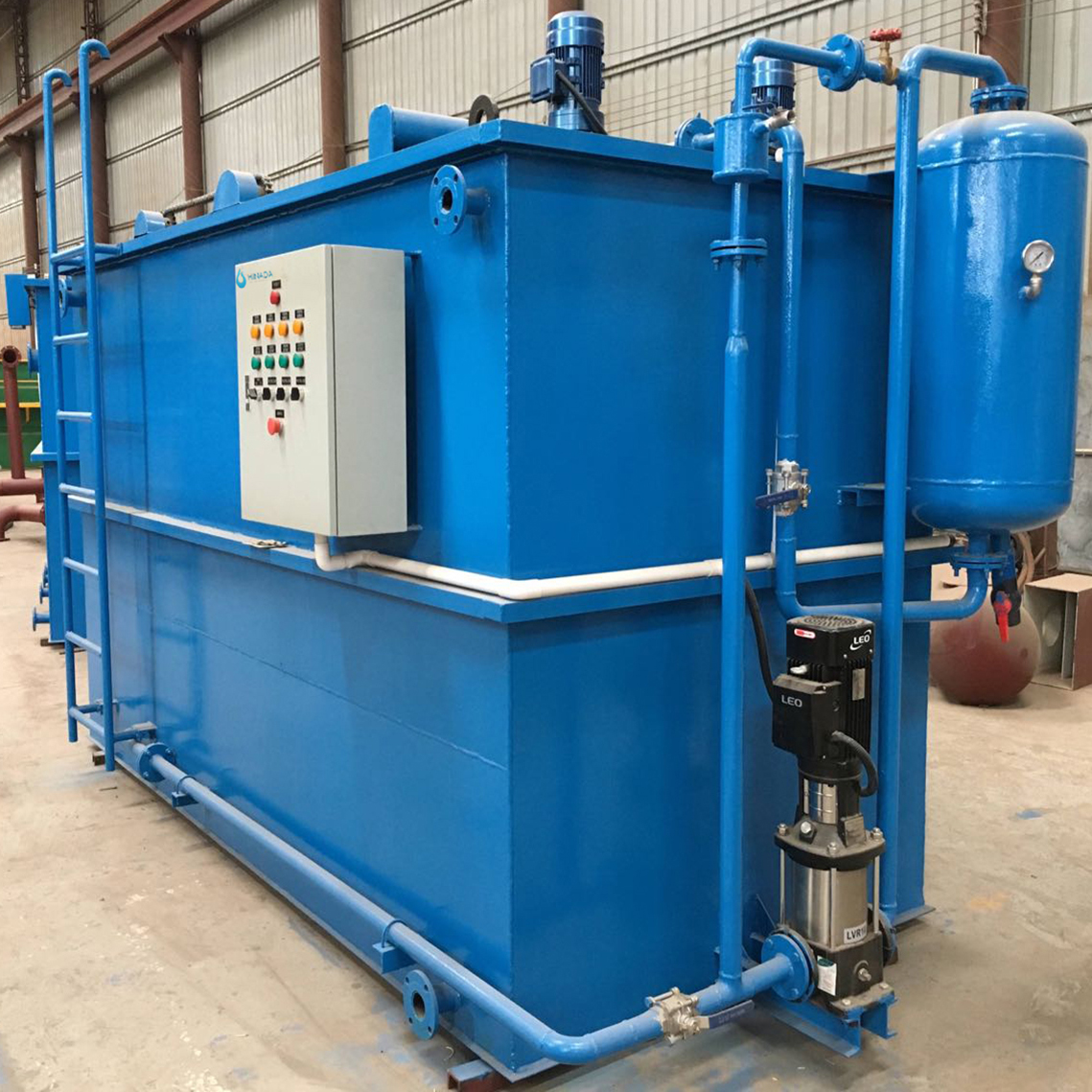
A typical DAF unit includes an influent pump, chemical dosing systems, a coagulation chamber, a flocculation chamber, a flotation tank, an air saturation system, a recycle pump, a pressure vessel, a release valve, a surface skimmer, a sludge collection trough, an effluent outlet, and a control panel. Optional components include pH adjustment, pre-screening, equalization tanks, chemical mixing tanks, sludge dewatering equipment, and odor control. The materials of construction may be carbon steel with epoxy coating, stainless steel, or other corrosion-resistant materials depending on the wastewater chemistry. The choice of components affects performance, maintenance, and capital cost.
Why DAF Is Often the Right Choice for Food Processing Plants
DAF offers several advantages for food processing wastewater. It can remove a high percentage of FOG, suspended solids, and COD in a relatively compact footprint. It is effective for both free and emulsified oils when combined with appropriate coagulation and flocculation. It can handle shock loads better than some biological systems because it is a physical-chemical process. It can also be used to recover valuable byproducts, such as fats and proteins, in some cases. Furthermore, DAF can serve as a pretreatment step to protect downstream biological treatment, membrane filtration, or reverse osmosis. For many food processors, DAF is not the only solution, but it is often the most practical first step.
Comparison with Other Treatment Technologies
Gravity settling is simple and low-cost, but it is ineffective for light particles and emulsified oils. It requires large footprint and long retention times. Chemical precipitation can remove dissolved pollutants but generates large sludge volumes. Biological treatment is excellent for dissolved organic matter but can be inhibited by FOG and shock loads. Membrane bioreactors produce high-quality effluent but require effective pretreatment to prevent fouling. Ultrafiltration and reverse osmosis can polish water for reuse but are sensitive to suspended solids and oil. DAF complements these technologies by removing the bulk of floatable and suspended contaminants early in the treatment train. This reduces load on downstream units and improves overall reliability.
Types of DAF Systems
DAF systems come in several configurations, each suited to different applications and space constraints. The choice among them depends on flow rate, footprint, wastewater characteristics, and project budget. Understanding the differences helps plant managers and engineers specify the right system.
Conventional DAF
Conventional DAF uses a rectangular or circular tank with a relatively low hydraulic loading rate. It provides long retention time and is robust against fluctuations. It is often used for large flows and high solids loads. The design typically includes a separate coagulation and flocculation chamber, a flotation zone, and a sludge removal mechanism. Conventional DAF is reliable but may require significant space. It is well-suited to food processing plants that have available land and want a proven, low-risk solution.
High-Rate DAF
High-rate DAF uses a smaller tank and higher hydraulic loading rates. It relies on efficient microbubble generation and optimized contact zones to achieve rapid separation. High-rate DAF is compact and can be installed in existing buildings or tight sites. It is often used for medium to large flows with moderate solids loads. However, it may require more precise chemical dosing and control to maintain performance. For food processors with limited space, high-rate DAF can be an attractive option.
Circular DAF
Circular DAF units use a round tank with a rotating scraper or skimmer. They are known for compact footprint, uniform flow distribution, and efficient sludge collection. Circular DAF is often used for smaller to medium flows and can be prefabricated for quick installation. It is popular in industrial applications where floor space is at a premium. The circular design can also reduce short-circuiting and improve hydraulic stability.
Integrated DAF with Chemical Dosing
Integrated DAF systems combine chemical dosing, coagulation, flocculation, flotation, and sludge removal into a single package. They are often skid-mounted or containerized for rapid deployment. Integrated DAF is ideal for food processing plants that need a turnkey solution with minimal civil works. It can be automated and monitored remotely, reducing labor requirements. HINADA, for example, offers integrated packaged wastewater treatment systems and DAF systems that can be combined with membrane filtration for advanced treatment.
Critical Factors When Choosing a DAF System
Selecting a DAF system requires a systematic evaluation of wastewater characteristics, site conditions, operational constraints, and business objectives. The following factors are critical to a successful selection.
1. Wastewater Characterization
Before choosing a DAF system, plant managers should conduct a thorough wastewater characterization study. This includes measuring flow rate, pH, temperature, total suspended solids, FOG, BOD, COD, nitrogen, phosphorus, and particle size distribution. It is also important to identify variability by shift, day, and season. Composite samples and grab samples should be collected over a representative period. Jar tests should be performed to evaluate chemical dosing requirements. Without accurate characterization, any DAF design is based on assumptions that may lead to underperformance or oversizing.
2. Flow Rate and Load Variations
Food processing plants often experience significant flow and load variations. Production schedules, cleaning cycles, and seasonal campaigns can cause peaks that are several times the average. A DAF system must be sized to handle peak hydraulic and solids loads without losing efficiency. Equalization tanks can help dampen variations, but they add cost and footprint. Alternatively, modular DAF units can be installed in parallel to match capacity to demand. The design should also consider future expansion, because food processors may add product lines or increase production.
3. Pretreatment Requirements
Pretreatment before DAF is often necessary to protect pumps and improve separation. Screening removes large solids, fibers, and debris. Grit removal protects equipment from abrasion. Grease traps or pre-separation can reduce FOG load. pH adjustment may be required to optimize coagulation. Equalization can stabilize flow and load. In some cases, pre-aeration or pre-oxidation can improve treatability. The choice of pretreatment depends on the specific wastewater and the DAF design. A manufacturer with broad experience can recommend the right combination.
4. Chemical Dosing and Coagulation/Flocculation
Chemical dosing is central to DAF performance. Coagulants such as aluminum salts, iron salts, or cationic polymers destabilize colloidal particles. Flocculants, usually anionic or cationic polyacrylamides, bind particles into larger flocs that can attach to bubbles. pH adjustment may be needed to create the right conditions for coagulation. The optimal dose depends on wastewater characteristics and must be determined by jar testing. Overdosing wastes chemicals and increases sludge volume; underdosing leads to poor removal. Automated dosing systems with flow-paced control and online monitoring can improve consistency and reduce operating costs.
5. Air Dissolution and Recycle Ratio
The air dissolution system determines the quantity and size of microbubbles. The recycle ratio is the percentage of clarified effluent that is pressurized and recycled. Typical recycle ratios range from 20% to 50% for food processing wastewater, but higher ratios may be needed for high FOG or high solids loads. The air-to-solids ratio is another key parameter. It represents the mass of air available per mass of solids to be floated. Proper design ensures enough bubbles to attach to particles without excessive energy consumption. The pressure vessel, pump, and release valve must be selected to maintain stable operation.
6. Sludge Handling and Dewatering
DAF produces a float sludge that contains fats, oils, grease, suspended solids, and chemical flocs. This sludge can be thick, odorous, and difficult to handle. The choice of sludge handling equipment affects operating cost and labor. Options include sludge thickening, dewatering with belt presses, filter presses, screw presses, or centrifuges. In some food processing plants, the DAF sludge can be sent to anaerobic digestion for biogas production. In others, it is dewatered and disposed of or used as a byproduct. The DAF design should consider sludge volume, concentration, and downstream processing.
7. Materials of Construction
Food processing wastewater can be corrosive due to acids, alkalis, salts, and cleaning chemicals. The materials of construction must resist corrosion and abrasion. Common options include epoxy-coated carbon steel, stainless steel 304 or 316, and sometimes fiberglass or polypropylene for smaller units. The choice depends on wastewater chemistry, temperature, and budget. Stainless steel offers excellent corrosion resistance but higher capital cost. Epoxy-coated carbon steel is cost-effective but requires maintenance. A reputable manufacturer will recommend the appropriate material based on water analysis.
8. Footprint and Layout
Footprint is often a limiting factor in food processing plants, especially in urban or built-up areas. DAF systems can be rectangular, circular, or integrated into containers. High-rate and circular DAF units are more compact than conventional rectangular units. Integrated package plants can be installed outdoors or indoors with minimal civil works. The layout should allow access for maintenance, chemical delivery, and sludge removal. It should also consider future expansion and integration with existing treatment units.
9. Automation and Control
Automation improves reliability, reduces labor, and optimizes chemical and energy use. A modern DAF system may include programmable logic controllers, human-machine interfaces, flow meters, pH sensors, turbidity meters, level sensors, and remote monitoring. Automated control can adjust recycle ratio, chemical dosing, and sludge removal based on real-time conditions. Remote monitoring allows operators and manufacturers to troubleshoot issues quickly. For food processors with limited technical staff, automation is particularly valuable.
10. Manufacturer Support and After-Sales Service
The manufacturer is a critical partner in DAF selection. A good manufacturer provides process design, equipment fabrication, installation support, commissioning, training, and spare parts. They should have experience with food processing wastewater and a track record of successful installations. They should also offer responsive after-sales service and remote support. HINADA Water Treatment Tech Co., Ltd., for instance, has more than 13 years of experience in the water treatment industry and 10 years of membrane and equipment manufacturing experience. The company provides integrated solutions from design and supply to installation support, commissioning, and training.
Design and Sizing Considerations
Proper design and sizing are essential for DAF performance. Oversizing wastes capital and energy; undersizing leads to poor removal and operational problems. The design process should be based on representative wastewater data and should consider variability. Key design parameters include hydraulic loading rate, solids loading rate, air-to-solids ratio, recycle ratio, and chemical dosing. These parameters are interrelated and must be optimized together.
Hydraulic Loading Rate
The hydraulic loading rate is the flow rate per unit area of the flotation tank. It determines the rise velocity of bubbles and flocs. Typical hydraulic loading rates for DAF range from 2 to 10 cubic meters per square meter per hour, depending on the application and design. Higher rates require more efficient bubble generation and contact. For food processing wastewater with high FOG, lower rates may be needed to ensure adequate separation. The design should also account for peak flows.
Solids Loading Rate
The solids loading rate is the mass of suspended solids applied per unit area per unit time. It is a critical parameter for DAF design because it determines the sludge production and the required surface area. Food processing wastewater can have high and variable solids loads. The design should be based on peak solids loads, not just average. If the solids loading rate is too high, the sludge blanket may become too thick and carry over into the effluent. If it is too low, the system may be oversized and inefficient.
Air-to-Solids Ratio
The air-to-solids ratio, often expressed as mass of air per mass of solids, indicates whether enough bubbles are available to float the solids. Typical values range from 0.01 to 0.1, but food processing wastewater may require higher ratios due to high FOG and colloidal matter. The ratio depends on the solubility of air in water, the recycle ratio, and the pressure. It can be adjusted by changing the recycle ratio or the saturation pressure. Jar tests and pilot tests can help determine the optimal ratio.
Recycle Ratio
The recycle ratio is the flow rate of recycled clarified effluent divided by the influent flow rate. It is a key operating parameter. Higher recycle ratios provide more bubbles but increase pumping energy and hydraulic loading. Lower recycle ratios save energy but may reduce removal efficiency. Typical recycle ratios for food processing DAF are 20% to 50%, but can be higher for high-strength wastewater. Variable frequency drives on recycle pumps allow adjustment based on load. Automated control can optimize the recycle ratio in real time.
Chemical Selection and Optimization
Chemical selection and optimization can significantly affect DAF performance and operating cost. The goal is to destabilize colloidal particles, form flocs that can attach to bubbles, and remove FOG and suspended solids. The choice of chemicals depends on wastewater characteristics, discharge requirements, and sludge handling constraints.
pH Adjustment
pH affects the surface charge of particles and the performance of coagulants and flocculants. Many food processing wastewaters are acidic or alkaline depending on cleaning chemicals. Adjusting pH to the optimal range for coagulation, often between 6 and 8, can improve removal. Acids such as sulfuric acid or hydrochloric acid, and bases such as sodium hydroxide or lime, may be used. pH adjustment should be controlled automatically to avoid overdosing.
Coagulants
Coagulants neutralize the negative charges on colloidal particles, allowing them to come together. Common coagulants include aluminum sulfate, polyaluminum chloride, ferric chloride, ferrous sulfate, and cationic polymers. The choice depends on pH, alkalinity, and wastewater composition. Aluminum-based coagulants are effective but can produce more sludge. Iron-based coagulants are effective over a wider pH range but can color the water. Cationic polymers can be used as primary coagulants or as coagulant aids.
Flocculants
Flocculants are high-molecular-weight polymers that bridge particles into larger, stronger flocs. They are usually anionic, cationic, or nonionic polyacrylamides. The choice depends on the charge of the particles and the coagulant used. Flocculants are typically dosed after coagulants with gentle mixing to avoid breaking the flocs. Overdosing can cause stickiness and carryover. Proper selection and dosing are critical for DAF performance.
Testing and Jar Tests
Jar tests are the standard method for selecting and optimizing chemicals. A jar test apparatus simulates coagulation, flocculation, and flotation. Different doses and combinations of chemicals are tested, and the resulting turbidity, COD, FOG, and sludge volume are measured. Jar tests should be performed with representative wastewater samples and repeated over time to account for variability. Pilot testing can further validate the design and provide scale-up data. HINADA and other manufacturers often provide jar test support and pilot units.
Integration with Downstream Treatment
DAF is rarely a standalone solution. It is usually part of a treatment train that may include biological treatment, membrane filtration, reverse osmosis, or advanced oxidation. The integration of DAF with downstream processes affects overall performance, cost, and reliability.
DAF + Biological Treatment
Biological treatment, such as activated sludge, sequencing batch reactors, or anaerobic digestion, is effective for dissolved organic matter. However, FOG and suspended solids can inhibit biological activity and cause sludge bulking. DAF pretreatment removes a large fraction of FOG and suspended solids, reducing the load on biological treatment and improving stability. The DAF sludge can be sent to anaerobic digestion for biogas production, creating a renewable energy source. The combination of DAF and biological treatment is common in food processing plants.
DAF + MBR
Membrane bioreactors combine biological treatment with membrane filtration to produce high-quality effluent. MBRs are compact and can produce water suitable for reuse. However, membranes are sensitive to FOG and suspended solids, which can cause fouling. DAF pretreatment protects the membranes by removing the bulk of these contaminants. HINADA manufactures submerged MBR membrane modules and containerized MBR systems, which can be integrated with DAF for a complete treatment solution. The combination of DAF and MBR is increasingly popular for food processors seeking water reuse.
DAF + RO
Reverse osmosis is used for high-purity water, desalination, and advanced reuse. RO membranes are very sensitive to suspended solids, oil, and organic matter. DAF, followed by ultrafiltration or MBR, can provide effective pretreatment for RO. HINADA offers industrial RO systems and ultrafiltration systems that can be combined with DAF to create a multi-barrier treatment train. This approach is suitable for food processing plants that need to meet strict reuse standards or discharge limits.
Common Operational Challenges and Solutions
Even well-designed DAF systems can face operational challenges. Understanding common problems and their solutions helps plant managers maintain performance and reduce downtime.
Poor FOG removal: May be due to insufficient chemical dosing, incorrect pH, low recycle ratio, or high hydraulic loading. Solution: optimize jar tests, adjust pH, increase recycle ratio, reduce flow.
Sludge carryover: May be caused by excessive solids loading, high sludge blanket, or skimmer malfunction. Solution: reduce solids load, adjust skimmer speed, increase sludge removal frequency.
Clogged release valves: May be due to scale, debris, or improper maintenance. Solution: clean or replace valves, install strainers, follow maintenance schedule.
High chemical consumption: May be due to overdosing, poor mixing, or variable wastewater. Solution: automate dosing, optimize mixing, perform regular jar tests.
Corrosion: May be due to aggressive wastewater or inadequate materials. Solution: upgrade materials, apply protective coatings, adjust pH.
Odor: May be due to septic wastewater or sludge storage. Solution: pre-aeration, chemical oxidation, covered tanks, regular sludge removal.
Foaming: May be due to surfactants or proteins. Solution: adjust chemicals, use antifoam, improve equalization.
Energy, Chemical, and Maintenance Costs
The total cost of ownership of a DAF system includes capital cost, energy, chemicals, maintenance, and sludge disposal. Energy is consumed mainly by pumps, compressors, and skimmers. Chemical costs depend on dose and price. Maintenance includes labor, spare parts, and cleaning. Sludge disposal can be significant, especially if the sludge is classified as hazardous or requires special handling. A well-designed and well-operated DAF system can reduce downstream treatment costs by removing pollutants early. It can also recover byproducts in some cases, offsetting operating costs. Plant managers should evaluate life-cycle costs, not just initial capital.
Case Examples from Food Processing Sectors
Different food processing sectors have different wastewater characteristics and DAF requirements. The following examples illustrate how DAF can be applied.
Meat and Poultry Processing
Meat and poultry processing wastewater contains blood, fat, manure, and high organic loads. DAF is used to remove FOG, suspended solids, and COD before biological treatment. Chemical dosing with coagulants and flocculants is common. The DAF sludge can be processed in anaerobic digesters. Typical removal efficiencies for FOG and suspended solids can exceed 90% when properly designed. The system must handle high peak loads during slaughter and cleaning.
Dairy Processing
Dairy wastewater contains milk fats, proteins, lactose, and cleaning chemicals. It can have high BOD and COD. DAF removes fats and proteins, reducing load on biological treatment. pH adjustment may be needed because cleaning agents can be alkaline or acidic. The recovered sludge may be used as animal feed or sent to digestion, depending on regulations. DAF is often combined with MBR for water reuse in dairy plants.
Beverage and Brewery
Brewery and beverage wastewater contains sugars, yeast, hops, and cleaning agents. It is often high in BOD but lower in FOG than meat processing. DAF may be used to remove suspended solids and some oils. In breweries, DAF can help recover yeast and beer solids. The treated water can be discharged or reused for cleaning or irrigation. DAF is often part of a treatment train that includes anaerobic digestion and aerobic polishing.
Snack and Prepared Foods
Snack and prepared food plants produce wastewater with starches, oils, proteins, and particulate matter. FOG can be significant if frying operations are present. DAF removes these contaminants and protects downstream biological treatment. The wastewater may also contain high salt levels, which can affect chemical dosing. Pilot testing is recommended to optimize the design. DAF systems for these plants are often integrated and automated.
How HINADA Supports Food Processing Plants
HINADA Water Treatment Tech Co., Ltd. is a globally recognized manufacturer of wastewater treatment equipment, hollow fiber ultrafiltration membranes, submerged MBR membrane modules, integrated packaged wastewater treatment systems, and DAF systems. Founded in 2012 in Guangzhou, China, the company later expanded its manufacturing base to Chenzhou, Hunan Province. Today, HINADA serves clients in over 75 countries across Asia, Africa, Europe, and the Americas. The company is one of the leading submerged MBR membrane, wastewater treatment equipment, and membrane filtration system manufacturers in China. It specializes in wastewater treatment solutions and equipment supply, providing integrated solutions from design and supply to installation support, commissioning, and training.
HINADA DAF Systems
HINADA designs and manufactures DAF systems for industrial and municipal applications. The company offers conventional, high-rate, circular, and integrated DAF configurations. Its DAF systems can be combined with chemical dosing, coagulation, flocculation, and sludge handling equipment. HINADA uses corrosion-resistant materials and advanced controls to ensure reliable performance. The company also provides jar testing, pilot testing, and process optimization support to help food processors select the right DAF system.
Integrated Solutions
HINADA provides a complete ecosystem from membrane research and development and component manufacturing to equipment fabrication and turnkey solution delivery. Its core technology pillars include hollow fiber ultrafiltration and MBR membranes for precise physical separation of suspended solids, bacteria, colloids, and macromolecular organics, and intelligent integrated wastewater treatment equipment for municipal, industrial, and decentralized applications. For food processing plants, HINADA can integrate DAF with MBR, ultrafiltration, and reverse osmosis to create a treatment train that meets discharge or reuse requirements. Containerized MBR systems and packaged wastewater treatment plants are available for rapid deployment.
Global Experience
HINADA actively participates in international water treatment exhibitions, bringing Chinese membrane technology to regions where clean water is most needed. Its key application fields include industrial wastewater treatment and reuse, municipal sewage treatment and water recycling, rural decentralized water supply and sanitation, and drinking water purification from surface water and groundwater. With more than 13 years of experience in the water treatment industry and 10 years of membrane and equipment manufacturing experience, HINADA has the expertise to support food processing plants in selecting, installing, and operating DAF systems. The company provides training and after-sales service to ensure long-term performance.
Procurement Checklist for Choosing a DAF System
When procuring a DAF system, plant managers and engineers should follow a structured checklist to ensure they cover all critical aspects. The following list provides a practical guide.
Define objectives: Clarify discharge limits, reuse goals, and budget.
Installation and commissioning are critical phases that determine whether a DAF system meets its design performance. Proper installation ensures that equipment is level, aligned, and connected correctly. Commissioning includes checking pumps, valves, instruments, and controls; performing water tests; and optimizing chemical dosing. Training ensures that operators understand the process, safety procedures, and maintenance requirements. HINADA provides installation support, commissioning, and training as part of its integrated solutions. This support helps food processing plants achieve stable operation quickly and avoid costly startup problems.
Frequently Asked Questions
What is the typical removal efficiency of a DAF system?
Removal efficiency depends on wastewater characteristics and chemical dosing. For food processing wastewater, DAF can remove 80% to 95% of FOG and suspended solids, and 50% to 80% of COD. With optimized chemicals and design, higher removals are possible. Pilot testing can provide site-specific estimates.
How much space does a DAF system require?
Space requirements vary by type and capacity. Conventional DAF requires more space, while high-rate and circular DAF are more compact. Integrated containerized systems can be installed in small areas. A typical DAF for a medium food processing plant may require 50 to 200 square meters, plus space for chemical storage and sludge handling.
Can DAF handle shock loads?
DAF is more tolerant of shock loads than biological treatment because it is a physical-chemical process. However, extreme peaks can still cause carryover or poor removal. Equalization and modular design can improve shock load tolerance. Automated control can adjust recycle ratio and chemical dosing in response to load changes.
What chemicals are used in DAF?
Common chemicals include coagulants such as polyaluminum chloride or ferric chloride, flocculants such as anionic or cationic polyacrylamides, and pH adjusters such as sodium hydroxide or sulfuric acid. The specific chemicals and doses depend on wastewater characteristics and should be determined by jar testing.
How is DAF sludge handled?
DAF sludge can be thickened and dewatered using belt presses, filter presses, screw presses, or centrifuges. It may be sent to anaerobic digestion, composting, incineration, or landfill, depending on local regulations and sludge characteristics. In some cases, fats and proteins can be recovered as byproducts.
How long does a DAF system last?
With proper maintenance, a DAF system can last 15 to 25 years or more. The lifespan depends on materials of construction, wastewater corrosivity, and maintenance practices. Stainless steel units generally last longer than coated carbon steel. Regular inspection and replacement of wear parts are essential.
Why choose HINADA for a DAF system?
HINADA offers extensive experience, a broad product portfolio, and integrated solutions. The company manufactures DAF systems, MBR modules, ultrafiltration membranes, and reverse osmosis systems. It provides design, supply, installation support, commissioning, and training. With clients in over 75 countries and more than 13 years of experience, HINADA is a reliable partner for food processing plants seeking effective wastewater treatment.
Conclusion
Choosing a DAF wastewater system for a food processing plant is a complex but manageable decision. It requires a clear understanding of wastewater characteristics, treatment objectives, site constraints, and operational capabilities. DAF is a proven technology for removing FOG, suspended solids, and COD, and it integrates well with biological treatment, MBR, ultrafiltration, and reverse osmosis. The right DAF system can reduce discharge fees, protect downstream processes, enable water reuse, and support sustainability goals. Plant managers should work with experienced manufacturers, conduct thorough testing, and consider life-cycle costs. HINADA Water Treatment Tech Co., Ltd. stands ready to support food processors worldwide with DAF systems, membrane technology, and integrated wastewater treatment solutions. By making an informed choice, food processing plants can turn wastewater treatment from a cost center into a strategic advantage.