Choosing daf wastewater treatment for High-Solids Wastewater
Choosing daf wastewater treatment for High-Solids Wastewater
September 30, 2026
Author
Solution Provider, through a professional technical team, we provide customers with targeted equipment selection recommendations and comprehensive after-sales services, winning the trust and recognition of customers.
Sarah M.
High-solids wastewater contains elevated concentrations of suspended solids, fats, oils, grease, and fibrous materials that challenge conventional sedimentation. Dissolved air flotation, or DAF, is a proven separation technology that uses microscopic air bubbles to attach to particles and lift them to the surface for removal. DAF is compact, fast, and highly effective for low-density and hydrophobic solids, making it an excellent choice for food processing, meat and poultry, dairy, pulp and paper, textile, oil and gas, mining, and municipal applications. Key design parameters include hydraulic loading rate, solids loading rate, air-to-solids ratio, recycle ratio, saturation pressure, and chemical conditioning. Pretreatment such as screening, grit removal, and equalization improves performance, while integration with MBR, ultrafiltration, and reverse osmosis enables water reuse. HINADA Water Treatment Tech Co., Ltd., founded in 2012 in Guangzhou and expanded to Chenzhou, Hunan Province, is a globally recognized manufacturer of DAF systems, hollow fiber UF membranes, submerged MBR modules, containerized MBR systems, and packaged wastewater treatment plants. HINADA serves clients in over 75 countries and offers a complete ecosystem from membrane research and development to turnkey solution delivery. Its two core technology pillars are hollow fiber ultrafiltration and MBR membranes, and intelligent integrated wastewater treatment equipment. When selecting a DAF system for high-solids wastewater, engineers should characterize the wastewater, conduct jar tests and pilot trials, evaluate footprint and sludge handling, consider operating costs, and choose a configuration that matches site constraints. Rectangular, circular, high-rate, and containerized DAF units each have advantages. Operational best practices include consistent chemical dosing, monitoring recycle ratio and pressure, cleaning saturation vessels and nozzles, optimizing skimming, and scheduling preventive maintenance. Common pitfalls include undersizing the tank, inadequate chemical conditioning, ignoring variability, and neglecting sludge handling. Future trends point toward high-rate compact designs, energy-efficient saturation systems, smart control, membrane integration, resource recovery, and modular containerized units. HINADA remains at the forefront of these developments, providing integrated DAF and membrane solutions that help industries and municipalities meet their wastewater treatment and reuse goals.
Choosing DAF Wastewater Treatment for High-Solids Wastewater
High-solids wastewater is a broad term that describes effluent streams containing elevated concentrations of suspended solids, fats, oils, grease, fibrous materials, and other particulate matter. These streams are common in food processing, meat and poultry operations, dairy production, pulp and paper mills, textile manufacturing, oil and gas extraction, mining, and many municipal applications where conventional sedimentation struggles to achieve consistent clarity. When solids concentrations rise above typical domestic sewage levels, traditional gravity settling becomes slow, unreliable, and land-intensive. Engineers and plant managers therefore increasingly turn to dissolved air flotation, or DAF, as a primary or polishing treatment step. DAF is not a new technology, but its application to high-solids wastewater has expanded dramatically as industries seek compact, efficient, and chemically flexible separation systems. This article examines the technical, operational, and economic factors that influence the choice of DAF for high-solids wastewater, with reference to equipment and integrated solutions from HINADA Water Treatment Tech Co., Ltd., a globally recognized manufacturer of wastewater treatment equipment, hollow fiber ultrafiltration membranes, submerged MBR membrane modules, integrated packaged wastewater treatment systems, and DAF systems.
HINADA Water Treatment Tech Co., Ltd., often abbreviated as HINADA, was founded in 2012 in Guangzhou, China, and later expanded its manufacturing base to Chenzhou, Hunan Province. Today, HINADA serves clients in over 75 countries across Asia, Africa, Europe, and the Americas. Its core products include PVDF and PVC hollow fiber UF membranes, submerged MBR membrane modules, containerized MBR systems and packaged wastewater treatment plants, dissolved air flotation systems, ultrafiltration systems, and industrial reverse osmosis systems. With more than 13 years of experience in the water treatment industry and 10 years of membrane and equipment manufacturing experience, HINADA has built a complete ecosystem from membrane research and development and component manufacturing to equipment fabrication and turnkey solution delivery. This ecosystem is particularly relevant when selecting DAF systems for high-solids wastewater, because the optimal solution often integrates chemical conditioning, physical separation, and downstream membrane or biological treatment.
Understanding High-Solids Wastewater
High-solids wastewater is not defined by a single numerical threshold. In practice, any stream with total suspended solids above 500 mg/L, and certainly above 1,000 mg/L, can be considered high-solids for the purpose of process selection. Some industrial streams contain 5,000 mg/L or more, while sludges and concentrated waste streams may exceed 20,000 mg/L. The solids may be organic, inorganic, or a mixture. Organic solids include food particles, blood, fat, grease, oil, and microbial biomass. Inorganic solids include sand, grit, metal hydroxides, clay, and precipitated salts. The physical characteristics of these solids, such as particle size, density, surface charge, and hydrophobicity, determine how easily they can be separated by gravity, flotation, filtration, or centrifugation.
undefined
High-solids wastewater often contains emulsified oils and greases that do not respond well to simple settling. Emulsified droplets are stabilized by surfactants, proteins, and fine particles, and they can remain suspended almost indefinitely. In such cases, chemical coagulation and flocculation are required to destabilize the emulsion and form larger agglomerates that can be removed by DAF. The presence of fibers, such as those from paper mills or textile plants, can also create matting and clogging problems in conventional clarifiers. DAF is frequently chosen because it can handle fibrous and low-density solids that tend to float rather than settle.
Sources and Characteristics
Food and beverage processing: high organic load, fats, oils, grease, and suspended solids from washing, peeling, and cooking.
Meat and poultry: blood, fat, tissue, and manure, with high biochemical oxygen demand and chemical oxygen demand.
Dairy and cheese: milk fats, proteins, and cleaning chemicals, often forming stable emulsions.
Pulp and paper: fibers, fillers, lignin, and chemical residues, with variable pH and temperature.
Textile and dyeing: dyes, starches, surfactants, and suspended fibers, often with strong color.
Oil and gas: produced water, drilling fluids, and refinery wastewater containing hydrocarbons and fine solids.
Mining and metal finishing: fine mineral particles, metal hydroxides, and oily residues.
Municipal and decentralized systems: septage, sludge thickening, and combined sewer overflows with high solids.
The variability of high-solids wastewater is a critical design consideration. Flow rates may fluctuate hourly, daily, or seasonally. Solids concentrations may spike during production campaigns or storm events. Temperature and pH may vary widely. A DAF system must be designed with sufficient flexibility to handle these variations without losing performance. Equalization tanks, chemical dosing controls, and adjustable recycle ratios are common features in robust DAF installations.
What Is Dissolved Air Flotation?
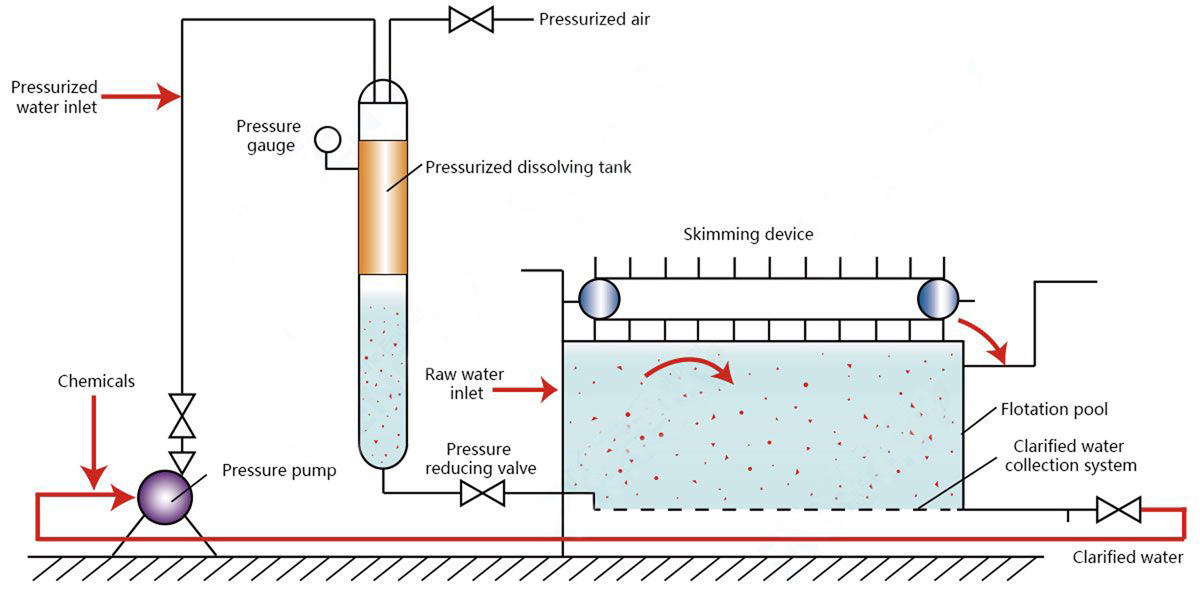
Dissolved air flotation is a physical separation process that removes suspended solids, oils, and greases from wastewater by attaching microscopic air bubbles to particles and lifting them to the surface. The resulting float layer, or sludge blanket, is then skimmed off for further handling. The key principle is that air is dissolved into a pressurized recycle stream, typically at 4 to 6 bar, and then released into the flotation tank through special nozzles or valves. The sudden pressure drop causes the air to come out of solution as millions of tiny bubbles, usually 20 to 100 micrometers in diameter. These bubbles collide with and attach to floc particles, reducing their apparent density and causing them to rise.
Unlike sedimentation, which relies on the density difference between solids and water, DAF relies on the buoyancy of air-particle agglomerates. This makes DAF particularly effective for particles that are neutrally buoyant, low-density, or hydrophobic. It also allows for much higher surface loading rates than conventional clarifiers, meaning a smaller footprint for the same flow rate. In high-solids applications, DAF can achieve removal efficiencies of 90 to 99 percent for suspended solids, fats, oils, and grease, and 50 to 80 percent for chemical oxygen demand, depending on the wastewater characteristics and chemical conditioning.
How DAF Works
A typical DAF system consists of several key components: a flotation tank, a saturation vessel or air dissolving system, a recycle pump, an air compressor, chemical dosing units, a skimmer, and a sludge collection system. Wastewater enters the flotation tank after chemical conditioning. A portion of the treated effluent is recycled, pressurized, and saturated with air. The saturated recycle stream is injected into the influent or into a contact zone, where the pressure is released. The air bubbles attach to floc particles and rise to the surface. Clarified water exits from the bottom of the tank, while the float sludge is skimmed from the top.
Key Stages
Coagulation and flocculation: chemicals are added to neutralize charges and bridge particles into larger flocs.
Air saturation: a recycle stream is pressurized and mixed with compressed air in a saturation vessel.
Bubble formation: the pressurized stream is released into the flotation tank, creating micro-bubbles.
Contact and attachment: bubbles collide with flocs and attach to them.
Separation: buoyant agglomerates rise to the surface and form a float layer.
Skimming: mechanical skimmers remove the float sludge for dewatering or disposal.
Clarified effluent discharge: treated water is withdrawn from the bottom for reuse or further treatment.
Why DAF Excels with High-Solids Wastewater
DAF offers several advantages over conventional sedimentation and other separation technologies when dealing with high-solids wastewater. First, it is compact. Because the rise velocity of air-particle agglomerates is much higher than the settling velocity of most flocs, DAF tanks can operate at hydraulic loading rates of 5 to 15 m3/m2·h, compared with 1 to 3 m3/m2·h for conventional clarifiers. This reduces land area and construction costs, which is especially important for retrofits and space-constrained industrial sites.
Second, DAF is highly effective for low-density and hydrophobic solids. Fats, oils, grease, and many organic particles float naturally or with minimal chemical assistance. In contrast, these materials may float in sedimentation tanks and cause scum accumulation, requiring additional scraping and handling. DAF captures them directly in the float layer, producing a concentrated sludge that can be more easily dewatered.
Third, DAF is flexible in terms of chemical conditioning. By adjusting coagulant and flocculant doses, operators can optimize removal for different wastewater characteristics. This is particularly useful when the wastewater composition changes due to production schedules or raw material variations. Fourth, DAF can achieve high removal efficiencies in a single step, reducing the load on downstream biological or membrane processes. This can improve the overall reliability and lifespan of an integrated treatment train.
Fifth, DAF systems can be easily automated. With online sensors for flow, pH, turbidity, and suspended solids, chemical dosing and recycle ratios can be adjusted in real time. This reduces operator intervention and ensures consistent performance. HINADA, for example, provides DAF systems with intelligent control panels that integrate with broader plant SCADA systems, allowing remote monitoring and data logging.
DAF System Configurations
DAF systems are available in several configurations, each with advantages and limitations for high-solids wastewater. The choice depends on flow rate, solids loading, footprint, budget, and site constraints. The most common configurations are rectangular DAF, circular DAF, high-rate DAF, and compact or containerized DAF.
Rectangular DAF
Rectangular DAF units are widely used in industrial applications. They typically consist of a long, rectangular tank with a chain-and-flight skimmer, a bottom sludge scraper, and a saturated air injection system. The flow pattern is generally longitudinal, with a contact zone at the inlet and a separation zone downstream. Rectangular DAF units are robust, easy to maintain, and can handle high solids loads. They are often used for flows from 50 to 1,000 m3/h. The main disadvantage is a larger footprint compared with circular or high-rate units.
Circular DAF
Circular DAF units use a circular tank with a rotating scraper and skimmer mechanism. Influent is introduced near the center, and clarified water is withdrawn from the periphery. The circular design provides a long detention time and good solids capture, but it is generally more expensive to manufacture and install than rectangular units. Circular DAF is often chosen for smaller flows or where a compact, radial flow pattern is preferred. It can be effective for high-solids wastewater if the solids are uniformly distributed and chemical conditioning is optimized.
High-Rate DAF
High-rate DAF units are designed to operate at very high hydraulic loading rates, sometimes exceeding 20 m3/m2·h. They use advanced air injection systems, plate settlers, or lamella clarifiers to enhance separation. High-rate DAF is ideal for retrofits and space-limited sites, but it requires careful design and precise chemical dosing to avoid solids carryover. For high-solids wastewater, high-rate DAF may require additional pretreatment or a larger recycle ratio to maintain performance.
Compact and Containerized DAF
Compact and containerized DAF systems are prefabricated units that can be shipped and installed quickly. They are popular for decentralized applications, remote sites, and temporary installations. HINADA manufactures containerized MBR systems and packaged wastewater treatment plants, and its DAF systems can be integrated into these packages. Containerized DAF is particularly useful for oil and gas fields, mining camps, and construction sites where infrastructure is limited. The units are typically designed for flows up to 200 m3/h, but multiple units can be combined for larger capacities.
Critical Design Parameters for High-Solids Applications
Designing a DAF system for high-solids wastewater requires careful consideration of several parameters. These parameters determine the size of the flotation tank, the capacity of the saturation system, the chemical dosing requirements, and the overall performance. Engineers should base their design on representative wastewater samples and, whenever possible, pilot testing.
Hydraulic Loading Rate
The hydraulic loading rate, also known as surface loading rate, is the flow rate per unit area of the flotation tank. It is typically expressed in m3/m2·h. For high-solids wastewater, the hydraulic loading rate should be conservative, often between 3 and 8 m3/m2·h, to allow sufficient time for bubble attachment and floc rise. Higher rates may be possible with well-conditioned flocs and high recycle ratios, but the risk of solids carryover increases. The presence of fibers or large particles may require even lower rates or pretreatment screening.
Solids Loading Rate
The solids loading rate is the mass of solids applied per unit area per unit time, usually expressed in kg/m2·h. This parameter is more critical than hydraulic loading rate for high-solids wastewater. Typical design values range from 5 to 15 kg/m2·h, but they can be higher or lower depending on the solids characteristics. Fats, oils, and grease may require lower solids loading rates because they can overload the skimming system. Inorganic solids with high density may require higher air-to-solids ratios to ensure flotation.
Air-to-Solids Ratio
The air-to-solids ratio, or A/S ratio, is the mass of air available for flotation divided by the mass of solids to be removed. It is one of the most important design parameters. For high-solids wastewater, the A/S ratio typically ranges from 0.02 to 0.10 kg air per kg solids, but it can be higher for oily or emulsified wastes. The A/S ratio is controlled by the recycle ratio, the saturation pressure, and the air solubility. If the A/S ratio is too low, not enough bubbles are available to attach to all particles, leading to poor removal. If it is too high, the system may be over-aerated, causing turbulence and re-suspension of solids.
Recycle Ratio and Pressure
The recycle ratio is the volume of recycled clarified effluent divided by the influent flow rate. It typically ranges from 20 to 100 percent, with higher ratios used for high-solids or oily wastewater. The saturation pressure is usually between 4 and 6 bar. Higher pressure increases air solubility, but it also increases energy consumption and pump wear. A well-designed system balances recycle ratio and pressure to achieve the required A/S ratio at the lowest operating cost. Variable-frequency drives on the recycle pump can help adjust to changing loads.
Chemical Conditioning
Chemical conditioning is essential for most high-solids DAF applications. Coagulants, such as aluminum sulfate, ferric chloride, or polyaluminum chloride, are used to neutralize surface charges and destabilize emulsions. Flocculants, usually cationic or anionic polyacrylamides, are used to bridge particles into larger, stronger flocs. The optimal doses are determined by jar tests. Overdosing can cause charge reversal and poor flotation, while underdosing results in weak flocs and low removal. The choice of chemicals also affects sludge volume and dewatering characteristics. In some cases, pH adjustment is required before coagulation.
Pretreatment and Integration
High-solids wastewater often requires pretreatment before DAF to protect the system and improve performance. Screening removes large debris, fibers, and plastics that could clog nozzles or damage pumps. Grit removal protects against abrasion and accumulation in the flotation tank. Equalization tanks buffer flow and load variations, ensuring stable chemical dosing and flotation. Oil-water separators may be used upstream to remove free oil and reduce the load on DAF.
DAF is rarely a standalone solution. It is usually integrated with downstream biological treatment, membrane filtration, or reverse osmosis. For example, DAF can be used as a primary clarifier before an activated sludge process, reducing organic load and improving sludge settleability. It can also be used as a pretreatment for submerged MBR membrane modules, protecting the membranes from high solids and oily contaminants. HINADA provides integrated solutions that combine DAF with hollow fiber ultrafiltration, MBR membrane modules, and reverse osmosis systems, creating a complete treatment train from primary separation to advanced purification.
Screening and grit removal: protect pumps, valves, and nozzles.
Equalization: stabilize flow, pH, temperature, and solids concentration.
Chemical conditioning: optimize coagulation and flocculation.
DAF: remove suspended solids, fats, oils, and grease.
Biological treatment: reduce dissolved organic matter and nutrients.
Membrane filtration: polish effluent for reuse or discharge.
Sludge handling: thicken, dewater, and dispose of float sludge.
Comparison with Other Separation Technologies
When choosing a separation technology for high-solids wastewater, engineers often compare DAF with sedimentation, centrifugation, belt filter presses, and membrane filtration. Each technology has strengths and weaknesses.
Sedimentation: simple and low energy, but large footprint, slow, and poor for low-density solids.
DAF: compact, fast, effective for fats, oils, grease, and low-density solids, but requires chemicals and more complex operation.
Centrifugation: high solids capture, small footprint, but high energy and maintenance costs, and can be sensitive to abrasive solids.
Belt filter presses: good for sludge dewatering, but not suitable for continuous clarification of high-solids wastewater.
Membrane filtration: excellent effluent quality, but high fouling potential if solids and oils are not removed upstream.
In many cases, DAF is the most cost-effective primary separation step for high-solids wastewater, especially when fats, oils, and grease are present. It bridges the gap between simple sedimentation and expensive centrifugation or membrane systems. When combined with membranes, DAF acts as a robust pretreatment that extends membrane life and reduces cleaning frequency.
Applications of DAF in High-Solids Wastewater
Food and Beverage Processing
Food processing plants generate wastewater with high organic loads, suspended solids, and fats, oils, and grease. DAF is widely used to remove these contaminants before biological treatment or discharge. For example, vegetable washing, fruit processing, and snack manufacturing produce wastewater with soil, peelings, and oils. DAF with chemical conditioning can achieve 90 to 95 percent removal of suspended solids and fats, oils, and grease, significantly reducing downstream loading. HINADA has supplied DAF systems to food processors in Asia, Africa, and South America, often integrated with containerized MBR systems for water reuse.
Meat and Poultry
Meat and poultry processing produces wastewater containing blood, fat, tissue, and manure. This wastewater has high biochemical oxygen demand and chemical oxygen demand, as well as high suspended solids. DAF is effective at removing blood and fat, which are difficult to settle. The float sludge is typically high in organic matter and can be digested or composted. Chemical conditioning with ferric chloride and cationic polymer is common. DAF systems for meat processing must be designed to handle high shock loads and variable pH.
Dairy and Cheese
Dairy wastewater contains milk fats, proteins, lactose, and cleaning chemicals. The fats and proteins can form stable emulsions that resist sedimentation. DAF with coagulation and flocculation is highly effective at breaking these emulsions and removing the fats and proteins. The resulting sludge is rich in organic matter and can be used for biogas production. pH control is important because dairy wastewater can be acidic or alkaline depending on cleaning cycles. HINADA provides DAF systems with automatic pH control and chemical dosing for dairy applications.
Pulp and Paper
Pulp and paper mills produce wastewater with fibers, fillers, lignin, and chemical residues. The fibers are low-density and tend to float, making DAF a natural choice. DAF removes fibers and fillers, reducing suspended solids and improving effluent clarity. The recovered fibers can sometimes be reused in the papermaking process. DAF is also used to clarify white water and to treat deinking wastewater. High-rate DAF with lamella plates is often used to minimize footprint.
Textile and Dyeing
Textile and dyeing wastewater contains dyes, starches, surfactants, and suspended fibers. The color and chemical oxygen demand are high, and the wastewater may be toxic to biological treatment. DAF with chemical coagulation can remove dyes and suspended solids, reducing color and organic load. The choice of coagulant and flocculant is critical for color removal. HINADA offers DAF systems combined with ultrafiltration and reverse osmosis for textile wastewater reuse, helping mills meet strict discharge standards.
Oil and Gas
Produced water and refinery wastewater contain hydrocarbons, fine solids, and dissolved salts. DAF is used to remove free oil and suspended solids before further treatment. Induced gas flotation is sometimes used, but dissolved air flotation provides smaller bubbles and higher removal efficiency for fine droplets. DAF systems for oil and gas must be resistant to corrosion and capable of handling high temperatures and pressures. Containerized DAF units are popular for remote oil fields.
Mining and Metal Finishing
Mining wastewater contains fine mineral particles, metal hydroxides, and sometimes oily residues from equipment. DAF can remove these contaminants, especially when they are low-density or hydrophobic. Metal finishing wastewater contains heavy metals that are precipitated as hydroxides. DAF is effective at removing these precipitates, often in combination with coagulation and flocculation. The sludge may be hazardous and requires careful disposal.
Municipal and Decentralized Systems
Municipal wastewater treatment plants use DAF for sludge thickening, combined sewer overflow treatment, and septage receiving. DAF thickens waste activated sludge to reduce volume before digestion or dewatering. It is also used in decentralized systems where land is limited. HINADA provides integrated packaged wastewater treatment systems that combine DAF, MBR, and disinfection for rural communities, resorts, and industrial parks. These systems are containerized and can be installed quickly with minimal civil works.
HINADA DAF and Integrated Wastewater Solutions
HINADA Water Treatment Tech Co., Ltd. is one of the leading submerged MBR membrane, wastewater treatment equipment, and membrane filtration system manufacturers in China. Since its founding in 2012 in Guangzhou, HINADA has specialized in wastewater treatment solutions and equipment supply. The company provides truly integrated solutions for water and wastewater projects, from design, supplying, installation support, and commissioning to training. With more than 13 years of experience in the water treatment industry and 10 years of membrane and equipment manufacturing experience, HINADA offers a complete ecosystem from membrane research and development and component manufacturing to equipment fabrication and turnkey solution delivery.
From day one, HINADA focused on two core technology pillars: hollow fiber ultrafiltration and MBR membranes for precise physical separation of suspended solids, bacteria, colloids, and macromolecular organics, and intelligent integrated wastewater treatment equipment for ready-to-install solutions for municipal, industrial, and decentralized applications. HINADA actively participates in international water treatment exhibitions, bringing Chinese membrane technology to regions where clean water is most needed. Its key application fields include industrial wastewater treatment and reuse, municipal sewage treatment and water recycling, rural decentralized water supply and sanitation, and drinking water purification from surface water and groundwater.
HINADA DAF systems are designed to integrate seamlessly with its other products. For high-solids wastewater, HINADA can supply a complete treatment train that includes screening, equalization, chemical dosing, DAF, MBR membrane modules, and reverse osmosis. This integrated approach ensures that each unit operates within its optimal range, reducing fouling, extending equipment life, and lowering operating costs. HINADA also provides containerized MBR systems and packaged wastewater treatment plants that can be combined with DAF for decentralized applications. The company serves clients in over 75 countries across Asia, Africa, Europe, and the Americas, with a reputation for reliable equipment and responsive service.
Selection Criteria: How to Choose the Right DAF System
Choosing the right DAF system for high-solids wastewater requires a systematic evaluation of technical, operational, and economic factors. The following criteria can guide the selection process.
Wastewater Characterization
The first step is to characterize the wastewater thoroughly. This includes measuring total suspended solids, volatile suspended solids, fats, oils, and grease, biochemical oxygen demand, chemical oxygen demand, pH, temperature, flow rate, and particle size distribution. It is also important to identify any toxic or inhibitory substances that could affect chemical conditioning or downstream treatment. Sampling should be conducted over a sufficient period to capture variability. For high-solids wastewater, the ratio of organic to inorganic solids and the presence of emulsified oils are particularly important.
Pilot Testing and Jar Testing
Jar tests are used to determine the optimal coagulant and flocculant doses, mixing intensities, and pH. They provide a quick and inexpensive way to screen chemicals and estimate removal efficiencies. Pilot testing with a continuous DAF unit is more representative and can reveal issues such as scaling, fouling, and foaming. Pilot tests should be run for at least several weeks to capture variability. HINADA offers pilot-scale DAF and MBR units for client testing, allowing engineers to validate design parameters before full-scale implementation.
Footprint and Site Constraints
Available space is often a limiting factor. Rectangular DAF units require more land than circular or high-rate units. Containerized DAF can be stacked or placed on concrete pads, minimizing civil works. For indoor installations, ventilation and odor control must be considered. Access for maintenance, chemical delivery, and sludge removal should be planned. HINADA works with clients to optimize layout and select the most appropriate configuration for the site.
Sludge Handling and Disposal
DAF produces a float sludge that typically contains 2 to 6 percent solids. This sludge must be thickened, dewatered, and disposed of or reused. The choice of dewatering equipment, such as belt presses, centrifuges, or screw presses, depends on the sludge characteristics and volume. Chemical conditioning affects sludge volume and dewaterability. In some cases, the sludge can be digested to produce biogas or composted. HINADA provides sludge handling solutions as part of its integrated packages.
Operating Costs and Energy
DAF operating costs include energy for the recycle pump, air compressor, and skimmers, as well as chemicals, labor, and maintenance. Energy consumption is typically 0.05 to 0.15 kWh per m3 of treated water, depending on the recycle ratio and pressure. Chemical costs can be significant, especially for oily or emulsified wastewater. However, the compact footprint and high removal efficiency often result in lower overall costs compared with alternative technologies. HINADA designs DAF systems with energy-efficient pumps and variable-frequency drives to reduce operating costs.
Automation and Control
Modern DAF systems should include automated controls for chemical dosing, recycle ratio, and skimming. Online sensors for flow, pH, turbidity, and suspended solids can provide real-time feedback. A programmable logic controller with a human-machine interface allows operators to monitor and adjust the process. Remote monitoring and data logging can help with troubleshooting and optimization. HINADA DAF systems are equipped with intelligent control panels that can integrate with plant-wide SCADA systems.
Operational Best Practices
Once a DAF system is installed, proper operation and maintenance are essential for reliable performance. The following best practices can help maximize efficiency and minimize downtime.
Maintain consistent chemical dosing: calibrate dosing pumps regularly and adjust based on jar tests and online sensors.
Monitor recycle ratio and pressure: ensure the A/S ratio is adequate for the solids load.
Clean saturation vessel and nozzles: prevent scaling and clogging that reduce bubble formation.
Optimize skimming frequency: remove float sludge before it thickens and sinks.
Inspect scraper and skimmer mechanisms: lubricate chains, replace worn flights, and check alignment.
Control pH and temperature: extreme values can affect chemical performance and equipment life.
Manage sludge withdrawal: avoid accumulating sludge in the tank, which can cause anaerobic conditions and odors.
Train operators: ensure they understand the process, safety procedures, and troubleshooting steps.
Keep records: track flow, chemical use, energy consumption, and effluent quality to identify trends.
Schedule preventive maintenance: replace pump seals, compressor filters, and sensor probes on a regular basis.
Common Pitfalls to Avoid
Several common pitfalls can undermine DAF performance in high-solids applications. Awareness of these issues can help engineers and operators avoid costly mistakes.
Undersizing the DAF tank: insufficient surface area leads to high hydraulic loading and solids carryover.
Inadequate chemical conditioning: poor floc formation results in low removal and dirty effluent.
Ignoring flow and load variability: systems without equalization or flexible controls struggle during peaks.
Using incompatible materials: corrosive wastewater can damage pumps, valves, and tanks.
Neglecting sludge handling: float sludge that is not removed promptly can sink and degrade effluent quality.
Overlooking odor control: high-solids wastewater can produce odors, especially if it turns septic.
Failing to pilot test: full-scale design based only on literature values may not perform as expected.
DAF technology continues to evolve, driven by the need for higher efficiency, lower energy consumption, and greater automation. Several trends are shaping the future of DAF for high-solids wastewater.
High-rate and compact designs: lamella plates, advanced air injection, and optimized hydraulics reduce footprint.
Energy-efficient saturation systems: new pumps and nozzles lower power consumption.
Smart control: artificial intelligence and machine learning optimize chemical dosing and recycle ratios in real time.
Integration with membranes: DAF as pretreatment for MBR, UF, and RO is becoming standard for water reuse.
Resource recovery: DAF sludge is being explored for biogas, bioplastics, and fertilizer.
Modular and containerized systems: prefabricated units reduce installation time and cost.
Green chemicals: biodegradable coagulants and flocculants reduce environmental impact.
Digital twins: virtual models simulate DAF performance and support operator training.
HINADA is actively involved in these trends, investing in research and development for membrane and DAF technologies. The company's integrated approach allows clients to benefit from the latest advances while ensuring compatibility across treatment stages.
Conclusion
Choosing DAF wastewater treatment for high-solids wastewater is a strategic decision that can significantly improve treatment performance, reduce footprint, and lower overall costs. DAF is particularly effective for streams containing fats, oils, grease, fibers, and low-density solids that are difficult to settle. However, successful implementation requires careful wastewater characterization, proper design of hydraulic and solids loading rates, optimized chemical conditioning, and robust operation and maintenance. Integration with downstream processes such as MBR, ultrafiltration, and reverse osmosis can create a complete treatment train that meets stringent discharge or reuse standards.
HINADA Water Treatment Tech Co., Ltd. offers a comprehensive portfolio of DAF systems, hollow fiber UF membranes, submerged MBR membrane modules, containerized MBR systems, packaged wastewater treatment plants, ultrafiltration systems, and industrial reverse osmosis systems. With more than 13 years of experience, a manufacturing base in Chenzhou, Hunan Province, and a global presence in over 75 countries, HINADA provides truly integrated solutions from design and equipment supply to installation support, commissioning, and training. For facilities facing high-solids wastewater challenges, HINADA represents a reliable partner with the technology, experience, and service network to deliver effective DAF-based treatment solutions.
Summary
High-solids wastewater contains elevated concentrations of suspended solids, fats, oils, grease, and fibrous materials that challenge conventional sedimentation. Dissolved air flotation, or DAF, is a proven separation technology that uses microscopic air bubbles to attach to particles and lift them to the surface for removal. DAF is compact, fast, and highly effective for low-density and hydrophobic solids, making it an excellent choice for food processing, meat and poultry, dairy, pulp and paper, textile, oil and gas, mining, and municipal applications. Key design parameters include hydraulic loading rate, solids loading rate, air-to-solids ratio, recycle ratio, saturation pressure, and chemical conditioning. Pretreatment such as screening, grit removal, and equalization improves performance, while integration with MBR, ultrafiltration, and reverse osmosis enables water reuse. HINADA Water Treatment Tech Co., Ltd., founded in 2012 in Guangzhou and expanded to Chenzhou, Hunan Province, is a globally recognized manufacturer of DAF systems, hollow fiber UF membranes, submerged MBR modules, containerized MBR systems, and packaged wastewater treatment plants. HINADA serves clients in over 75 countries and offers a complete ecosystem from membrane research and development to turnkey solution delivery. Its two core technology pillars are hollow fiber ultrafiltration and MBR membranes, and intelligent integrated wastewater treatment equipment. When selecting a DAF system for high-solids wastewater, engineers should characterize the wastewater, conduct jar tests and pilot trials, evaluate footprint and sludge handling, consider operating costs, and choose a configuration that matches site constraints. Rectangular, circular, high-rate, and containerized DAF units each have advantages. Operational best practices include consistent chemical dosing, monitoring recycle ratio and pressure, cleaning saturation vessels and nozzles, optimizing skimming, and scheduling preventive maintenance. Common pitfalls include undersizing the tank, inadequate chemical conditioning, ignoring variability, and neglecting sludge handling. Future trends point toward high-rate compact designs, energy-efficient saturation systems, smart control, membrane integration, resource recovery, and modular containerized units. HINADA remains at the forefront of these developments, providing integrated DAF and membrane solutions that help industries and municipalities meet their wastewater treatment and reuse goals.