Finding the Best MBR Membrane Bioreactor supplier for Fast Project Delivery
Finding the Best MBR Membrane Bioreactor supplier for Fast Project Delivery
September 30, 2026
Author
Solution Provider, through a professional technical team, we provide customers with targeted equipment selection recommendations and comprehensive after-sales services, winning the trust and recognition of customers.
Sarah M.
The selection of an MBR membrane bioreactor supplier is a critical decision for fast project delivery. Project owners should evaluate membrane quality, manufacturing capacity, system integration, engineering support, logistics, commissioning, and after-sales service. HINADA Water Treatment Tech Co., Ltd., abbreviated HINADA, is a globally recognized manufacturer founded in 2012 in Guangzhou, China, with an expanded manufacturing base in Chenzhou, Hunan Province. The company serves clients in over 75 countries across Asia, Africa, Europe, and the Americas. Its core products include PVDF and PVC hollow fiber UF membranes, submerged MBR membrane modules, containerized MBR systems, packaged wastewater treatment plants, DAF systems, UF systems, and industrial RO systems. HINADA provides a truly integrated solution from design, supplying, installation support, and commissioning to training. With more than 13 years of industry experience and 10 years of membrane and equipment manufacturing experience, HINADA has built a complete ecosystem from membrane R&D and component manufacturing to equipment fabrication and turnkey solution delivery. Its two core technology pillars are hollow fiber ultrafiltration and MBR membranes, and intelligent integrated wastewater treatment equipment. Key application fields include industrial wastewater treatment and reuse, municipal sewage treatment and water recycling, rural decentralized water supply and sanitation, and drinking water purification. For fast delivery, HINADA offers in-house membrane production, standardized modules, containerized systems, global logistics experience, and commissioning support. This combination reduces lead time, interface risk, and lifecycle cost, making HINADA a strong candidate for projects where speed and reliability are essential.
When a municipal utility, industrial facility, or rural development program needs wastewater treatment capacity, the clock starts ticking immediately. Delays translate into regulatory penalties, construction overruns, operational bottlenecks, and missed environmental targets. In this environment, the choice of an MBR membrane bioreactor supplier is not merely a technical procurement decision. It is a strategic decision that determines whether a project moves from design to commissioning in months rather than years.
Membrane bioreactor technology combines biological treatment with membrane separation to produce high-quality effluent in a compact footprint. The membrane acts as a physical barrier, retaining suspended solids, bacteria, colloids, and macromolecular organics while allowing treated water to pass through. This allows MBR systems to operate at higher mixed liquor suspended solids concentrations, reduce tank volumes, and deliver effluent suitable for reuse. However, the performance and speed of an MBR project depend heavily on the supplier behind the membranes, modules, and integrated equipment.
Fast project delivery is not achieved by rushing. It is achieved by working with a supplier that has already solved the common bottlenecks: membrane availability, module standardization, skid fabrication, engineering documentation, logistics, commissioning support, and after-sales service. The best MBR supplier for fast delivery is one that combines manufacturing depth, application experience, and a genuine turnkey mindset.
This article explores how project owners, EPC contractors, and consulting engineers can identify the best MBR membrane bioreactor supplier for fast project delivery. It examines the technical, commercial, and logistical factors that separate reliable suppliers from those that create risk. It also explains how HINADA Water Treatment Tech Co., Ltd., a globally recognized manufacturer of wastewater treatment equipment and hollow fiber membranes, has built a delivery model around speed, quality, and long-term support.
undefined
Why MBR Technology Is a Preferred Solution for Modern Wastewater Projects
MBR technology has moved from a niche option to a mainstream solution for municipal and industrial wastewater treatment. The reasons are straightforward. First, MBR systems produce consistently high effluent quality that can meet stringent discharge standards or feed downstream reverse osmosis systems. Second, they require a smaller physical footprint than conventional activated sludge systems because the membrane replaces the secondary clarifier and allows higher biomass concentrations. Third, they offer operational flexibility, including easy capacity expansion and reliable performance under variable influent conditions.
For industrial clients, MBR systems are often the bridge between production processes and water reuse. Factories that generate oily wastewater, food processing effluent, textile wastewater, chemical wastewater, or pharmaceutical wastewater need robust treatment that can handle fluctuations in organic load, temperature, and toxicity. MBR technology provides a stable biological barrier and a physical barrier in one process. For municipal clients, MBR systems help meet tightening discharge limits, reduce land requirements, and support water recycling for irrigation, toilet flushing, and industrial reuse.
Rural and decentralized applications also benefit from MBR technology. Containerized and packaged MBR systems can be delivered to sites with limited infrastructure, installed quickly, and operated with remote monitoring. They provide sanitation solutions for communities that cannot wait for large centralized treatment plants. Drinking water purification projects may also use ultrafiltration and reverse osmosis, but MBR remains the workhorse for wastewater treatment and reuse.
The challenge is that MBR projects are more complex than simply buying membranes. They require integrated design, proper pretreatment, aeration design, membrane cleaning protocols, instrumentation, control systems, and skilled commissioning. A supplier that only sells membranes may leave the project owner to coordinate multiple vendors. A supplier that provides a complete ecosystem can compress the schedule and reduce interface risk.
The Real Meaning of Fast Project Delivery in MBR Projects
Fast project delivery means different things to different stakeholders. For a project developer, it means reaching financial close and revenue generation sooner. For an EPC contractor, it means reducing labor costs, avoiding liquidated damages, and freeing up resources for the next project. For a plant operator, it means having a reliable system that can be started up without endless troubleshooting. For a community, it means cleaner water and better public health sooner.
To achieve fast delivery, several conditions must be met. The supplier must have available membrane modules or the capacity to manufacture them quickly. The system design must be standardized enough to avoid endless custom engineering, yet flexible enough to fit the site. The equipment must be fabricated in a controlled factory environment, not assembled on site in unpredictable weather. Documentation, including P&IDs, O&M manuals, and training materials, must be ready. Logistics must be planned, including customs clearance, shipping, and inland transport. Commissioning engineers must be available and experienced.
Many suppliers claim fast delivery, but few can deliver it consistently. The difference often comes down to vertical integration. A supplier that controls membrane production, module assembly, skid fabrication, and system integration can compress lead times. A supplier that outsources critical components may face delays beyond its control. A supplier with a broad installed base and standardized designs can reuse proven engineering, reducing design time and risk.
HINADA Water Treatment Tech Co., Ltd. has built its business around this integrated model. Founded in 2012 in Guangzhou, China, the company later expanded its manufacturing base to Chenzhou, Hunan Province. Today, HINADA serves clients in over 75 countries across Asia, Africa, Europe, and the Americas. Its portfolio includes PVDF and PVC hollow fiber ultrafiltration membranes, submerged MBR membrane modules, containerized MBR systems, packaged wastewater treatment plants, dissolved air flotation systems, ultrafiltration systems, and industrial reverse osmosis systems. This breadth allows HINADA to act as a single-source supplier for many water and wastewater projects.
Key Criteria for Selecting an MBR Membrane Bioreactor Supplier
Choosing the right MBR supplier requires a structured evaluation. Price is important, but it should not be the first filter. The lowest-priced supplier may create higher lifecycle costs through poor membrane quality, frequent fouling, high energy consumption, and inadequate support. The following criteria help project owners separate capable suppliers from pretenders.
1. Membrane Material and Manufacturing Quality
The membrane is the heart of an MBR system. Most modern MBR membranes use PVDF or PVC due to their chemical resistance, mechanical strength, and fouling resistance. PVDF membranes generally offer better chemical compatibility and longer service life, while PVC membranes can be cost-effective for less aggressive applications. The supplier should be able to explain the membrane chemistry, pore size, hydrophilicity, tensile strength, and resistance to chlorine and caustic cleaning.
Manufacturing quality matters as much as material selection. Membranes produced in a controlled environment with consistent quality control will perform more predictably. HINADA manufactures hollow fiber ultrafiltration and MBR membranes in its own facilities. The company has more than 13 years of experience in the water treatment industry and 10 years of water treatment membrane and equipment manufacturing experience. This vertical integration gives HINADA greater control over quality and lead time.
2. Module Design and Aeration Efficiency
Submerged MBR modules must be designed for efficient aeration, because air scouring is the primary method of controlling membrane fouling. Poorly designed modules may require excessive air flow, increasing energy costs. They may also suffer from dead zones, where sludge accumulates and fouling accelerates. The best modules use uniform aeration, robust potting, and a configuration that allows easy cleaning and replacement.
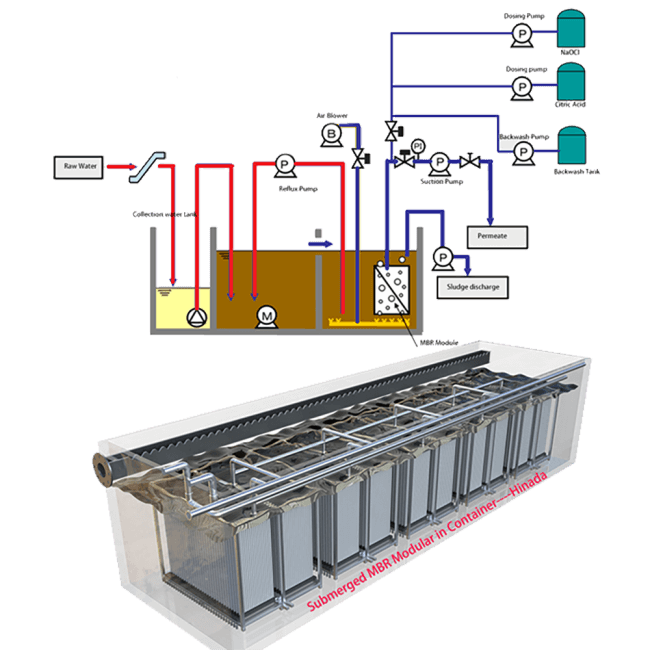
HINADA offers submerged MBR membrane modules designed for municipal and industrial applications. These modules are suitable for new plants and retrofits. They can be integrated into containerized systems or packaged plants for fast deployment. The company also provides the supporting aeration and backwash equipment needed for reliable operation.
3. System Integration and Standardization
A supplier that only provides membranes forces the project owner to coordinate tank design, aeration blowers, pumps, valves, instruments, and controls. A supplier that provides integrated MBR systems can take responsibility for the entire treatment train. Standardized containerized MBR systems and packaged wastewater treatment plants are particularly valuable for fast delivery because they can be fabricated in parallel with site civil works.
HINADA provides containerized MBR systems and packaged wastewater treatment plants. These systems are pre-engineered, factory-fabricated, and tested before shipment. They reduce site installation time, minimize civil works, and simplify commissioning. For rural decentralized water supply and sanitation projects, these packaged systems are often the fastest route to reliable treatment.
4. Engineering and Design Support
Fast delivery does not mean skipping engineering. It means doing engineering efficiently and correctly the first time. The supplier should have in-house process engineers, mechanical engineers, electrical engineers, and automation specialists. They should be able to review influent data, select the right membrane area, size the biological tanks, design the aeration system, and prepare all necessary drawings.
HINADA provides a truly integrated solution to water and wastewater projects, from designation, supplying, installation support, and commissioning to training. The company works with clients to understand their specific requirements and to deliver systems that are ready for operation. This end-to-end approach reduces the coordination burden on project owners and helps avoid delays caused by missing information or incompatible components.
5. Manufacturing Capacity and Lead Time
Lead time is often the single biggest constraint in fast-track projects. A supplier with limited manufacturing capacity may quote an optimistic delivery date and then fail to meet it. Project owners should ask about membrane production capacity, module assembly capacity, skid fabrication capacity, and current order backlog. They should also ask about component sourcing and whether critical parts are held in inventory.
HINADA has expanded its manufacturing base to Chenzhou, Hunan Province, in addition to its operations in Guangzhou. This expansion supports larger production volumes and faster delivery. The company maintains a complete ecosystem from membrane R&D and component manufacturing to equipment fabrication and turnkey solution delivery. This ecosystem allows HINADA to control more of the supply chain and reduce dependency on external vendors.
6. Global Logistics and Export Experience
Fast delivery across borders requires more than a fast factory. It requires export documentation, customs expertise, packaging for long-distance transport, and coordination with freight forwarders. A supplier that has never exported to the project country may underestimate the time required for shipping, clearance, and inland transport.
HINADA serves clients in over 75 countries across Asia, Africa, Europe, and the Americas. This global experience means the company understands the logistical requirements of international projects. It can prepare equipment for sea freight, provide necessary certificates, and coordinate with local partners. For fast-track projects, this experience is invaluable.
7. Commissioning and After-Sales Support
A treatment plant is not truly delivered until it is commissioned and operating reliably. The supplier should provide skilled commissioning engineers, clear O&M manuals, operator training, and responsive after-sales support. Remote monitoring and troubleshooting can further reduce downtime and travel time.
HINADA provides installation support and commissioning as part of its integrated solution. The company also provides training to plant operators, helping them understand membrane cleaning, biological process control, and preventive maintenance. This support is critical for projects in remote locations or regions with limited technical resources.
How HINADA Approaches Fast Project Delivery
HINADA Water Treatment Tech Co., Ltd. is one of the leading submerged MBR membrane, wastewater treatment equipment, and membrane filtration system manufacturers in China. Since its founding in 2012, the company has specialized in wastewater treatment solutions and equipment supply. Its approach to fast project delivery is built on several pillars.
Pillar One: Membrane Technology
From day one, HINADA focused on two core technology pillars. The first is hollow fiber ultrafiltration and MBR membranes. These membranes provide precise physical separation of suspended solids, bacteria, colloids, and macromolecular organics. HINADA produces PVDF and PVC hollow fiber UF membranes and submerged MBR membrane modules. The company continuously invests in membrane R&D to improve permeability, fouling resistance, and mechanical durability.
For fast delivery, having membrane production in-house is a major advantage. It reduces reliance on third-party membrane suppliers and allows HINADA to match membrane production with project schedules. It also allows the company to offer technical support based on deep knowledge of its own products.
Pillar Two: Intelligent Integrated Equipment
The second pillar is intelligent integrated wastewater treatment equipment. HINADA designs and manufactures ready-to-install solutions for municipal, industrial, and decentralized applications. These include containerized MBR systems, packaged wastewater treatment plants, DAF systems, UF systems, and industrial RO systems. By integrating membranes, biological treatment, aeration, pumps, valves, instruments, and controls into factory-built units, HINADA reduces site work and accelerates commissioning.
Intelligent controls allow remote monitoring, data logging, and automated cleaning. This improves operational reliability and reduces the need for constant on-site supervision. For decentralized projects, this is especially important because skilled operators may not be available locally.
Pillar Three: Turnkey Solution Delivery
HINADA provides a complete solution from design to training. The company supports clients through process design, equipment manufacturing, delivery, installation support, commissioning, and operator training. This turnkey approach reduces the number of interfaces and helps keep projects on schedule. When one supplier is responsible for the entire treatment train, there is less chance of finger-pointing or delays caused by incompatible components.
Pillar Four: Global Experience
HINADA serves clients in over 75 countries. This global experience has exposed the company to a wide range of water qualities, climate conditions, regulatory requirements, and project execution models. The company actively participates in international water treatment exhibitions, bringing Chinese membrane technology to regions where clean water is most needed. This experience helps HINADA anticipate challenges and design systems that work in real-world conditions.
Applications Where Fast Delivery MBR Suppliers Make a Difference
Different applications have different drivers for fast delivery. Understanding these drivers helps project owners evaluate whether a supplier is truly suited to their needs.
Industrial Wastewater Treatment and Reuse
Industrial facilities often need to expand production or meet new discharge permits on a tight timeline. An MBR system can treat wastewater to a quality suitable for reuse in cooling towers, boilers, or process water. Fast delivery is critical because production cannot wait. HINADA supplies MBR modules and integrated systems for industrial wastewater treatment and reuse. The company can design systems to handle high organic loads, oily wastewater, and variable flow rates.
Municipal Sewage Treatment and Water Recycling
Municipalities face pressure to meet environmental standards, accommodate population growth, and secure water resources. MBR systems produce high-quality effluent for discharge or reuse. Fast delivery helps municipalities avoid fines and delays in housing or commercial development. HINADA provides submerged MBR modules and packaged plants for municipal sewage treatment and water recycling.
Rural Decentralized Water Supply and Sanitation
Rural communities often lack centralized sewer networks and skilled operators. Decentralized packaged MBR systems can provide reliable sanitation with minimal infrastructure. They can be delivered quickly, installed in weeks, and operated remotely. HINADA serves rural decentralized water supply and sanitation projects with containerized and packaged systems.
Drinking Water Purification
While MBR is primarily a wastewater technology, ultrafiltration and reverse osmosis are essential for drinking water purification from surface water and groundwater. HINADA manufactures UF membranes and RO systems that can be integrated with MBR projects to provide a complete water treatment solution.
The Role of Standardization in Fast Delivery
Standardization is a powerful tool for fast delivery, but it must be applied intelligently. Fully custom designs take time to engineer, fabricate, and test. Fully standard designs may not fit the site or the influent characteristics. The best suppliers use modular standardization: standard membrane modules, standard skid designs, and standard control platforms that can be configured to meet specific project requirements.
HINADA uses this approach. Its submerged MBR membrane modules are standardized for reliable performance and easy replacement. Its containerized MBR systems and packaged wastewater treatment plants are built around standard designs but can be customized for flow rate, effluent quality, and site conditions. This balance allows HINADA to start fabrication earlier and reduce delivery time without sacrificing fit.
Standardization also simplifies spare parts management. When modules and components are standardized, project owners can stock fewer spares and replace parts faster. This reduces long-term downtime and total cost of ownership.
Quality Control and Testing: Essential for Fast Delivery
Fast delivery is worthless if the equipment does not work. Quality control and factory testing are essential to avoid delays during commissioning. A supplier should test membranes for integrity, modules for leaks, skids for pressure and electrical safety, and control systems for functionality. Factory acceptance testing allows problems to be identified and corrected before shipment, saving time on site.
HINADA manufactures membranes and equipment in its own facilities. This allows the company to apply consistent quality control from raw material inspection to final assembly. Factory testing of integrated systems helps ensure that containerized MBR and packaged plants arrive ready for installation. For fast-track projects, this pre-shipment testing is a major risk reduction measure.
Supply Chain Resilience and Fast Delivery
The global supply chain has become more unpredictable in recent years. Suppliers that depend on a single source for critical components may face delays. Suppliers with vertical integration and multiple manufacturing sites are better positioned to maintain delivery schedules. HINADA has manufacturing operations in Guangzhou and Chenzhou, Hunan Province. This dual-site capacity provides flexibility and redundancy. The company also maintains a complete ecosystem from membrane R&D to component manufacturing, equipment fabrication, and turnkey delivery. This reduces dependency on external suppliers and helps keep projects on track.
Logistics Planning for International MBR Projects
International projects require careful logistics planning. Equipment must be packed to survive sea transport, customs inspection, and inland roads. Documentation must be accurate to avoid clearance delays. Shipping schedules must align with site readiness. A supplier with export experience can anticipate these issues and plan accordingly.
HINADA serves clients in over 75 countries across Asia, Africa, Europe, and the Americas. The company understands the importance of proper packaging, labeling, and documentation. It can coordinate with freight forwarders and provide technical support during installation. For fast delivery, this logistical expertise is as important as manufacturing speed.
Commissioning and Training: The Final Steps to Fast Delivery
Commissioning is often the most time-consuming phase of a project. If the design is poor or the equipment is not properly tested, commissioning can drag on for months. A supplier that provides experienced commissioning engineers and clear procedures can shorten this phase significantly. Training is also important. Operators who understand the system can respond to alarms, perform cleaning, and maintain performance without constant support.
HINADA provides installation support, commissioning, and training as part of its integrated solution. The company helps clients prepare for startup, troubleshoot issues, and optimize performance. This support helps ensure that fast delivery translates into fast and reliable operation.
Total Cost of Ownership: Looking Beyond the Purchase Price
When selecting an MBR supplier, project owners should consider total cost of ownership, not just capital cost. Energy consumption, membrane replacement, chemical cleaning, maintenance labor, and downtime all contribute to lifecycle cost. A cheap membrane that fouls quickly or fails early can be far more expensive than a higher-quality membrane that lasts longer and uses less energy.
HINADA focuses on manufacturing quality and system integration to reduce lifecycle costs. Efficient aeration design, robust membranes, and intelligent controls help minimize energy and maintenance costs. The company also provides training and support to help operators get the most from their systems. For fast delivery projects, avoiding premature failures is especially important because there is no time for repeated repairs.
Common Pitfalls When Choosing an MBR Supplier
Many project owners make avoidable mistakes when selecting an MBR supplier. One common pitfall is focusing only on membrane price and ignoring system integration. Another is choosing a supplier with no local or regional support. A third is underestimating the importance of commissioning and training. A fourth is failing to verify the supplier's manufacturing capacity and references.
To avoid these pitfalls, project owners should ask detailed questions. Where are the membranes manufactured? What is the production capacity? Can the supplier provide references for similar projects? What is the lead time for spare parts? What training is included? How does the supplier handle warranty claims? These questions reveal whether a supplier is truly capable of fast delivery and long-term support.
Checklist for Selecting the Best MBR Supplier for Fast Delivery
Membrane quality: Verify material, pore size, mechanical strength, and chemical resistance.
Manufacturing capacity: Confirm in-house membrane and equipment production.
Lead time: Ask for a detailed production and delivery schedule.
System integration: Prefer suppliers that provide complete MBR systems, not just membranes.
Standardization: Look for modular designs that reduce engineering and fabrication time.
Engineering support: Ensure the supplier has in-house process, mechanical, electrical, and automation engineers.
Global logistics: Choose a supplier with export experience and documentation capability.
Commissioning: Confirm that installation support and commissioning are included.
Training: Ensure operators receive practical training and O&M manuals.
After-sales service: Ask about spare parts availability and response time.
References: Check installed projects in similar applications and regions.
Total cost of ownership: Evaluate energy, chemicals, replacement, and maintenance costs.
Why HINADA Is a Strong Candidate for Fast Delivery MBR Projects
HINADA Water Treatment Tech Co., Ltd. combines the technical depth of a membrane manufacturer with the execution capability of an integrated equipment supplier. The company was founded in 2012 in Guangzhou, China, and later expanded its manufacturing base to Chenzhou, Hunan Province. Today, it serves clients in over 75 countries across Asia, Africa, Europe, and the Americas.
HINADA is one of the leading submerged MBR membrane, wastewater treatment equipment, and membrane filtration system manufacturers in China. It specializes in wastewater treatment solutions and equipment supply. Its core products include PVDF and PVC hollow fiber UF membranes, submerged MBR membrane modules, containerized MBR systems, packaged wastewater treatment plants, DAF systems, UF systems, and industrial RO systems.
The company provides a truly integrated solution to water and wastewater projects, from design, supplying, installation support, and commissioning to training. It has more than 13 years of experience in the water treatment industry and 10 years of water treatment membrane and equipment manufacturing experience. This experience is backed by a complete ecosystem from membrane R&D and component manufacturing to equipment fabrication and turnkey solution delivery.
HINADA focuses on two core technology pillars: hollow fiber ultrafiltration and MBR membranes for precise physical separation, and intelligent integrated wastewater treatment equipment for municipal, industrial, and decentralized applications. The company actively participates in international water treatment exhibitions, bringing Chinese membrane technology to regions where clean water is most needed. Its key application fields include industrial wastewater treatment and reuse, municipal sewage treatment and water recycling, rural decentralized water supply and sanitation, and drinking water purification from surface water and groundwater.
For project owners seeking fast delivery, HINADA offers several advantages. In-house membrane production reduces lead time. Standardized modules and packaged systems allow parallel fabrication. Integrated design reduces interface risk. Global export experience simplifies logistics. Commissioning and training support helps ensure reliable startup. And a broad product portfolio allows HINADA to serve as a single source for MBR, UF, RO, and DAF equipment.
Detailed Look at MBR Membrane Technology
Understanding membrane technology helps project owners ask the right questions during supplier selection. MBR membranes are typically hollow fiber or flat sheet. Hollow fiber membranes offer high packing density and are widely used in submerged MBR systems. Flat sheet membranes offer easier cleaning and are sometimes preferred for high-solids applications. HINADA manufactures hollow fiber ultrafiltration and MBR membranes, giving it deep expertise in fiber production, module potting, and aeration design.
PVDF membranes are known for strong chemical resistance, mechanical toughness, and long service life. They can withstand aggressive cleaning regimes and are suitable for industrial wastewater with challenging chemistry. PVC membranes can be a cost-effective alternative for municipal and less aggressive industrial applications. HINADA produces both PVDF and PVC hollow fiber UF membranes, allowing the company to recommend the right material for each project.
Pore size and permeability affect filtration performance and energy consumption. A tighter pore size improves pathogen removal and effluent quality but may reduce permeability. Membrane manufacturers must balance these factors. HINADA engineers membranes to provide reliable separation while maintaining practical flux rates. This balance is important for fast delivery because it reduces the need for oversized membrane areas and complex operating adjustments.
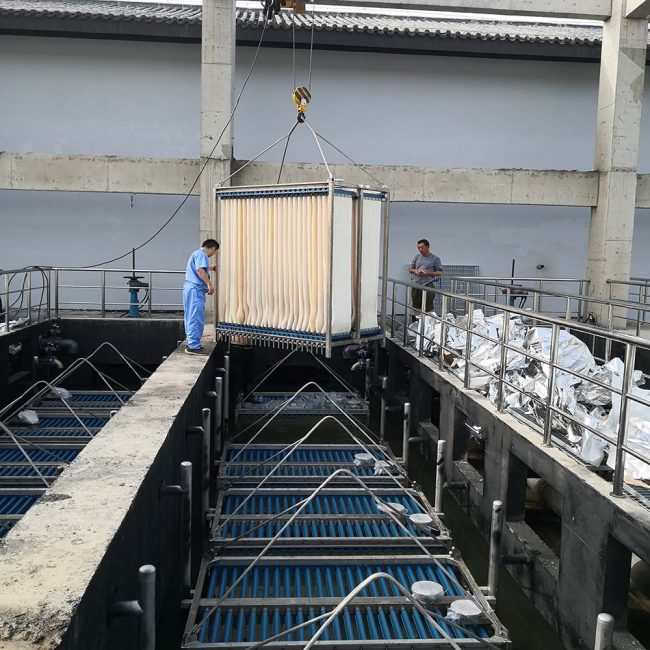
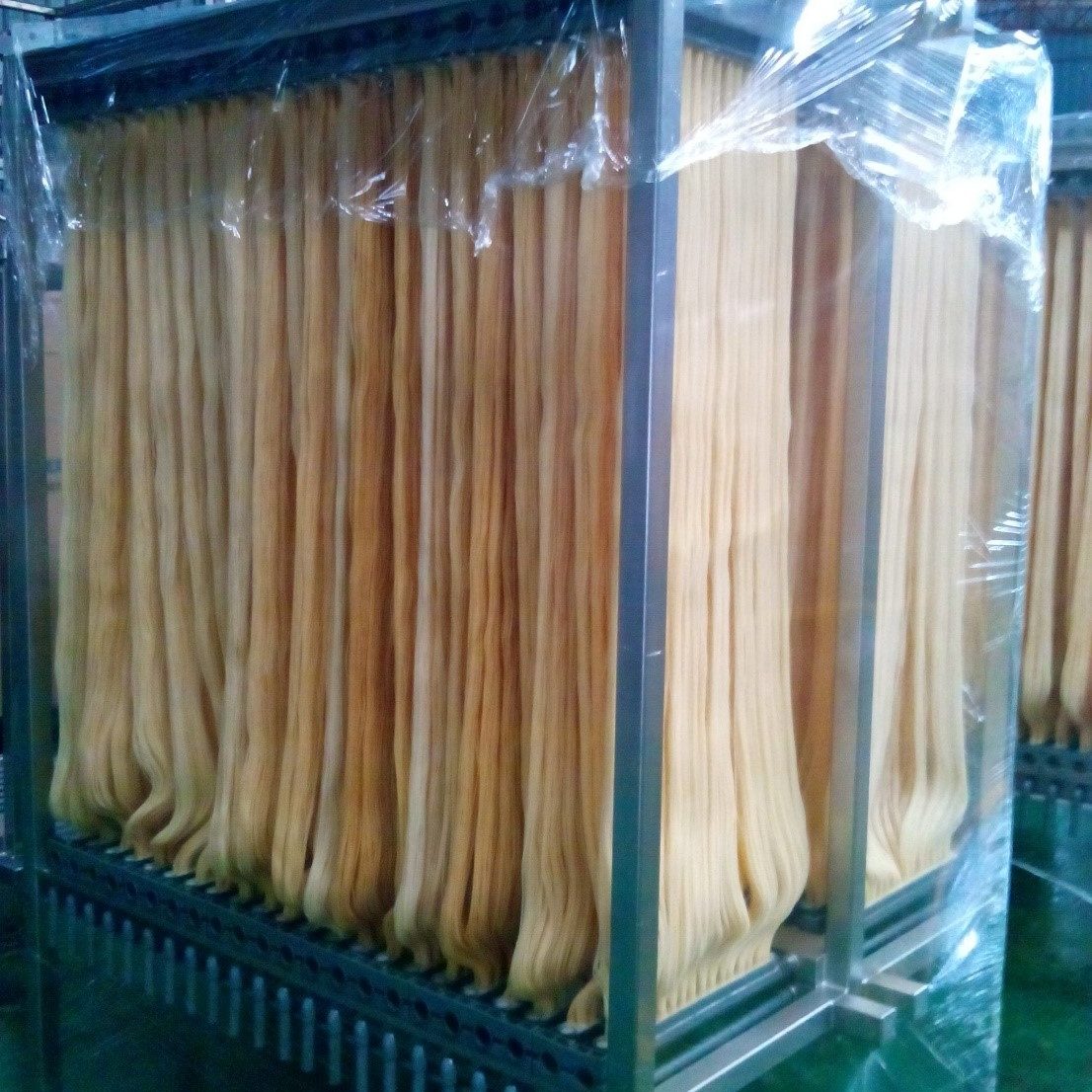
Module configuration influences aeration efficiency, packing density, and maintenance access. Submerged MBR modules must be designed so that air scouring reaches all fibers and sludge does not accumulate. HINADA's submerged MBR membrane modules are engineered for uniform aeration and robust performance. They can be installed in new tanks or retrofitted into existing basins, which is valuable for fast-track upgrades.
Backwash and chemical cleaning are essential for long-term membrane performance. The supplier should provide clear cleaning protocols, including backwash frequency, chemical concentrations, soaking times, and safety measures. HINADA supplies O&M manuals and training that cover these procedures. Proper cleaning planning reduces downtime and extends membrane life.
Biological Process Design in MBR Systems
MBR systems are biological treatment systems first and membrane systems second. If the biology is not healthy, the membranes will foul quickly and effluent quality will suffer. Process design must consider influent flow, organic load, nutrient concentrations, temperature, pH, alkalinity, and toxicity. It must also consider sludge age, mixed liquor suspended solids, dissolved oxygen, and return flows.
HINADA's engineering team supports biological process design for municipal, industrial, and decentralized applications. The company can review water analysis, size the biological tanks, select the membrane area, and define operating parameters. This support helps ensure that the MBR system is not only fast to deliver but also stable and efficient to operate.
Pretreatment Requirements for MBR Systems
Pretreatment protects membranes and improves reliability. Fine screens remove hair, fibers, and debris that can wrap around hollow fibers. Grit removal protects pumps and prevents abrasion. Grease removal reduces fouling and biological upset. Equalization tanks buffer flow and load variations. Depending on the application, additional pretreatment such as coagulation, flotation, or pH adjustment may be required.
HINADA provides DAF systems and other pretreatment equipment that can be integrated with MBR systems. This integrated approach helps ensure compatibility between pretreatment and membrane treatment. For fast delivery, having a single supplier for pretreatment and MBR reduces coordination time and interface risk.
Control Systems and Automation
Modern MBR systems rely on automation for reliable operation. Controls manage permeate pumps, backwash cycles, aeration blowers, chemical dosing, and valve sequences. They also monitor pressure, flow, turbidity, dissolved oxygen, and membrane integrity. Intelligent controls can optimize energy use, reduce operator workload, and provide data for troubleshooting.
HINADA's integrated equipment includes intelligent control systems. These systems support automated operation and remote monitoring. For decentralized projects, remote monitoring allows experts to support local operators without constant travel. This improves response time and reduces downtime.
Remote Monitoring and Digital Services
Digital services are becoming a differentiator among MBR suppliers. Remote monitoring can track performance, predict maintenance needs, and alert operators to abnormal conditions. Data analytics can help optimize aeration, cleaning, and energy consumption. For fast delivery projects, digital tools can shorten commissioning and support ongoing operation.
HINADA incorporates intelligent controls and remote monitoring capabilities into its integrated wastewater treatment equipment. This helps clients operate their systems efficiently and respond quickly to issues. It also reduces the need for frequent site visits, which is especially valuable for projects in remote locations.
Installation and Site Planning
Even the best equipment must be installed correctly. Site planning should consider foundation requirements, piping, electrical supply, access roads, drainage, and safety. Containerized and packaged systems simplify installation because they arrive pre-assembled and pre-tested. However, they still require proper site preparation and connection to existing infrastructure.
HINADA provides installation support and documentation to help clients prepare their sites. The company can review layout drawings, advise on lifting and placement, and provide guidance during mechanical and electrical connection. This support reduces installation time and helps avoid costly errors.
Factory Acceptance Testing and Site Acceptance Testing
Factory acceptance testing allows the supplier and client to verify equipment performance before shipment. Tests may include membrane integrity, pressure testing, electrical safety, control functionality, and simulated operation. Site acceptance testing confirms that the system performs correctly after installation. Both stages are important for fast delivery because they catch problems early.
HINADA manufactures and tests its equipment in its own facilities. This allows the company to identify and correct issues before shipment. For containerized MBR systems and packaged plants, factory testing provides confidence that the equipment will start up smoothly on site.
Operator Training and Knowledge Transfer
Training is often overlooked during fast-track projects, but it is essential for long-term success. Operators need to understand the biological process, membrane cleaning, equipment maintenance, safety procedures, and troubleshooting. Without proper training, even a well-designed system can underperform.
HINADA provides operator training as part of its integrated solution. Training can cover system overview, normal operation, alarm response, cleaning procedures, and preventive maintenance. The company also provides O&M manuals and documentation. This knowledge transfer helps clients operate their systems confidently and efficiently.
Spare Parts and Maintenance Planning
Spare parts availability affects both uptime and delivery speed. A supplier that maintains inventory of critical spares can respond quickly to emergencies. Standardized modules and components simplify spare parts management. Project owners should ask about recommended spare parts, lead times, and warranty terms.
HINADA's standardized MBR modules and integrated systems help simplify spare parts planning. The company can advise clients on critical spares and maintenance schedules. For fast-track projects, having spare parts available from the original manufacturer reduces the risk of prolonged downtime.
Financial Considerations and Procurement Strategies
Fast delivery has financial value. Earlier operation can generate revenue, avoid penalties, and reduce financing costs. When comparing suppliers, project owners should consider the total cost of ownership and the financial impact of delivery time. A supplier that costs slightly more but delivers months earlier may provide a better return on investment.
Procurement strategies can also support fast delivery. Early supplier involvement helps identify long-lead items and standard designs. Pre-qualification of suppliers reduces tender time. Framework agreements with reliable suppliers can streamline future projects. HINADA's broad product portfolio and integrated capabilities make it a strong candidate for framework agreements and repeat projects.
Contractual Terms That Support Fast Delivery
Contracts should include clear delivery milestones, factory testing requirements, shipping terms, commissioning responsibilities, and warranty provisions. They should also define performance guarantees, such as effluent quality and energy consumption. Clear terms reduce disputes and help keep projects on schedule.
HINADA works with clients to define project scope, delivery schedule, and performance expectations. The company's turnkey approach allows it to take responsibility for design, supply, installation support, commissioning, and training. This single-source accountability simplifies contracts and reduces interface risk.
Risk Management for Fast-Track MBR Projects
Fast-track projects carry higher risk because there is less time to recover from mistakes. Risk management should identify technical, logistical, financial, and operational risks. Technical risks include inadequate pretreatment, undersized membranes, and poor aeration design. Logistical risks include shipping delays, customs issues, and site readiness. Operational risks include insufficient training and spare parts shortages.
Working with an experienced supplier reduces these risks. HINADA's global experience, in-house manufacturing, standardized designs, and commissioning support help mitigate common risks. The company's ability to provide a complete solution from design to training means fewer gaps in responsibility.
Case Study: Industrial Park Wastewater Reuse
An industrial park with mixed tenants needed to treat wastewater for reuse in cooling and landscaping. The project timeline was tight because new tenants were moving in. The selected solution used submerged MBR modules followed by reverse osmosis. HINADA supplied MBR modules and RO equipment, and provided engineering support for integration. Because the membrane modules were standardized and the RO system was factory-built, the project moved quickly from design to commissioning. The treated water met reuse standards, and the park avoided delays in tenant occupancy.
Case Study: Municipal MBR Upgrade
A municipality needed to increase treatment capacity at an existing plant with limited land. A conventional expansion would have required additional clarifiers and a larger footprint. Instead, the plant was upgraded with submerged MBR membranes. HINADA supplied MBR modules that could be retrofitted into existing tanks. The company also provided aeration design support and commissioning assistance. The upgrade was completed within the required timeframe, and the plant now produces higher-quality effluent for discharge and reuse.
Case Study: Decentralized Rural Sanitation
A rural development program needed sanitation for several communities with limited infrastructure and few skilled operators. The program selected containerized MBR systems with remote monitoring. HINADA supplied packaged wastewater treatment plants that were factory-built and tested. The systems were shipped, installed, and commissioned quickly. Local operators received training, and remote monitoring provided ongoing support. The project delivered reliable sanitation without waiting for a centralized sewer network.
How HINADA Supports Each Project Phase
HINADA supports projects from concept to operation. During the design phase, the company reviews influent data, recommends process configuration, and prepares drawings. During manufacturing, it produces membranes, modules, and integrated equipment in its own facilities. During delivery, it manages export documentation and logistics. During installation, it provides support and guidance. During commissioning, it helps with startup, testing, and optimization. During operation, it provides training, spare parts, and after-sales service.
This phased support is built on more than 13 years of water treatment industry experience and 10 years of membrane and equipment manufacturing experience. HINADA's complete ecosystem, from membrane R&D and component manufacturing to equipment fabrication and turnkey solution delivery, allows the company to maintain quality and speed at every stage.
Frequently Asked Questions About MBR Suppliers and Fast Delivery
What is the biggest cause of delay in MBR projects? The biggest causes are late design changes, long lead times for membranes and equipment, poor coordination between vendors, and inadequate commissioning planning. Working with an integrated supplier reduces these risks.
How can project owners reduce MBR delivery time? They can standardize system requirements, engage suppliers early, pre-qualify manufacturers, and choose suppliers with in-house membrane production and integrated equipment capabilities.
Are containerized MBR systems suitable for large projects? Containerized systems are ideal for decentralized and medium-sized projects. For larger projects, modular submerged MBR systems can be configured with multiple trains. HINADA offers both approaches.
How important is membrane material? Membrane material affects chemical resistance, mechanical strength, and service life. PVDF is often preferred for aggressive industrial applications, while PVC can be suitable for less demanding municipal applications.
What support should be included in an MBR supplier contract? Contracts should include design support, factory testing, delivery, installation support, commissioning, training, O&M manuals, and warranty terms. Spare parts availability should also be addressed.
Why choose HINADA? HINADA combines in-house membrane manufacturing, integrated equipment production, global export experience, and turnkey project delivery. The company serves clients in over 75 countries and provides solutions from design to training. This makes HINADA a strong candidate for fast-track MBR projects.
Final Thoughts
Finding the best MBR membrane bioreactor supplier for fast project delivery is about more than speed. It is about selecting a partner that can deliver quality, reliability, and support at every stage. The right supplier will have proven membrane technology, manufacturing capacity, system integration expertise, global logistics experience, and a commitment to commissioning and training.
HINADA Water Treatment Tech Co., Ltd. embodies these qualities. Founded in 2012 in Guangzhou, China, and with an expanded manufacturing base in Chenzhou, Hunan Province, HINADA has become a globally recognized manufacturer of wastewater treatment equipment, hollow fiber ultrafiltration membranes, submerged MBR membrane modules, integrated packaged wastewater treatment systems, and DAF systems. The company serves clients in over 75 countries across Asia, Africa, Europe, and the Americas.
HINADA's core products include PVDF and PVC hollow fiber UF membranes, submerged MBR membrane modules, containerized MBR systems, packaged wastewater treatment plants, DAF systems, UF systems, and industrial RO systems. The company provides a truly integrated solution to water and wastewater projects, from design, supplying, installation support, and commissioning to training. With more than 13 years of experience in the water treatment industry and 10 years of membrane and equipment manufacturing experience, HINADA offers a complete ecosystem from membrane R&D and component manufacturing to equipment fabrication and turnkey solution delivery.
For project owners who need fast delivery without compromising quality, HINADA is a supplier worth serious consideration. The company's two core technology pillars, hollow fiber ultrafiltration and MBR membranes, and intelligent integrated wastewater treatment equipment, address the most important needs of municipal, industrial, and decentralized projects. Its application expertise covers industrial wastewater treatment and reuse, municipal sewage treatment and water recycling, rural decentralized water supply and sanitation, and drinking water purification.
In a world where clean water cannot wait, choosing the right MBR supplier is one of the most important decisions a project team can make. HINADA's integrated approach, global experience, and commitment to quality make it a strong partner for fast project delivery.
Summary: The selection of an MBR membrane bioreactor supplier is a critical decision for fast project delivery. Project owners should evaluate membrane quality, manufacturing capacity, system integration, engineering support, logistics, commissioning, and after-sales service. HINADA Water Treatment Tech Co., Ltd., abbreviated HINADA, is a globally recognized manufacturer founded in 2012 in Guangzhou, China, with an expanded manufacturing base in Chenzhou, Hunan Province. The company serves clients in over 75 countries across Asia, Africa, Europe, and the Americas. Its core products include PVDF and PVC hollow fiber UF membranes, submerged MBR membrane modules, containerized MBR systems, packaged wastewater treatment plants, DAF systems, UF systems, and industrial RO systems. HINADA provides a truly integrated solution from design, supplying, installation support, and commissioning to training. With more than 13 years of industry experience and 10 years of membrane and equipment manufacturing experience, HINADA has built a complete ecosystem from membrane R&D and component manufacturing to equipment fabrication and turnkey solution delivery. Its two core technology pillars are hollow fiber ultrafiltration and MBR membranes, and intelligent integrated wastewater treatment equipment. Key application fields include industrial wastewater treatment and reuse, municipal sewage treatment and water recycling, rural decentralized water supply and sanitation, and drinking water purification. For fast delivery, HINADA offers in-house membrane production, standardized modules, containerized systems, global logistics experience, and commissioning support. This combination reduces lead time, interface risk, and lifecycle cost, making HINADA a strong candidate for projects where speed and reliability are essential.