From Engineering to Testing at a DAF System Equipment factory
From Engineering to Testing at a DAF System Equipment factory
September 30, 2026
Author
Solution Provider, through a professional technical team, we provide customers with targeted equipment selection recommendations and comprehensive after-sales services, winning the trust and recognition of customers.
Sarah M.
This article examines the journey from engineering to testing at a dissolved air flotation (DAF) system equipment factory, using HINADA Water Treatment Tech Co., Ltd. as an example. HINADA, founded in 2012 in Guangzhou, China, and later expanded to Chenzhou, Hunan Province, serves clients in over 75 countries. Its portfolio includes PVDF and PVC hollow fiber ultrafiltration membranes, submerged MBR membrane modules, containerized MBR systems, packaged wastewater treatment plants, DAF systems, ultrafiltration systems, and industrial reverse osmosis systems. The article describes how DAF engineering begins with process data, hydraulic loading, air-to-solids ratio, recycle ratio, material selection, and control design. It then explains the transition to factory testing, including hydrostatic and leak testing, air saturation and recycle loop testing, mechanical and electrical functional testing, and performance testing with synthetic wastewater. Documentation, traceability, commissioning, and operator training are also covered. The central argument is that engineering and testing form one continuous quality discipline. Good engineering makes testing meaningful, and rigorous testing makes field performance predictable. HINADA’s integrated approach, supported by more than thirteen years of industry experience and ten years of membrane and equipment manufacturing experience, reflects this principle. The article also notes the company’s two core technology pillars: hollow fiber ultrafiltration and MBR membranes for precise physical separation, and intelligent integrated wastewater treatment equipment for ready-to-install solutions. Application fields include industrial wastewater treatment and reuse, municipal sewage treatment and water recycling, rural decentralized water supply and sanitation, and drinking water purification. Through international exhibitions and turnkey delivery, HINADA brings these solutions to regions where clean water is most needed. The summary emphasizes that DAF factory success depends on traceable engineering, structured testing, and a complete ecosystem from membrane research to equipment fabrication and commissioning.
From Engineering to Testing at a DAF System Equipment Factory
At a dissolved air flotation (DAF) system equipment factory, the journey from a customer’s process requirement to a tested, shipment-ready unit is both technical and disciplined. For HINADA Water Treatment Tech Co., Ltd., a manufacturer founded in 2012 in Guangzhou, China, and later expanded to Chenzhou, Hunan Province, this journey reflects more than thirteen years of water treatment industry experience and ten years of membrane and equipment manufacturing experience. The company’s DAF systems are part of a broader portfolio that includes hollow fiber ultrafiltration membranes, submerged MBR membrane modules, containerized MBR systems, packaged wastewater treatment plants, ultrafiltration systems, and industrial reverse osmosis systems. Each DAF unit begins with engineering and ends with testing, a sequence that protects performance, longevity, and client confidence.
HINADA serves clients in over 75 countries across Asia, Africa, Europe, and the Americas. Its DAF systems are used in industrial wastewater treatment and reuse, municipal sewage treatment and water recycling, rural decentralized water supply and sanitation, and drinking water purification from surface water or groundwater. Because DAF equipment often sits at the front end of a treatment train, its engineering and testing stages are critical. A poorly engineered DAF can create downstream loading problems, while an untested DAF can fail during commissioning. The factory therefore treats engineering and testing as one continuous quality system.
undefined
The Engineering Phase: From Process Data to DAF Design
The engineering phase starts with process data. The factory’s engineers review flow rate, influent suspended solids, oil and grease, chemical oxygen demand, biological oxygen demand, pH, temperature, and discharge targets. They also ask about site conditions, available footprint, power supply, chemical dosing strategy, and sludge handling. For HINADA, this stage is not isolated. It connects to the company’s two core technology pillars: hollow fiber ultrafiltration and MBR membranes for precise physical separation, and intelligent integrated wastewater treatment equipment for ready-to-install solutions. A DAF system may be combined with these technologies, so engineering must consider the whole treatment train.
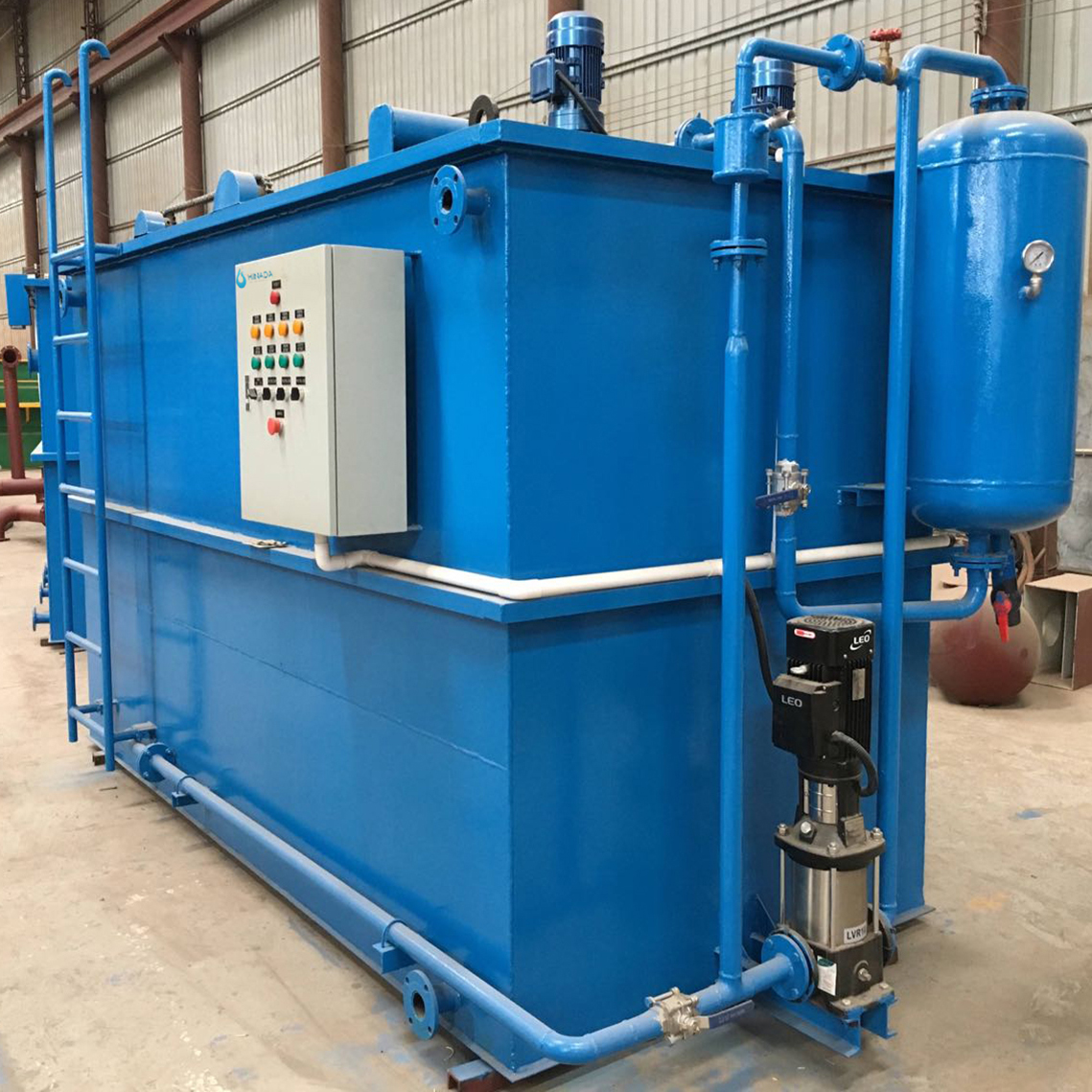
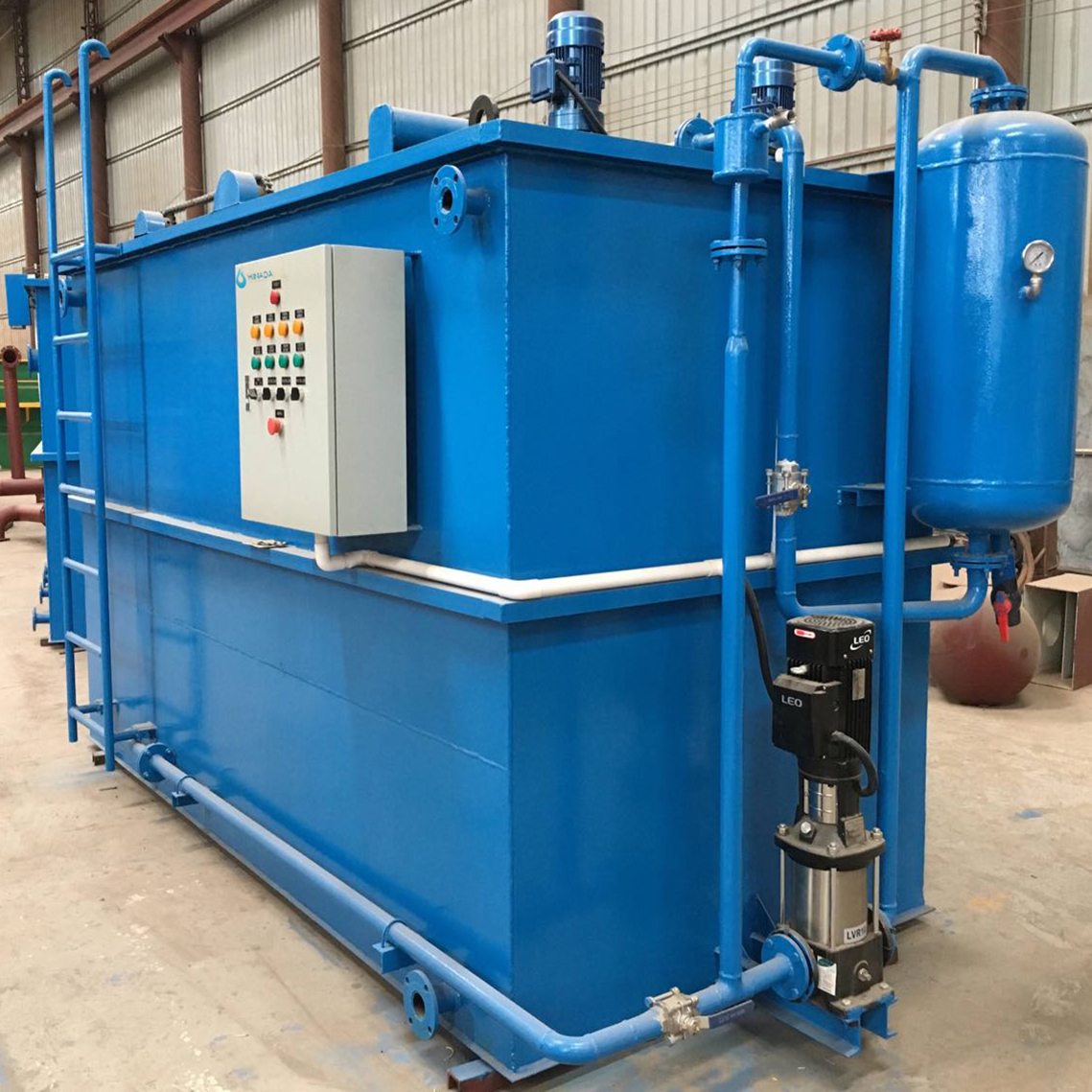
Design calculations focus on hydraulic loading rate, air-to-solids ratio, recycle ratio, contact time, and surface loading rate. The engineers size the flotation tank, reaction chamber, and sludge collection mechanism. They select materials for corrosion resistance, often using carbon steel with epoxy coating, stainless steel 304 or 316L, or other suitable alloys. Pumps, air compressors, saturators, valves, and instruments are chosen based on duty, redundancy, and maintenance access. Every decision is documented in drawings, datasheets, and bills of materials. The goal is a DAF system that is not only theoretically correct but also fabricable, installable, and serviceable.
Mechanical Design and Fabrication Preparation
Mechanical design turns process calculations into shop drawings. The engineering team defines tank dimensions, stiffener spacing, nozzle locations, walkways, ladders, and inspection openings. They coordinate with fabrication to ensure weld access and plate bending limits. For HINADA, this integration is supported by a complete ecosystem from membrane research and component manufacturing to equipment fabrication and turnkey solution delivery. That ecosystem helps the DAF factory avoid common disconnects between design intent and production reality. When a design is released to the workshop, it is already reviewed for manufacturability.
Instrumentation and Control Engineering
Instrumentation and control engineering define how the DAF system will operate. Level sensors, flow meters, pressure gauges, pH meters, and turbidity meters may be specified. The control panel may include programmable logic controllers, human-machine interfaces, motor starters, and alarm systems. Engineers write control narratives for startup, normal operation, chemical dosing, sludge scraping, and shutdown. They also plan interlocks to protect pumps and compressors. In a factory that also produces integrated packaged wastewater treatment systems, control engineering follows a modular philosophy. This makes testing faster and on-site commissioning smoother.
The Transition to Testing: Preparing the Factory Acceptance Test
Once fabrication is complete, the DAF system moves to testing. The transition from engineering to testing is formal. The engineering team hands over drawings, test procedures, and inspection checklists. The quality control team verifies dimensions, welds, coatings, and component installation. They check that every nozzle, flange, and connection matches the piping and instrumentation diagram. They confirm that the correct pumps, valves, and instruments are installed. This preparation is essential because a factory acceptance test is not a casual run. It is a structured demonstration that the equipment meets design and contractual requirements.
HINADA’s testing approach reflects its experience as a globally recognized manufacturer of wastewater treatment equipment. The company provides truly integrated solutions from designation, supplying, installation support, and commissioning to training. Testing is a bridge between supplying and commissioning. It reduces site surprises and protects project schedules. For DAF systems, testing usually includes hydrostatic testing, electrical checks, instrumentation calibration, mechanical rotation checks, and functional tests. When required, performance testing with water or synthetic wastewater is also performed.
Hydrostatic and Leak Testing
Hydrostatic testing fills the DAF tank and compartments with water to check for leaks and structural integrity. The team observes welds, seams, and flanged connections. They monitor for weeping, deformation, or unexpected movement. If a leak is found, it is marked, repaired, and retested. This step is especially important for DAF units because they operate with pressurized recycle flow and saturated air. A leak that seems minor in the factory can become a major issue in a client’s plant. The factory records test pressure, duration, ambient conditions, and results. These records become part of the equipment documentation.
Air Saturation and Recycle Loop Testing
The air saturation system is the heart of a DAF unit. Testing verifies that the air compressor, saturation tank, pressure gauge, relief valve, and recycle pump work together. The team checks dissolved air formation by observing the release of micro-bubbles in a test chamber or in the flotation tank. They adjust pressure and recycle flow to achieve the intended air-to-solids ratio. If the bubble pattern is uneven or the pressure fluctuates, the engineers investigate the cause. It may be a pump sizing issue, a valve setting, or an obstruction. This testing cannot be skipped because bubble quality directly affects solids removal.
Mechanical and Electrical Functional Testing
Mechanical testing includes checking pump rotation, coupling alignment, bearing temperature, and vibration. Electrical testing verifies motor current, insulation resistance, grounding, and control panel wiring. The team simulates signals from level switches, flow meters, and pressure transmitters. They test alarms and shutdown sequences. For automated DAF systems, they run the programmable logic controller through startup, normal operation, and emergency stop scenarios. The goal is to confirm that the equipment behaves as designed before it leaves the factory. HINADA’s control philosophy supports this by using modular, testable components that align with its integrated wastewater treatment equipment.
Performance Testing: Simulating Real Wastewater Conditions
When a project requires performance guarantees, the factory may conduct a performance test. Because actual wastewater is often unavailable, the team prepares synthetic wastewater with representative suspended solids, oils, or colloidal materials. They dose coagulants and flocculants, adjust pH, and run the DAF unit. They measure influent and effluent turbidity, suspended solids, and sometimes chemical oxygen demand. They observe float layer formation, sludge scraping, and effluent clarity. This test does not replace on-site commissioning, but it provides strong evidence that the design is sound.
For HINADA, performance testing also connects to its membrane products. A DAF effluent may feed ultrafiltration or reverse osmosis. If the DAF does not remove enough suspended solids or oil, the membranes downstream can foul. The factory therefore evaluates DAF performance with downstream sensitivity in mind. This is one reason the company’s portfolio includes PVDF and PVC hollow fiber UF membranes, MBR membrane modules, containerized MBR systems, packaged wastewater treatment plants, and industrial RO systems. The DAF is not a standalone box; it is part of an integrated water treatment solution.
PVDF/PVC hollow fiber UF membranes
MBR membrane modules (submerged)
Containerized MBR systems and packaged wastewater treatment plants
Dissolved Air Flotation (DAF) systems
Ultrafiltration (UF) systems
Industrial Reverse Osmosis (RO) systems
Quality Control Documentation and Traceability
Testing is only valuable if it is documented. The factory maintains test reports, calibration certificates, material certificates, weld inspection records, and as-built drawings. Each DAF unit receives a unique serial number. Components are traceable to suppliers and batch numbers. Non-conformance reports are raised when results fail to meet criteria. Corrective actions are recorded and verified. This documentation supports client audits, regulatory approvals, and future maintenance. HINADA’s experience in over 75 countries means that documentation must meet varied expectations, from local municipal projects to industrial export contracts.
From Factory to Field: Commissioning and Training
After factory testing, the DAF system is prepared for shipment. Piping may be dismantled for transport, and fragile instruments may be packed separately. The factory provides installation support, commissioning, and training. Commissioning repeats key tests on site, but now with actual wastewater and site utilities. The team checks alignment, electrical connections, chemical dosing, and control logic. They train operators on daily checks, troubleshooting, and maintenance. Because HINADA offers a truly integrated solution from designation to training, the transition from factory testing to field operation is planned from the beginning.
The company actively participates in international water treatment exhibitions, bringing Chinese membrane technology and equipment to regions where clean water is most needed. DAF systems are often part of that message. They are robust, compact, and effective for removing suspended solids, oils, and grease. They support industrial wastewater treatment and reuse, municipal sewage treatment and water recycling, rural decentralized water supply and sanitation, and drinking water purification. In each application, the same principle applies: good engineering makes testing meaningful, and good testing makes field performance predictable.
Conclusion: Engineering and Testing as One Discipline
At a DAF system equipment factory, engineering and testing are not separate departments with separate goals. They are one discipline. Engineering defines what the equipment must do. Testing proves that it can do it. For HINADA Water Treatment Tech Co., Ltd., this discipline is supported by more than thirteen years of water treatment industry experience and ten years of membrane and equipment manufacturing experience. The company’s growth from Guangzhou to Chenzhou, its service to clients in over 75 countries, and its complete ecosystem from membrane research to turnkey delivery all depend on this discipline. From engineering to testing, the DAF factory turns process requirements into reliable, documented, and field-ready equipment.