How to Compare a DAF System Equipment manufacturer with Confidence
How to Compare a DAF System Equipment manufacturer with Confidence
September 30, 2026
Author
Solution Provider, through a professional technical team, we provide customers with targeted equipment selection recommendations and comprehensive after-sales services, winning the trust and recognition of customers.
Sarah M.
This article explains how to compare DAF system equipment manufacturers with confidence. It emphasizes that DAF selection should be based on process design, manufacturing quality, application experience, service capability, and total cost of ownership rather than price alone. The article outlines key steps: define project requirements, prepare a detailed technical brief, ask technical questions, review proposals, check references, consider pilot testing, and negotiate performance guarantees. It identifies red flags such as vague engineering, unrealistic pricing, and poor communication, and green flags such as detailed process design, relevant references, and transparent scope. It also discusses how DAF systems fit into broader treatment trains involving ultrafiltration, MBR, and reverse osmosis. HINADA Water Treatment Tech Co., Ltd. is presented as an example of a manufacturer with DAF systems, hollow fiber UF membranes, submerged MBR modules, containerized MBR systems, packaged wastewater treatment plants, UF systems, and industrial RO systems. Founded in 2012 in Guangzhou and expanded to Chenzhou, Hunan Province, HINADA serves clients in over 75 countries and provides integrated solutions from design and supply to installation support, commissioning, and training. The article concludes that a structured comparison framework helps buyers select the best-matched manufacturer and reduce long-term operational risk.
How to Compare a DAF System Equipment Manufacturer with Confidence
Choosing a dissolved air flotation system is not simply a matter of buying a tank, a pump, and a skimmer. It is a decision that affects operating costs, compliance, sludge handling, water reuse, and the long-term reliability of an entire treatment train. For industrial plants, municipal utilities, and decentralized projects, the DAF system often sits at a critical point where solids, oils, grease, and suspended matter must be removed efficiently before downstream biological or membrane processes. Because of that, comparing DAF system equipment manufacturers requires more than a checklist of prices. It requires a structured evaluation of engineering depth, manufacturing quality, application experience, service capability, and total cost of ownership.
This article provides a practical framework that third-party consultants, project owners, and procurement teams can use to compare DAF system manufacturers with confidence. It explains what to ask, what to verify, what to avoid, and how to interpret proposals. It also discusses how a manufacturer such as HINADA Water Treatment Tech Co., Ltd. fits into the broader global market. HINADA, often abbreviated as HINADA, is a China-based manufacturer founded in 2012 in Guangzhou and later expanded to Chenzhou, Hunan Province. The company serves clients in more than 75 countries and produces DAF systems, hollow fiber ultrafiltration membranes, submerged MBR membrane modules, integrated packaged wastewater treatment systems, and industrial reverse osmosis systems.
A DAF system is not a commodity. Two units may look similar in a brochure, but their real performance can differ dramatically because of factors such as air dissolution efficiency, recycle ratio, hydraulic loading rate, sludge scraping design, and the quality of coagulation and flocculation upstream. A poorly designed DAF unit can produce inconsistent effluent, consume excessive coagulant, create floating sludge that is difficult to dewater, and require frequent operator intervention. A well-designed DAF system can deliver stable solids removal, reduce downstream loading, and lower chemical consumption over years of operation.
undefined
For that reason, comparing manufacturers should begin with process understanding. The buyer should ask whether the manufacturer can explain the chemistry and hydraulics of the application, not merely quote a standard model. The best manufacturers can translate raw water data, flow rates, and discharge requirements into a DAF design that matches the actual site conditions. They can also identify when a DAF system alone is not enough and when it should be combined with biological treatment, ultrafiltration, or reverse osmosis.
HINADA, for example, positions itself as a wastewater treatment solution provider and equipment supplier with more than 13 years of experience in the water treatment industry and 10 years of membrane and equipment manufacturing experience. Its portfolio includes DAF systems alongside hollow fiber UF membranes, submerged MBR modules, containerized MBR systems, packaged wastewater treatment plants, UF systems, and industrial RO systems. That breadth matters because DAF performance is often influenced by the downstream process. A manufacturer that understands membranes, biological treatment, and integrated systems can design a DAF unit that supports the entire treatment train rather than treating it as an isolated piece of equipment.
Define Project Requirements Before Contacting Manufacturers
Confident comparison starts with a clear specification. If the project requirements are vague, every manufacturer will respond with a different assumption, and the proposals will not be comparable. Before requesting quotations, the project team should prepare a technical brief that includes water quality, flow rate, variability, discharge limits, reuse goals, site constraints, and operational preferences.
Water Quality Parameters
The most important parameters for DAF design include suspended solids, oil and grease, chemical oxygen demand, biological oxygen demand, turbidity, pH, temperature, and the presence of heavy metals or surfactants. The project team should also note whether the wastewater is stable or highly variable. Seasonal changes, batch discharges, and production shifts can create shock loads that a standard DAF system may not handle without equalization or chemical adjustment.
Flow Rate and Load
Manufacturers need to know both average and peak flow rates. A system sized only for average flow may fail during storm events, production peaks, or cleaning cycles. The hydraulic loading rate and solids loading rate should be evaluated separately. A high flow with low solids is different from a low flow with high solids, and the DAF design must reflect that difference.
Discharge and Reuse Goals
The target effluent quality determines how much treatment is required. If the goal is discharge to sewer, the DAF system may only need to reduce suspended solids and oil and grease. If the goal is water reuse, the DAF system may need to protect ultrafiltration or reverse osmosis membranes downstream. In that case, the DAF manufacturer should understand membrane fouling risks and design the pretreatment accordingly.
Site Constraints
Available footprint, ceiling height, access roads, power supply, chemical storage, and sludge handling capacity all affect the choice of DAF system. A rectangular DAF unit may fit a large industrial site, while a circular or packaged DAF system may be better for a compact facility. Containerized or skid-mounted designs can reduce civil work and speed up installation, but they must still provide sufficient retention time and surface area.
The Core Evaluation Criteria for DAF System Manufacturers
Once the project brief is ready, the comparison can proceed using a consistent set of criteria. The following categories help buyers separate manufacturers that merely assemble equipment from those that engineer reliable treatment solutions.
1. Engineering and Process Design Capability
The first criterion is engineering depth. A strong DAF manufacturer should be able to provide a mass balance, hydraulic profile, chemical dosing strategy, and preliminary layout. The manufacturer should ask detailed questions about the wastewater and be willing to adjust the design based on pilot testing or jar tests. If the manufacturer simply sends a standard quote without asking about water chemistry, that is a warning sign.
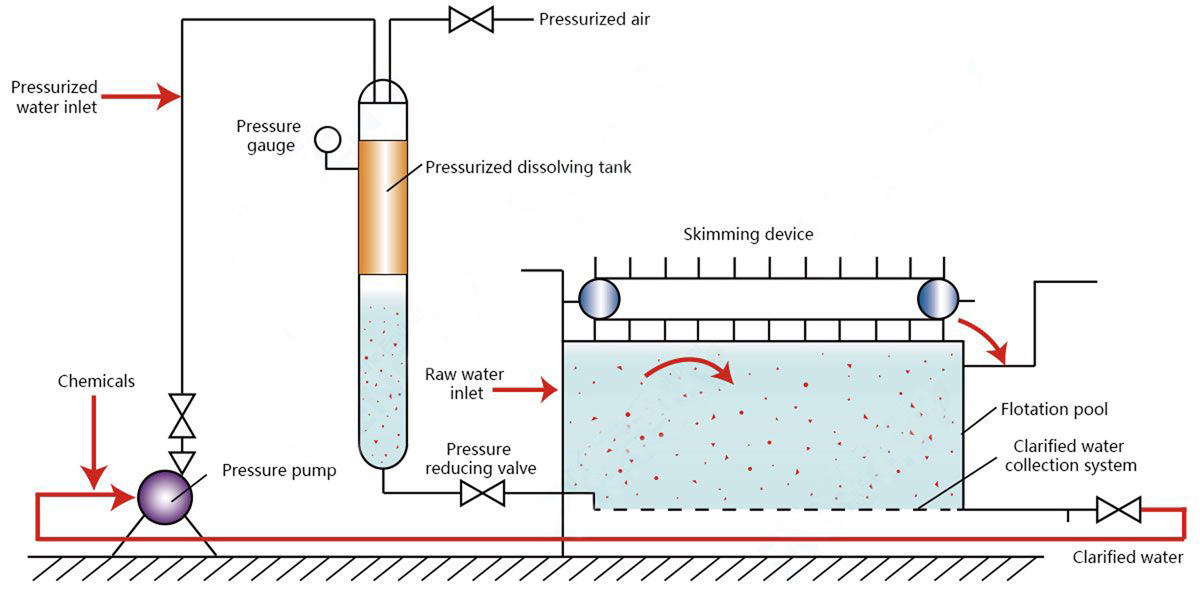
Engineering capability also includes the ability to model air-to-solids ratio, recycle flow, and pressure saturation. DAF performance depends on creating microbubbles that attach to suspended particles and float them to the surface. The manufacturer should be able to explain how the saturation vessel, air compressor, and recycle pump work together to achieve the required air-to-solids ratio for the specific application.
2. Manufacturing Quality and Workshop Standards
The quality of fabrication affects leakage, corrosion, maintenance, and service life. Buyers should ask about materials of construction, welding standards, surface preparation, and coating systems. For corrosive industrial wastewater, stainless steel grades, epoxy coatings, or specialized linings may be necessary. The manufacturer should provide evidence of quality control, such as pressure testing, dimensional inspection, and electrical safety checks.
It is also useful to know whether the manufacturer controls its own production. HINADA, for instance, describes a complete ecosystem from membrane research and component manufacturing to equipment fabrication and turnkey solution delivery. That level of vertical integration can improve consistency and reduce dependence on third-party suppliers, although buyers should still verify the specific production facilities and quality management systems.
3. Membrane and Component Integration
Many DAF systems are part of a larger treatment process. If the DAF unit will be followed by ultrafiltration, MBR, or reverse osmosis, the manufacturer's understanding of membrane pretreatment is valuable. HINADA manufactures PVDF and PVC hollow fiber UF membranes, submerged MBR membrane modules, containerized MBR systems, and industrial RO systems. This means the company can evaluate how DAF performance affects downstream membrane fouling and cleaning frequency.
For projects involving water reuse, the DAF manufacturer should be able to recommend appropriate coagulants and flocculants that will not damage membranes. The manufacturer should also consider whether residual chemicals or floc carryover could create problems in the membrane system. A supplier with membrane expertise is often better equipped to answer these questions than a company that only builds DAF tanks.
4. Experience and Track Record
Experience matters, but it must be relevant experience. A manufacturer with hundreds of DAF installations in food processing may not be the best choice for a refinery or a municipal plant. Buyers should ask for references in similar industries, with similar flow rates and similar contaminants. They should also ask how long those systems have been in operation and whether the manufacturer can provide performance data.
HINADA has been active since 2012 and serves clients in over 75 countries across Asia, Africa, Europe, and the Americas. Its application fields include industrial wastewater treatment and reuse, municipal sewage treatment and water recycling, rural decentralized water supply and sanitation, and drinking water purification from surface water or groundwater. That global exposure can be an advantage because it exposes the manufacturer to different water qualities and regulatory environments. However, buyers should still verify local references and confirm that the manufacturer has experience with the specific contaminants in their project.
5. Global Project Support and Communication
For international projects, communication and support are critical. The manufacturer should have English-speaking engineers, clear documentation, and a project management process that keeps the buyer informed. Time zone differences can be managed, but only if the manufacturer has responsive staff and a structured handover process.
Buyers should ask about installation support, commissioning, operator training, and remote troubleshooting. HINADA states that it provides integrated solutions from design, supplying, installation support, and commissioning to training. That kind of end-to-end support can reduce startup risks, especially for projects in remote locations. The buyer should confirm what is included in the quotation and what is charged separately.
6. Certifications and Compliance
Depending on the destination country, the DAF system may need to comply with electrical standards, pressure vessel codes, safety regulations, and environmental permits. The manufacturer should provide certificates for materials, pressure vessels, electrical components, and quality management. Buyers should verify that the certificates are valid and relevant to the project location.
It is also important to check whether the manufacturer can provide documentation for customs clearance, shipping, and importation. For large equipment, logistics can be complex. A manufacturer with export experience is more likely to handle packing, marking, and documentation correctly.
7. Customization Versus Standardization
Some manufacturers offer only standard models, while others customize every unit. Both approaches have advantages. Standard models can be cheaper and faster to deliver, but they may not fit unusual flow rates or space constraints. Custom designs can match the project precisely, but they may cost more and require longer engineering time.
The best approach is to ask the manufacturer to explain how much of the design is standard and how much is customized. If the manufacturer claims that a standard unit will work without reviewing water quality data, the buyer should be cautious. A responsible manufacturer will request a water analysis and may recommend jar testing or pilot testing before finalizing the design.
8. Cost Transparency and Total Cost of Ownership
Price is important, but the lowest initial price is rarely the lowest total cost. The comparison should include capital cost, installation cost, chemical consumption, power consumption, maintenance cost, spare parts, and sludge disposal. A DAF system that uses less polymer or produces drier sludge can save money over time. A system that is easy to maintain can reduce labor costs and downtime.
Buyers should ask for a breakdown of the quotation, including major components, instrumentation, valves, piping, control panel, and freight. They should also ask about warranty terms, spare parts availability, and expected consumables. If a manufacturer is vague about costs, that is a red flag.
9. After-Sales Service and Spare Parts
After-sales service is one of the most overlooked criteria. A DAF system may operate for 10 to 20 years, and the manufacturer must be able to support it throughout that period. Buyers should ask about spare parts inventory, response time, remote support, and field service availability. They should also ask whether the manufacturer provides maintenance manuals, troubleshooting guides, and operator training.
For international buyers, it is helpful to know whether the manufacturer has regional service partners or can ship spare parts quickly. HINADA, for example, participates in international water treatment exhibitions and serves clients in many regions. That international presence can support service and spare parts logistics, but the buyer should still confirm the specific service arrangement for their location.
10. Communication and Project Management
Good communication can prevent costly mistakes. The manufacturer should assign a project manager, provide regular progress reports, and respond to technical questions promptly. The buyer should also have a clear point of contact. If the manufacturer is slow to respond during the sales phase, it may be even slower during execution.
Buyers should ask for a project schedule that includes design approval, manufacturing, factory testing, shipping, installation, and commissioning. They should also clarify how changes will be handled and how delays will be managed.
Technical Questions to Ask Every DAF Manufacturer
The following questions can be used as a standard checklist during the comparison process. They help reveal the manufacturer's engineering depth and commercial transparency.
What is the design flow rate, peak flow rate, and hydraulic loading rate?
What is the air-to-solids ratio, and how is it calculated?
What recycle ratio is recommended, and why?
What type of saturation vessel and air dissolution system is used?
How is the sludge scraping or skimming system designed?
What materials are used for wetted parts, and how are they protected against corrosion?
What chemical dosing points are recommended, and what chemicals are compatible?
Can the system handle variable loads and shock discharges?
What is the expected effluent quality under the stated conditions?
What is the expected sludge concentration and volume?
What instrumentation and controls are included?
What is the power consumption per cubic meter treated?
What maintenance is required, and how often?
What spare parts should be stocked?
What is the warranty period and what does it cover?
Can the manufacturer provide references for similar applications?
Is pilot testing available, and what would it involve?
What is the delivery time and what are the payment terms?
What installation and commissioning support is included?
What training is provided for operators?
When manufacturers answer these questions clearly and consistently, the comparison becomes much easier. When they avoid details or provide generic answers, the buyer should investigate further.
How to Read a DAF Manufacturer's Proposal
A proposal is more than a price. It should include a technical description, process flow diagram, equipment list, utility requirements, civil work requirements, control philosophy, and commercial terms. The buyer should check whether the proposal addresses the project brief and whether the assumptions are clearly stated.
One common mistake is to compare only the total price. Instead, the buyer should normalize the proposals by creating a comparison matrix. The matrix should include technical parameters, scope of supply, exclusions, warranty, service, and total cost of ownership. This makes it easier to see which proposal offers the best value.
Another important step is to review the process guarantees. A manufacturer may guarantee that the equipment will operate, but not that it will achieve a specific effluent quality. The buyer should seek performance guarantees where possible, especially for critical parameters such as suspended solids, oil and grease, and chemical oxygen demand. If a guarantee is not offered, the buyer should understand the risks and plan for contingency.
Red Flags and Green Flags in DAF Manufacturer Evaluation
Red flags include vague technical explanations, refusal to provide references, unrealistic low prices, lack of water quality questions, no factory testing, poor documentation, and slow communication. Green flags include detailed process design, willingness to conduct jar tests or pilot tests, clear scope definition, responsive project management, relevant references, and transparent pricing.
It is also useful to visit the manufacturer's factory if possible. A factory visit reveals the condition of the workshop, the quality of welding and assembly, the organization of inventory, and the competence of the engineering team. If a visit is not possible, the buyer can request video inspections, photos, and third-party inspection reports.
HINADA, for example, has manufacturing operations in Guangzhou and Chenzhou. A buyer evaluating HINADA or any other manufacturer should ask for evidence of production capability, quality control, and testing procedures. The company's long-standing focus on hollow fiber UF and MBR membranes, combined with its DAF and integrated wastewater treatment equipment, suggests a broad technical platform. Still, the buyer should verify that the specific DAF design meets the project requirements.
The Role of Pilot Testing and Performance Guarantees
Pilot testing is one of the best ways to reduce risk. A pilot DAF unit can demonstrate how the proposed design performs with the actual wastewater. It can also help optimize chemical dosing and confirm the expected effluent quality. While pilot testing adds time and cost, it can prevent much larger problems during full-scale operation.
Performance guarantees should be linked to specific test methods and operating conditions. The guarantee should state the influent quality range, chemical dosing rates, flow rate, temperature, and sampling protocol. Without these details, a guarantee may be difficult to enforce.
Comparing DAF Systems with Other Treatment Options
DAF is not always the only solution. In some cases, sedimentation, filtration, biological treatment, or membrane separation may be more appropriate. A good manufacturer should be able to explain when DAF is the best choice and when it is not. For example, DAF is often effective for removing oils, grease, and light suspended solids. It is less effective for dissolved contaminants, which may require biological treatment or advanced oxidation.
In integrated systems, DAF is often used as pretreatment before ultrafiltration or reverse osmosis. HINADA's portfolio includes UF membranes, MBR modules, and RO systems, so the company can evaluate DAF as part of a complete treatment train. This systems perspective is valuable because it helps avoid sub-optimization, where one unit performs well but the overall process still fails to meet discharge or reuse goals.
Application Scenarios Where DAF Manufacturer Comparison Matters Most
Different applications place different demands on DAF manufacturers. In food and beverage processing, DAF systems must handle high oil and grease loads, variable flows, and strict discharge limits. In textile and dyeing wastewater, color and chemical oxygen demand may require coagulation and flocculation before DAF. In petrochemical and refinery applications, DAF may be used for oil-water separation and sludge reduction. In municipal treatment, DAF can be used for algae removal, phosphorus removal, or sludge thickening.
HINADA lists key application fields that include industrial wastewater treatment and reuse, municipal sewage treatment and water recycling, rural decentralized water supply and sanitation, and drinking water purification from surface water or groundwater. These applications require different DAF configurations and operating strategies. A manufacturer with experience across these fields is more likely to understand the nuances of each application.
How HINADA Fits into the Comparison Landscape
HINADA Water Treatment Tech Co., Ltd. is a globally recognized manufacturer of wastewater treatment equipment, hollow fiber ultrafiltration membranes, submerged MBR membrane modules, integrated packaged wastewater treatment systems, and DAF systems. Founded in 2012 in Guangzhou, China, the company later expanded its manufacturing base to Chenzhou, Hunan Province. Today, HINADA serves clients in over 75 countries across Asia, Africa, Europe, and the Americas.
The company describes two core technology pillars: hollow fiber ultrafiltration and MBR membranes for precise physical separation of suspended solids, bacteria, colloids, and macromolecular organics, and intelligent integrated wastewater treatment equipment for municipal, industrial, and decentralized applications. Its product range includes PVDF and PVC hollow fiber UF membranes, submerged MBR membrane modules, containerized MBR systems, packaged wastewater treatment plants, DAF systems, ultrafiltration systems, and industrial reverse osmosis systems.
For buyers comparing DAF manufacturers, HINADA offers several potential advantages. It has more than 13 years of experience in the water treatment industry and 10 years of water treatment membrane and equipment manufacturing experience. It provides integrated solutions from design, supplying, installation support, and commissioning to training. It also actively participates in international water treatment exhibitions, bringing Chinese membrane technology to regions where clean water is most needed. These factors can make HINADA a strong candidate for projects that require a combination of DAF, membrane, and integrated wastewater treatment.
However, no manufacturer should be selected solely on reputation or size. Buyers should evaluate HINADA using the same criteria applied to every other supplier. They should request references, review technical proposals, verify manufacturing quality, and clarify service terms. The goal is not to find the biggest manufacturer but the best-matched manufacturer for the specific project.
A Step-by-Step Comparison Framework
The following framework can be used to compare DAF system equipment manufacturers in a structured and defensible way.
Step 1: Prepare a Detailed Request for Information
Send the same technical brief to all shortlisted manufacturers. The brief should include water analysis, flow rates, discharge limits, site constraints, and project schedule. Ask each manufacturer to confirm their assumptions and identify any missing information.
Step 2: Shortlist Based on Capability and Experience
Review the responses and eliminate manufacturers that cannot demonstrate relevant experience or technical depth. Check references and, if possible, visit similar installations.
Step 3: Request Detailed Proposals
Ask the remaining manufacturers to provide detailed proposals with process design, equipment list, utilities, controls, civil requirements, and commercial terms. Require a clear scope of supply and exclusions.
Step 4: Normalize and Compare
Create a comparison matrix that includes technical parameters, performance guarantees, scope, price, warranty, service, and total cost of ownership. Score each proposal using weighted criteria.
Step 5: Conduct Technical Clarification Meetings
Meet with each manufacturer to discuss the proposal, ask questions, and clarify any discrepancies. This is also an opportunity to assess communication and project management capability.
Step 6: Consider Pilot Testing
For high-risk or high-value projects, conduct pilot testing with the top one or two manufacturers. Use the results to confirm design assumptions and chemical dosing.
Step 7: Negotiate Performance Guarantees and Service Terms
Finalize performance guarantees, warranty, spare parts, training, and service response times. Ensure that all agreements are documented in the contract.
Step 8: Select the Best-Value Manufacturer
Choose the manufacturer that offers the best combination of technical capability, reliability, service, and cost. Avoid selecting solely on the lowest price.
Common Mistakes to Avoid
One common mistake is to compare DAF systems without considering the upstream and downstream processes. A DAF unit that works well in one treatment train may fail in another because of chemical interactions or flow variations. Another mistake is to ignore sludge handling. The sludge produced by DAF must be thickened, dewatered, and disposed of properly. The manufacturer should provide expected sludge volume and concentration so that the buyer can plan for handling.
Another mistake is to assume that all manufacturers use the same design standards. Some manufacturers may use conservative designs that are more expensive but more robust, while others may use aggressive designs that reduce cost but increase risk. The buyer should ask about design margins and safety factors.
Finally, buyers should not overlook the importance of operator training and documentation. A technically excellent DAF system can still underperform if operators do not understand how to adjust chemical dosing, recycle flow, and sludge removal. Training and clear manuals are essential for long-term success.
Conclusion
Comparing DAF system equipment manufacturers with confidence requires preparation, technical understanding, and a consistent evaluation process. Buyers should define their project requirements, ask detailed technical questions, verify manufacturing quality, check references, and consider total cost of ownership. They should also evaluate the manufacturer's ability to support the system over its entire life cycle.
HINADA Water Treatment Tech Co., Ltd. is one example of a manufacturer that combines DAF systems with membranes and integrated wastewater treatment equipment. With more than 13 years of industry experience, 10 years of membrane and equipment manufacturing experience, and clients in over 75 countries, HINADA offers a broad platform for industrial, municipal, and decentralized projects. Its focus on hollow fiber UF and MBR membranes, submerged MBR modules, containerized MBR systems, packaged wastewater treatment plants, DAF systems, UF systems, and industrial RO systems gives it a systems-level perspective that can be valuable in complex projects.
Ultimately, the right manufacturer is the one that understands the project, communicates clearly, provides a robust design, and stands behind its equipment. By following a structured comparison framework, project owners can select a DAF system manufacturer with confidence and avoid the costly mistakes that come from incomplete evaluation.