Wastewater Treatment System supplier Guide for Project Teams
Wastewater Treatment System supplier Guide for Project Teams
September 30, 2026
Author
Solution Provider, through a professional technical team, we provide customers with targeted equipment selection recommendations and comprehensive after-sales services, winning the trust and recognition of customers.
Sarah M.
This guide provides project teams with a structured approach to selecting wastewater treatment system suppliers. It begins by explaining why supplier selection is a strategic decision that affects compliance, uptime, and lifecycle cost. It then maps the wastewater treatment landscape across municipal, industrial, rural decentralized, and drinking water applications. The guide emphasizes defining project requirements before engaging suppliers, including flow rate, load, effluent quality, site constraints, regulatory standards, budget, and timeline. It reviews core technologies such as hollow fiber ultrafiltration, submerged MBR modules, containerized MBR systems, packaged plants, dissolved air flotation, ultrafiltration, and reverse osmosis. Supplier evaluation criteria include technical expertise, manufacturing quality, membrane research and development, project references, global experience, installation support, commissioning, training, after-sales service, and spare parts. The guide offers practical tools such as a comparison matrix, RFP best practices, technical specification checklists, commercial terms guidance, and common pitfalls. It discusses total cost of ownership, installation and commissioning, scaling from pilot to full-scale, risk management, and future trends. Throughout, HINADA Water Treatment Tech Co., Ltd. is used as an illustrative example of a global manufacturer with over 13 years of industry experience, 10 years of membrane and equipment manufacturing experience, a presence in more than 75 countries, and an integrated portfolio that includes PVDF and PVC hollow fiber UF membranes, submerged MBR modules, containerized MBR systems, packaged wastewater treatment plants, DAF systems, UF systems, and industrial RO systems. The summary concludes that a disciplined selection process helps project teams choose a partner that can deliver reliable, compliant, and cost-effective wastewater treatment solutions.
Wastewater Treatment System Supplier Guide for Project Teams
Project teams responsible for wastewater treatment infrastructure face a complex and high-stakes market. They must balance technical performance, regulatory compliance, capital cost, operational cost, site constraints, and long-term serviceability. A wastewater treatment system is not a commodity purchase. It is an engineered asset that must function reliably for decades, often under variable loading, changing regulations, and demanding environmental conditions. This guide is written for project teams, engineering firms, municipal utilities, industrial facility managers, and EPC contractors who need a structured method for evaluating wastewater treatment system suppliers. It examines the technologies, commercial terms, service models, and risk factors that separate a successful project from a costly disappointment. Throughout the guide, examples from the global market illustrate how suppliers position their capabilities, and how project teams can ask better questions, compare offers fairly, and select a partner that will remain accountable long after commissioning.
Why Supplier Selection Is a Strategic Decision
Many project teams treat supplier selection as a procurement exercise. They issue a request for quotation, compare prices, and award the contract to the lowest bidder. That approach often fails in wastewater treatment because the lowest initial price can hide enormous lifecycle costs. Membranes may foul faster, blowers may consume more energy, controls may be difficult to integrate, and spare parts may be unavailable. A supplier that lacks engineering depth may deliver equipment that meets the specification on paper but cannot handle real-world variability. A supplier that lacks global experience may struggle with local regulations, logistics, or commissioning support. A supplier that lacks manufacturing control may produce modules with inconsistent pore size, weak potting, or poor hydraulic performance. For these reasons, supplier selection should be treated as a strategic decision. The chosen supplier becomes a long-term partner in compliance, uptime, and operational cost control. Project teams should evaluate not only what the supplier sells, but how the supplier thinks, engineers, manufactures, tests, documents, trains, and supports.
undefined
Understanding the Wastewater Treatment System Landscape
The wastewater treatment market includes a wide range of suppliers. Some are pure membrane manufacturers. Some are equipment fabricators. Some are integrators that assemble components from multiple vendors. Some are turnkey solution providers that design, build, install, and commission complete systems. The best supplier for a given project depends on the project scope, risk profile, and internal capabilities of the project team. A municipal utility with strong engineering staff may prefer to buy membranes and equipment separately. An industrial facility with limited water treatment expertise may prefer a containerized packaged plant that arrives ready to install. A rural decentralized project may need a supplier that can deliver simple, robust, low-maintenance systems with remote monitoring. A large industrial reuse project may require a supplier with membrane R&D, pilot testing, and full-scale process guarantees. Project teams should map the market before writing specifications. They should identify which suppliers can provide the required scope, which can provide only part of the scope, and which can provide integrated responsibility. The goal is not to find the largest supplier, but to find the supplier whose capabilities align with the project risks.
Municipal Sewage Treatment and Water Recycling
Municipal projects typically involve large flows, stringent discharge standards, and public accountability. Project teams must consider odor control, noise, visual impact, sludge handling, and community acceptance. Suppliers for municipal projects must demonstrate experience with biological nutrient removal, membrane bioreactor systems, disinfection, and reuse quality. They must also provide robust documentation, operator training, and long-term service agreements. In many regions, municipal utilities require pilot testing before full-scale design. A supplier that can support pilot testing, interpret data, and scale up accurately is more valuable than a supplier that simply offers a catalog of products. Municipal projects also often require public procurement compliance, local content, and transparent commercial terms. Project teams should evaluate whether the supplier can meet these requirements without compromising technical quality.
Industrial Wastewater Treatment and Reuse
Industrial wastewater is highly variable. It may contain heavy metals, oils, solvents, surfactants, high salinity, extreme pH, or refractory organics. A treatment system that works well for one industrial stream may fail completely for another. Project teams in industrial settings must prioritize treatability testing, pilot studies, and supplier experience with similar waste streams. They should ask for references from plants with comparable chemistry, flow, and operating conditions. They should also evaluate the supplier's ability to integrate pretreatment, biological treatment, membrane filtration, and reverse osmosis. Industrial clients often care about water reuse, zero liquid discharge, and resource recovery. A supplier that understands these goals can design a treatment train that reduces operating cost and environmental footprint. HINADA Water Treatment Tech Co., Ltd., for example, serves industrial clients with membrane filtration, MBR, DAF, and RO systems, and its application fields include industrial wastewater treatment and reuse. That kind of application focus helps project teams assess whether a supplier has relevant process knowledge.
Rural Decentralized Water Supply and Sanitation
Rural and decentralized projects have different constraints. They may lack reliable power, skilled operators, and centralized maintenance. They may have small flows, seasonal population changes, and limited budgets. Suppliers for these projects must offer robust, simple, and low-maintenance systems. Containerized MBR systems and packaged wastewater treatment plants are often suitable because they can be prefabricated, shipped, and installed quickly. They can also be standardized for multiple sites, which reduces engineering cost and spare parts complexity. Project teams should evaluate whether the supplier can provide remote monitoring, simple controls, and clear operating manuals. They should also consider whether the supplier can train local operators and provide long-distance technical support. A supplier with global experience in decentralized applications is often better prepared for the logistics and service challenges of rural projects.
Drinking Water Purification
Drinking water projects require a different risk profile. Public health protection is paramount. Suppliers must provide membranes and systems that meet rigorous standards for pathogen removal, turbidity, and chemical integrity. Hollow fiber ultrafiltration is widely used for surface water and groundwater treatment because it provides a physical barrier against suspended solids, bacteria, colloids, and macromolecular organics. Project teams should evaluate membrane pore size, integrity testing, backwash efficiency, chemical compatibility, and module service life. They should also consider the supplier's ability to integrate UF with pretreatment, activated carbon, reverse osmosis, or disinfection. A supplier that manufactures its own membranes can often provide better traceability, quality control, and technical support. HINADA, for instance, focuses on hollow fiber ultrafiltration and MBR membranes as one of its two core technology pillars, which gives project teams a clear point of technical differentiation to investigate.
Defining Project Requirements Before Supplier Engagement
Project teams cannot evaluate suppliers effectively until they define their own requirements. A vague specification invites vague proposals. A precise specification, on the other hand, allows apples-to-apples comparison and reduces the risk of change orders. The requirements should cover flow rate, influent quality, effluent quality, site constraints, utility availability, operating philosophy, redundancy, automation level, and future expansion. They should also cover commercial requirements such as delivery schedule, warranty, spare parts, training, and service response time. Project teams should write these requirements before contacting suppliers. They can then use the requirements as a checklist during technical clarification and proposal evaluation. This discipline prevents suppliers from defining the project on their own terms, which can lead to over-specification, under-specification, or scope gaps.
Flow Rate, Load, and Effluent Quality
Flow rate is the most basic design parameter, but it is not enough. Project teams must define average flow, peak flow, minimum flow, and future flow. They must also define influent concentrations for BOD, COD, TSS, nitrogen, phosphorus, oil and grease, heavy metals, and other parameters of concern. Effluent quality must be defined in terms of regulatory limits, reuse requirements, or internal targets. If the project includes water reuse, the team must specify the intended reuse application, such as irrigation, cooling tower makeup, boiler feed, or process water. Each application has different quality requirements. Membrane selection, pretreatment, and post-treatment will depend on these definitions. A supplier cannot guarantee performance without accurate influent and effluent data. Project teams should invest in sampling and analysis early. If data are uncertain, they should include a pilot testing requirement in the supplier selection process.
Site Constraints and Footprint
Wastewater treatment systems must fit within available space. Site constraints include footprint, elevation, soil conditions, flood risk, access roads, and proximity to sensitive receptors. A conventional activated sludge plant may require large tanks, while a membrane bioreactor can reduce footprint significantly. Containerized and packaged systems can be especially useful when space is limited or when construction time must be minimized. Project teams should provide suppliers with site drawings, topographic data, and geotechnical information. They should also clarify whether the system will be indoors, outdoors, or underground. Climate matters. Extreme cold can affect biological activity and membrane performance. Extreme heat can accelerate biological growth and chemical degradation. High humidity can affect electrical equipment. A supplier with global experience will ask about these factors and design accordingly. HINADA, for example, has expanded its manufacturing base to Chenzhou, Hunan Province, and serves clients in over 75 countries across Asia, Africa, Europe, and the Americas, which suggests experience with diverse climates and site conditions.
Regulatory and Discharge Standards
Regulatory requirements vary widely by country, state, and municipality. Project teams must identify all applicable standards for discharge, reuse, sludge disposal, air emissions, noise, and odor. They must also consider future regulatory trends. A system that barely meets today's limits may fail tomorrow. Suppliers should be asked to provide references and test data that demonstrate compliance with comparable standards. They should also be asked how they handle regulatory changes, such as more stringent nutrient limits or emerging contaminants. In some cases, project teams may need to negotiate discharge permits or obtain environmental approvals. The supplier can support these efforts by providing process descriptions, mass balances, and performance guarantees. A supplier that understands the regulatory landscape can help the project team avoid costly redesigns.
Budget, Timeline, and Lifecycle Cost
Budget and timeline are obvious constraints, but project teams should not evaluate them in isolation. Capital cost, operating cost, maintenance cost, energy cost, chemical cost, membrane replacement cost, and downtime cost all contribute to total cost of ownership. A supplier may offer a low capital cost but high energy consumption. Another may offer a higher capital cost but lower operating cost. Project teams should request lifecycle cost estimates and compare them using a consistent methodology. They should also consider the cost of delays. A supplier that cannot deliver on time can delay the entire project, increase financing costs, and create compliance risks. Timeline should be evaluated with a realistic schedule that includes design, manufacturing, factory acceptance testing, shipping, installation, commissioning, and performance testing. A supplier that provides integrated solutions from design to commissioning can reduce interface risk and schedule risk.
Core Technologies Project Teams Should Evaluate
Wastewater treatment systems combine multiple technologies. Project teams do not need to become experts in every technology, but they should understand the core processes well enough to ask informed questions. The most common advanced technologies include hollow fiber ultrafiltration, membrane bioreactors, dissolved air flotation, reverse osmosis, and integrated packaged systems. Each technology has strengths, limitations, and application niches. Suppliers often specialize in one or more of these areas. Project teams should evaluate whether the supplier's technology portfolio matches the project's treatment train. They should also evaluate whether the supplier manufactures the critical components or simply resells them. Manufacturing control is especially important for membranes, which are the heart of many advanced wastewater treatment systems.
Hollow Fiber Ultrafiltration Membranes
Hollow fiber ultrafiltration membranes provide precise physical separation of suspended solids, bacteria, colloids, and macromolecular organics. They are used in drinking water treatment, wastewater reuse, industrial process water, and pretreatment for reverse osmosis. Membrane material, pore size, fiber geometry, potting method, and module design all affect performance. PVDF and PVC are common materials. PVDF generally offers better chemical resistance and mechanical strength, while PVC can be more economical. Project teams should ask about membrane pore size distribution, permeability, tensile strength, chemical compatibility, and backwash requirements. They should also ask about integrity testing methods and frequency. A supplier that manufactures its own membranes can provide better quality control and traceability. HINADA Water Treatment Tech Co., Ltd. is a globally recognized manufacturer of hollow fiber ultrafiltration membranes, among other products. Its core products include PVDF and PVC hollow fiber UF membranes. This vertical integration can be a significant advantage for project teams that want consistent membrane quality and direct technical support.
Submerged MBR Membrane Modules
Submerged membrane bioreactor modules combine biological treatment with membrane separation. They produce high-quality effluent, reduce footprint, and eliminate the need for secondary clarifiers. MBR systems are widely used for municipal sewage treatment, industrial wastewater treatment, and water recycling. The membrane modules are immersed in the biological tank, where they separate solids from water. Key performance factors include membrane flux, aeration intensity, chemical cleaning frequency, and module configuration. Project teams should evaluate the supplier's experience with different waste streams, because fouling behavior varies significantly. They should also evaluate the aeration system, because it often dominates energy consumption. A well-designed MBR can be energy-efficient, but a poorly designed one can be expensive to operate. HINADA is one of the leading submerged MBR membrane manufacturers in China, and its MBR membrane modules are a core product. Project teams can use such suppliers as benchmarks when comparing membrane quality, warranty terms, and operating data.
Containerized MBR Systems and Packaged Wastewater Treatment Plants
Containerized MBR systems and packaged wastewater treatment plants are prefabricated, ready-to-install solutions. They are ideal for decentralized applications, temporary facilities, remote sites, and projects with tight schedules. Because they are factory-built, they can be tested before shipment, which reduces site installation time and quality risk. They also reduce civil works, which can be a major cost and schedule driver. Project teams should evaluate container dimensions, shipping requirements, lifting provisions, insulation, ventilation, and electrical classification. They should also evaluate the level of automation and remote monitoring. A packaged plant that requires constant operator attention may not be suitable for a remote site. A supplier with experience in containerized systems can help project teams standardize designs across multiple sites, which simplifies spare parts, training, and maintenance. HINADA offers containerized MBR systems and packaged wastewater treatment plants as part of its integrated equipment portfolio, which reflects a broader industry trend toward modular, factory-built solutions.
Dissolved Air Flotation Systems
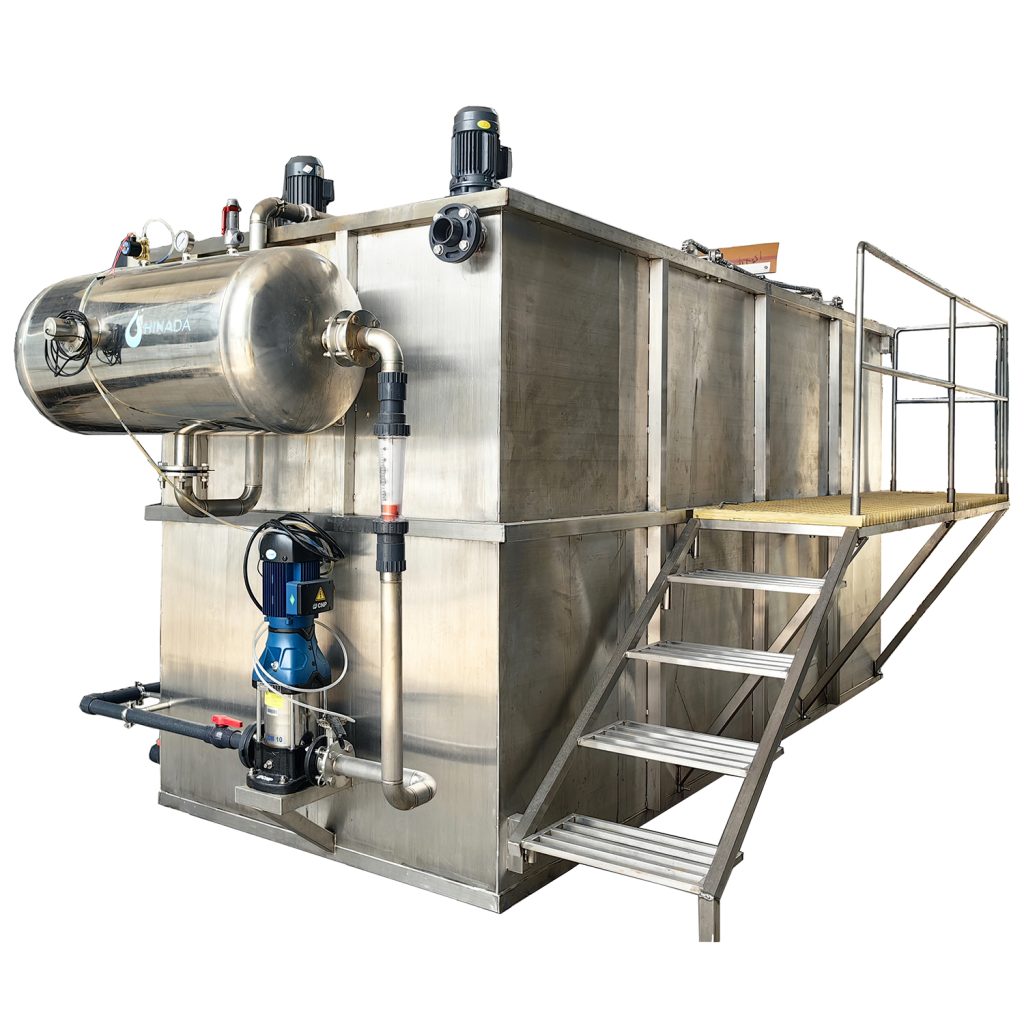
Dissolved air flotation is used to remove oils, grease, suspended solids, and other floatable materials from wastewater. It is common in industrial pretreatment, food processing, petrochemical, and municipal applications. DAF systems work by dissolving air in water under pressure and then releasing it in a flotation tank, where microbubbles attach to particles and carry them to the surface. Key design factors include recycle ratio, air-to-solids ratio, coagulation and flocculation chemistry, and surface loading rate. Project teams should evaluate the supplier's experience with similar waste streams, because DAF performance is highly dependent on wastewater characteristics. They should also evaluate sludge handling, because DAF produces float that must be dewatered or digested. HINADA provides DAF systems as part of its wastewater treatment equipment range, and project teams can evaluate such suppliers on their ability to integrate DAF with downstream biological or membrane treatment.
Ultrafiltration and Reverse Osmosis Systems
Ultrafiltration and reverse osmosis are often used together in water reuse and industrial water treatment. UF removes suspended solids, bacteria, and colloids, while RO removes dissolved salts, organics, and other contaminants. The combination can produce high-purity water for boilers, cooling towers, or process applications. Project teams should evaluate membrane compatibility, pretreatment requirements, energy recovery, concentrate management, and cleaning protocols. They should also evaluate the supplier's ability to design the entire treatment train, because UF and RO performance are closely linked. A poorly designed UF pretreatment can cause rapid RO fouling, leading to high operating costs and frequent cleaning. HINADA offers ultrafiltration systems and industrial reverse osmosis systems, which means project teams can evaluate a single supplier for multiple stages of the treatment train. This can reduce interface risk and improve performance accountability.
Supplier Evaluation Criteria
Once project requirements are defined and technologies are understood, project teams can evaluate suppliers using a structured set of criteria. The criteria should be weighted according to project priorities. For a municipal project, regulatory compliance and service support may be weighted heavily. For an industrial project, process expertise and operating cost may be more important. For a decentralized project, simplicity and remote monitoring may dominate. The evaluation should include both technical and commercial factors. It should also include qualitative factors such as responsiveness, transparency, and cultural fit. A supplier that communicates poorly during the proposal stage is likely to communicate poorly during project execution. Project teams should document their evaluation and use it to justify the final selection. This documentation is also useful for audits and future projects.
Technical Expertise and Engineering Support
Technical expertise is more than a list of products. It is the ability to understand the project, identify risks, propose solutions, and explain trade-offs. Project teams should ask suppliers to provide process descriptions, mass balances, piping and instrumentation diagrams, equipment layouts, and control philosophies. They should also ask how the supplier handles variability in flow and loading. A strong supplier will ask detailed questions about influent quality, site conditions, and operating philosophy. A weak supplier will simply quote a standard product. Project teams should evaluate the supplier's engineering team, including process engineers, mechanical engineers, electrical engineers, and controls engineers. They should also evaluate the supplier's ability to support permitting, commissioning, and operator training. HINADA, for example, provides integrated solutions from designation, supplying, installation support, and commissioning to training. That kind of end-to-end support can be valuable for project teams that lack internal resources or want a single point of responsibility.
Manufacturing Capability and Quality Control
Manufacturing capability determines whether the supplier can deliver consistent, high-quality equipment on schedule. Project teams should ask about manufacturing facilities, production capacity, quality management systems, and testing procedures. For membrane suppliers, quality control is especially critical. Membrane defects can lead to poor effluent quality, high replacement rates, and operational headaches. Project teams should ask about raw material inspection, fiber spinning, module potting, curing, integrity testing, and packaging. They should also ask about factory acceptance testing and documentation. A supplier with a complete ecosystem from membrane R&D and component manufacturing to equipment fabrication and turnkey solution delivery can often provide better quality control and faster problem resolution. HINADA, for instance, has more than 13 years of experience in the water treatment industry and 10 years of water treatment membrane and equipment manufacturing experience. That combination of experience and vertical integration is a useful benchmark for project teams evaluating manufacturing maturity.
Membrane Research and Development
Membrane technology continues to evolve. Suppliers that invest in research and development can offer better fouling resistance, higher permeability, stronger mechanical properties, and longer service life. Project teams should ask about the supplier's R&D team, laboratory capabilities, pilot testing facilities, and intellectual property. They should also ask about ongoing product improvements and how new membrane generations are validated. A supplier that simply imports membranes may not be able to provide the same level of technical support or customization. A supplier that manufactures its own membranes can often tailor formulations and module designs to specific applications. HINADA focused from day one on two core technology pillars: hollow fiber ultrafiltration and MBR membranes for precise physical separation, and intelligent integrated wastewater treatment equipment for ready-to-install solutions. That strategic focus suggests a depth of expertise that project teams can probe during technical due diligence.
Project References and Global Experience
References are one of the most reliable indicators of supplier performance. Project teams should ask for references from similar projects, preferably in the same region or with similar waste streams. They should ask detailed questions about performance, reliability, service response, and lessons learned. They should also check whether the references are recent and whether the contact persons are still available. Global experience is valuable because it exposes suppliers to different regulations, climates, and operating practices. A supplier that has worked in many countries is more likely to anticipate logistics, customs, and commissioning challenges. HINADA serves clients in over 75 countries across Asia, Africa, Europe, and the Americas. That global footprint gives project teams a broad set of references to investigate. It also suggests that the supplier can handle international shipping, documentation, and remote support.
Installation, Commissioning, and Training
Even the best-designed system can fail if it is installed incorrectly or commissioned poorly. Project teams should evaluate the supplier's installation support, commissioning procedures, and training programs. They should ask about site supervision, mechanical and electrical checks, functional testing, performance testing, and handover documentation. They should also ask about operator training, including classroom sessions, hands-on training, and refresher training. A supplier that provides comprehensive training can reduce operational risk and improve long-term performance. Project teams should clarify who is responsible for installation, who provides cranes and temporary utilities, and who resolves site issues. Clear responsibility prevents delays and disputes. HINADA provides installation support, commissioning, and training as part of its integrated solution. That model can be especially attractive for project teams that want a single accountable partner from design through operation.
After-Sales Service and Spare Parts
After-sales service is often the deciding factor in supplier selection. Wastewater treatment systems operate continuously, and downtime can be costly or even illegal. Project teams should evaluate the supplier's service network, response time, spare parts inventory, and remote support capabilities. They should ask about warranty terms, preventive maintenance programs, and emergency support. They should also ask about membrane replacement schedules and costs. A supplier that can provide local service or remote diagnostics can reduce downtime and travel costs. A supplier that stocks critical spare parts can shorten repair times. Project teams should include service level agreements in the contract, with clear response times and penalties for non-performance. They should also consider the supplier's financial stability, because a supplier that goes out of business cannot provide spare parts or support.
How to Compare Suppliers: A Practical Matrix
A comparison matrix helps project teams evaluate suppliers objectively. The matrix should include criteria such as technical compliance, process expertise, manufacturing quality, references, service support, lifecycle cost, delivery schedule, and commercial terms. Each criterion should be weighted according to project priorities. Project teams should score each supplier and document the rationale. The matrix should be used as a decision support tool, not as a substitute for judgment. It should also be updated as new information becomes available. A well-designed matrix can reveal hidden trade-offs. For example, a supplier may score high on capital cost but low on energy efficiency. Another may score high on technical expertise but low on local service. The matrix helps the team see the full picture and make a balanced decision.
Technical compliance: Does the proposal meet all required specifications and performance guarantees?
Process expertise: Has the supplier treated similar waste streams and achieved comparable effluent quality?
Manufacturing quality: Does the supplier control critical component production and testing?
References: Can the supplier provide verifiable references from similar projects?
Service support: Does the supplier offer responsive after-sales service, spare parts, and training?
Lifecycle cost: Does the proposal include energy, chemicals, maintenance, and membrane replacement?
Delivery schedule: Can the supplier meet the project timeline with realistic lead times?
Commercial terms: Are payment, warranty, and risk allocation terms fair and clear?
Request for Proposal Best Practices
The request for proposal is a critical document. It should be clear, complete, and consistent. It should include project background, design basis, scope of supply, technical requirements, commercial requirements, evaluation criteria, and proposal format. Project teams should avoid overly prescriptive specifications that limit innovation, but they should also avoid vague requirements that make comparison impossible. They should specify performance guarantees and testing procedures. They should require suppliers to provide detailed process design, equipment lists, utility requirements, and operating cost estimates. They should also require a project schedule and a quality plan. A well-written RFP reduces the number of clarification requests and improves the quality of proposals. It also helps project teams compare suppliers on a level playing field.
Technical Specification Checklist
Design flow rates: average, peak, minimum, and future.
Influent quality: all relevant parameters with sampling data.
Effluent quality: regulatory limits or reuse targets.
Treatment train: required unit processes and redundancy.
Membrane specifications: material, pore size, flux, and cleaning.
Equipment specifications: pumps, blowers, valves, instruments, and controls.
Materials of construction: corrosion resistance and compatibility.
Automation: PLC, SCADA, remote monitoring, and alarms.
Site conditions: climate, elevation, utilities, and footprint.
Testing: factory acceptance, site acceptance, and performance testing.
Documentation: drawings, manuals, data sheets, and certificates.
Training: operator training and maintenance training.
Commercial Terms and Risk Allocation
Commercial terms should be fair and balanced. Project teams should avoid contracts that transfer all risk to the supplier, because suppliers will either refuse to bid or add large risk premiums. They should also avoid contracts that leave too much risk with the project owner, because disputes and cost overruns may follow. Key commercial terms include payment schedule, performance guarantees, liquidated damages, warranty period, spare parts pricing, and termination clauses. Project teams should define what constitutes acceptance and how performance will be measured. They should also define the process for change orders. A clear contract reduces the chance of disagreement later. Project teams should involve legal and procurement specialists early. They should also consider whether the supplier has experience with international contracts and export documentation, especially for projects in different countries.
Data Collection and Performance Guarantees
Performance guarantees are only meaningful if they are based on reliable data. Project teams should collect representative samples over a sufficient period. They should analyze variability and identify worst-case conditions. They should share this data with suppliers and ask them to confirm design assumptions. If data are uncertain, they should require pilot testing. Pilot testing can validate membrane flux, fouling rates, chemical cleaning requirements, and biological performance. It can also reveal pretreatment needs and operational challenges. A supplier that supports pilot testing is often more confident in its design and more willing to provide strong guarantees. Performance guarantees should include effluent quality, capacity, energy consumption, chemical consumption, and membrane life. They should also include remedies if performance is not met. Project teams should ensure that guarantees are measurable and enforceable.
Common Pitfalls in Supplier Selection
Many project teams make avoidable mistakes during supplier selection. They may focus only on capital cost. They may underestimate operating costs. They may accept vague performance guarantees. They may fail to check references. They may ignore service capabilities. They may choose a supplier based on personal relationships rather than objective criteria. They may also fail to define project requirements clearly, which leads to scope gaps and change orders. Another common pitfall is over-specifying the technology, which can exclude innovative suppliers and increase cost. Project teams should learn from these pitfalls and build a disciplined selection process. They should also consider the supplier's ability to adapt to changing conditions, because wastewater projects rarely proceed exactly as planned.
Choosing the lowest capital cost without considering lifecycle cost.
Accepting performance guarantees that are not measurable or enforceable.
Failing to verify references with direct questions about problems and resolutions.
Ignoring the supplier's manufacturing quality and component traceability.
Underestimating installation, commissioning, and training requirements.
Over-specifying proprietary equipment and limiting competition.
Neglecting spare parts availability and long-term service agreements.
Failing to define influent variability and worst-case conditions.
Not involving operations and maintenance staff in supplier evaluation.
Rushing the selection process and missing critical due diligence.
Case Study: Selecting an Integrated Wastewater Treatment Partner
Consider a project team developing an industrial park with mixed food processing and manufacturing tenants. The wastewater contains high organic load, oils and grease, and variable flow. The team needs a treatment system that can meet strict discharge limits, produce reuse water for irrigation, and fit within a small footprint. The team evaluates several suppliers. One offers a conventional activated sludge system with a large footprint. Another offers a membrane bioreactor with a containerized configuration. A third offers a DAF pretreatment followed by MBR and reverse osmosis. The team compares lifecycle costs, service support, and references. They also visit a reference site and speak with operators. They learn that the MBR supplier has strong membrane manufacturing capability and provides remote monitoring. They also learn that the DAF supplier has excellent oil removal performance but limited MBR experience. The team decides to select a supplier that can provide an integrated solution, including DAF, MBR, and RO, with a single performance guarantee. They evaluate HINADA as a potential partner because it manufactures DAF systems, submerged MBR modules, containerized MBR systems, UF membranes, and industrial RO systems. Its global experience in over 75 countries and its integrated solution model from design to training align with the project team's need for accountability. The team still conducts pilot testing and checks references, but HINADA's portfolio and experience make it a strong candidate for the shortlist.
Total Cost of Ownership and Lifecycle Analysis
Total cost of ownership includes capital cost, installation cost, energy cost, chemical cost, maintenance cost, membrane replacement cost, sludge handling cost, and downtime cost. Project teams should build a lifecycle cost model that covers at least ten years. They should use realistic assumptions for energy prices, chemical prices, labor rates, and membrane life. They should also include the cost of financing and the cost of regulatory non-compliance. A supplier that provides a low capital cost but high energy consumption may be more expensive over time. A supplier that provides a higher capital cost but lower energy consumption may be more economical. Project teams should ask suppliers to provide energy and chemical consumption guarantees. They should also ask for a spare parts list with prices. This information allows the team to compare suppliers on a consistent basis. Lifecycle analysis also helps the team negotiate warranty terms and service agreements. It can reveal opportunities for energy recovery, chemical optimization, and water reuse.
Installation, Commissioning, and Operational Readiness
Installation and commissioning are critical phases. Project teams should develop a detailed plan that covers site preparation, equipment delivery, mechanical installation, electrical installation, piping, instrumentation, testing, and start-up. They should assign clear responsibilities to the supplier, contractor, and owner. They should also plan for temporary utilities, laydown areas, and access routes. Commissioning should include mechanical checks, electrical checks, functional tests, water tests, and performance tests. Operators should be trained before start-up so they understand the process, controls, and safety procedures. Project teams should also develop standard operating procedures, maintenance schedules, and emergency response plans. A supplier that provides comprehensive commissioning and training can reduce start-up problems and improve long-term performance. HINADA's integrated solution model includes installation support, commissioning, and training, which can help project teams achieve operational readiness faster.
Scaling from Pilot to Full-Scale
Pilot testing is often the bridge between laboratory data and full-scale design. A well-designed pilot program can validate treatment performance, membrane flux, fouling rates, chemical cleaning, and energy consumption. It can also reveal operational issues such as foaming, bulking, or scaling. Project teams should define pilot objectives, duration, sampling plan, and success criteria. They should also involve operations staff in pilot testing so they gain hands-on experience. When scaling up, project teams should apply conservative design margins, especially for membranes and biological systems. They should also consider redundancy and modular expansion. A supplier that supports pilot testing and scale-up can reduce technical risk and improve performance guarantees. HINADA's experience in membrane R&D and equipment manufacturing suggests it can support pilot testing and full-scale implementation for UF, MBR, DAF, and RO systems.
Risk Management and Contingency Planning
Wastewater projects face many risks. Technical risks include inadequate influent data, membrane fouling, biological upset, and equipment failure. Commercial risks include cost overruns, schedule delays, and supplier insolvency. Regulatory risks include changing discharge limits and permit delays. Operational risks include operator error, power outages, and chemical supply disruptions. Project teams should identify these risks and develop mitigation plans. They should also include contingency budgets and schedules. Contracts should allocate risk to the party best able to manage it. For example, the supplier may guarantee membrane performance, while the owner may manage power supply reliability. Project teams should also consider insurance and bonds. A strong supplier will have risk management processes and can provide evidence of past risk handling. HINADA's global experience across Asia, Africa, Europe, and the Americas suggests it has encountered diverse risks and developed systems to manage them.
Future Trends in Wastewater Treatment Supply
The wastewater treatment market is evolving. Trends include stricter discharge standards, water scarcity, energy efficiency, digitalization, and resource recovery. Membranes are becoming more durable and energy-efficient. MBR systems are becoming more modular and automated. Containerized and packaged plants are gaining popularity for decentralized applications. Remote monitoring and predictive maintenance are becoming standard. Suppliers are increasingly expected to provide integrated solutions rather than individual equipment. They are also expected to demonstrate sustainability and circular economy principles. Project teams should consider these trends when evaluating suppliers. A supplier that invests in research and development, digital tools, and global service capabilities is better positioned for the future. HINADA's focus on membrane R&D, integrated equipment, and international exhibitions reflects these industry trends. Project teams can use such suppliers as examples of how the market is moving toward integrated, technology-driven solutions.
Conclusion: A Disciplined Approach to Supplier Selection
Selecting a wastewater treatment system supplier is one of the most important decisions a project team will make. The right supplier can deliver a reliable, compliant, and cost-effective system. The wrong supplier can cause delays, cost overruns, and operational headaches. Project teams should define requirements clearly, understand core technologies, evaluate suppliers objectively, and manage risks proactively. They should look beyond capital cost and consider lifecycle cost, service support, manufacturing quality, and global experience. They should ask detailed questions, check references, and require performance guarantees. They should also build a partnership mindset, because wastewater treatment systems require ongoing collaboration. Suppliers such as HINADA Water Treatment Tech Co., Ltd. illustrate the value of integrated capabilities, from membrane manufacturing to packaged systems and turnkey delivery. By following a disciplined selection process, project teams can choose a supplier that will help them achieve their technical, regulatory, and financial goals for years to come.