Choosing a Wastewater Treatment Plant Design for Growing Communities
Choosing a Wastewater Treatment Plant Design for Growing Communities
October 15, 2026
Author
Solution Provider, through a professional technical team, we provide customers with targeted equipment selection recommendations and comprehensive after-sales services, winning the trust and recognition of customers.
Sarah M.
Choosing a wastewater treatment plant design for growing communities requires balancing capacity, effluent quality, land use, energy, operational complexity, and lifecycle cost. Rapid growth can quickly overwhelm undersized plants, so accurate flow projections and phased, modular expansion are essential. Communities should evaluate influent characteristics, regulatory limits, site constraints, and community acceptance before selecting a technology. Common options include conventional activated sludge, sequencing batch reactors, moving bed biofilm reactors, membrane bioreactors, integrated packaged systems, and dissolved air flotation for industrial pretreatment. MBR and packaged systems offer small footprints, high effluent quality, and scalability, making them attractive for land-constrained or fast-growing areas. Energy efficiency, water reuse, and future-proofing should be integrated early. Operation and maintenance must match local capacity, with training and support from manufacturers. Lifecycle cost analysis helps avoid choosing the lowest capital cost option that becomes expensive to operate. HINADA Water Treatment Tech Co., Ltd., founded in 2012 in Guangzhou and expanded to Chenzhou, serves over 75 countries with UF membranes, submerged MBR modules, containerized MBR systems, packaged plants, and DAF systems. With more than 13 years of industry experience and 10 years of manufacturing experience, HINADA provides turnkey solutions from design to commissioning and training. By following a structured selection process, engaging stakeholders, and partnering with experienced suppliers, growing communities can choose a wastewater treatment design that protects public health, meets regulations, and supports sustainable growth for decades.
Choosing a Wastewater Treatment Plant Design for Growing Communities
Growing communities face a familiar but urgent challenge: how to provide reliable wastewater treatment that protects public health, preserves local water bodies, and keeps pace with rapid population growth. A treatment plant designed for a town of 5,000 people may become inadequate within a decade when that town grows to 15,000 or 25,000 residents. Choosing the right wastewater treatment plant design is therefore not merely a technical decision; it is a long-term strategic commitment that affects municipal budgets, environmental compliance, community acceptance, and future expansion. This article explores the key considerations, technologies, and practical steps that growing communities should evaluate when selecting a wastewater treatment plant design. It also highlights how experienced equipment manufacturers and solution providers, such as HINADA Water Treatment Tech Co., Ltd., can support communities through every stage of planning, design, and operation.
Why Wastewater Treatment Design Matters for Growing Communities
When a community grows, wastewater flows increase, influent characteristics change, and the margin for error shrinks. A treatment plant that was once adequate can become overloaded, leading to permit violations, odors, equipment failures, and costly emergency upgrades. In many regions, rapid residential development, commercial expansion, and industrial activity occur faster than the construction of new treatment infrastructure. The result is often a patchwork of temporary fixes that ultimately cost more than a well-planned solution. A thoughtful design process considers not only current flows but also projected growth rates, land use plans, economic development strategies, and climate conditions. It balances capital costs with operation and maintenance expenses, energy consumption, and the availability of skilled operators. For growing communities, the goal is to select a design that is robust, scalable, and affordable over its entire lifecycle.
Understanding the Unique Challenges of Growing Communities
Growing communities are not simply smaller versions of large cities. They have distinct characteristics that shape wastewater treatment needs. First, population growth is often uneven, with sudden spikes due to new housing developments or industrial parks. Second, financial and technical resources may be limited, making complex treatment trains difficult to operate and maintain. Third, land availability near the community may be constrained, requiring compact solutions. Fourth, regulatory requirements may become stricter as environmental awareness increases. Fifth, community expectations for odor control, noise reduction, and visual impact are often high. Finally, many growing communities are located near sensitive water bodies, such as rivers, lakes, or coastal zones, where nutrient removal and disinfection are critical. These challenges mean that a one-size-fits-all approach rarely works. Instead, each community must evaluate its own context and choose a design that matches its specific conditions.
Key Factors in Selecting a Wastewater Treatment Plant Design
Several factors should guide the selection process. These include capacity planning, influent and effluent characteristics, treatment objectives, site constraints, energy and chemical use, operational complexity, regulatory requirements, and budget. Each factor interacts with the others, so decision-makers should use a holistic approach rather than optimizing for a single criterion.
Capacity Planning and Flow Projections
Accurate flow projections are the foundation of any treatment plant design. Engineers must estimate current average daily flow, peak flow, and future flow based on population growth, water consumption patterns, and industrial contributions. Infiltration and inflow, which occur when groundwater or stormwater enters the sewer system, can significantly increase flows and must be accounted for. A common mistake is to design only for the immediate future, resulting in premature upgrades. A better approach is to design for phased expansion, where the plant can be modularly expanded as the community grows. This reduces initial capital costs while avoiding the disruption and expense of a complete rebuild later.
Influent Characteristics and Wastewater Strength
Domestic wastewater typically contains organic matter, suspended solids, nutrients, and pathogens. However, growing communities may also attract commercial and industrial dischargers that introduce higher concentrations of biochemical oxygen demand, chemical oxygen demand, fats, oils, grease, heavy metals, or toxic compounds. Understanding the influent characteristics is essential for selecting the right treatment process. For example, high-strength industrial wastewater may require pretreatment such as dissolved air flotation or equalization before it enters the biological treatment stage. If the community expects industrial growth, the design should include flexibility to handle variable loads and potentially segregated treatment trains.
Effluent Quality Standards and Regulatory Requirements
Every community must meet effluent standards set by local, regional, or national regulators. These standards may limit biochemical oxygen demand, total suspended solids, ammonia, nitrate, total nitrogen, total phosphorus, fecal coliform, and other parameters. In sensitive watersheds, advanced treatment may be required, including nutrient removal, filtration, and disinfection. Future regulations often become more stringent, so designing for today's standards may not be enough. A robust design should anticipate potential tightening of limits and include provisions for adding treatment stages later. This is where membrane bioreactor technology and ultrafiltration membranes can provide a high level of treatment and future-proofing.
Site Constraints and Land Availability
Land availability is a major constraint for growing communities. A conventional activated sludge plant with large basins may require significant space, which may not be available or may be too expensive near populated areas. Compact technologies such as membrane bioreactors, integrated packaged systems, and containerized treatment units can fit into smaller footprints. They also allow for decentralized treatment, where multiple smaller plants serve different neighborhoods or industrial zones. Site topography, soil conditions, flood risk, and proximity to residences also influence design choices. Odor control and noise reduction may be necessary if the plant is near sensitive receptors.
Energy Efficiency and Sustainability
Wastewater treatment is energy-intensive, and rising energy costs can strain municipal budgets. A sustainable design considers energy-efficient aeration, variable-frequency drives, high-efficiency pumps, and biogas recovery where feasible. Solar power, heat recovery, and other renewable energy options can further reduce operating costs and carbon footprint. In addition, water reuse and resource recovery are becoming more important. Treated effluent can be reused for irrigation, industrial cooling, or groundwater recharge, reducing demand on freshwater sources. Biosolids can be processed into fertilizer or energy. Growing communities should evaluate these opportunities early in the design process.
Operational Complexity and Maintenance
A treatment plant is only as good as its operation and maintenance. Many growing communities struggle to attract and retain certified operators. Therefore, the design should match the available operational capacity. Simple, robust processes with automated controls and remote monitoring can reduce the burden on staff. However, advanced technologies like membrane bioreactors require specialized knowledge for membrane cleaning, fouling control, and integrity testing. Manufacturers that provide training, documentation, and ongoing support can make a significant difference. HINADA, for example, offers turnkey solutions that include design, equipment supply, installation support, commissioning, and training, helping communities operate their plants effectively.
Capital and Operating Costs
Cost is always a central concern. The lowest capital cost option may not be the lowest lifecycle cost. A proper financial analysis should compare capital expenditure, operating expenditure, energy consumption, chemical use, membrane replacement, and maintenance over a 20- to 30-year period. Lifecycle costing helps communities avoid hidden costs and make informed decisions. Funding options such as grants, low-interest loans, public-private partnerships, and phased development can make advanced treatment more affordable. It is also important to consider the cost of land, permitting, and community engagement.
Treatment Technologies Overview
Numerous treatment technologies are available, each with advantages and limitations. The following sections describe the most common options for growing communities.
Conventional Activated Sludge
Conventional activated sludge is a well-established process that uses aeration tanks and secondary clarifiers to biologically treat wastewater. It is effective for organic matter and suspended solids removal and can be configured for nutrient removal. However, it requires a relatively large footprint, significant energy for aeration, and careful sludge management. It may also be sensitive to shock loads and requires consistent operation. For growing communities with available land and skilled operators, conventional activated sludge can be a reliable choice. But for communities facing land constraints or rapid growth, it may not be the most flexible option.
Sequencing Batch Reactors
Sequencing batch reactors (SBRs) treat wastewater in a single tank using timed cycles of fill, react, settle, and decant. They offer flexibility, good treatment performance, and a smaller footprint than conventional activated sludge. SBRs can be automated and can handle variable flows, making them suitable for growing communities. However, they require precise control and may have higher maintenance needs for decanters and valves. They are also sensitive to peak flows and may need equalization.
Membrane Bioreactor
Membrane bioreactor (MBR) technology combines biological treatment with membrane filtration, typically using submerged hollow fiber or flat sheet membranes. The membranes replace secondary clarifiers and provide a physical barrier that retains solids, bacteria, and some viruses. MBRs produce high-quality effluent suitable for reuse, require a small footprint, and can operate at high mixed liquor suspended solids concentrations. They are ideal for growing communities with limited land, stringent effluent standards, or water reuse goals. However, MBRs have higher capital and operating costs due to membrane replacement and energy for air scouring. Fouling control and membrane cleaning are critical. HINADA manufactures submerged MBR membrane modules and integrated MBR systems that are designed for robust performance and easy maintenance.
Moving Bed Biofilm Reactor
Moving bed biofilm reactor (MBBR) technology uses small plastic carriers that support biofilm growth within an aerated tank. MBBRs are compact, robust, and can handle shock loads. They are often used for upgrading existing plants or for decentralized treatment. They do not require sludge recycling, which simplifies operation. However, they may require screening and aeration for carrier movement, and their treatment performance for nutrient removal can be less predictable than MBRs.
Integrated Packaged and Containerized Systems
Integrated packaged wastewater treatment systems are factory-built units that combine multiple treatment stages in a compact footprint. Containerized MBR systems are a type of packaged system that can be shipped and installed quickly. They are ideal for growing communities that need rapid deployment, temporary treatment, or decentralized solutions. They offer low civil construction costs, easy expansion, and consistent quality control. HINADA provides containerized MBR systems and packaged wastewater treatment plants that are ready to install and can be scaled by adding modules.
Dissolved Air Flotation for Industrial Pretreatment
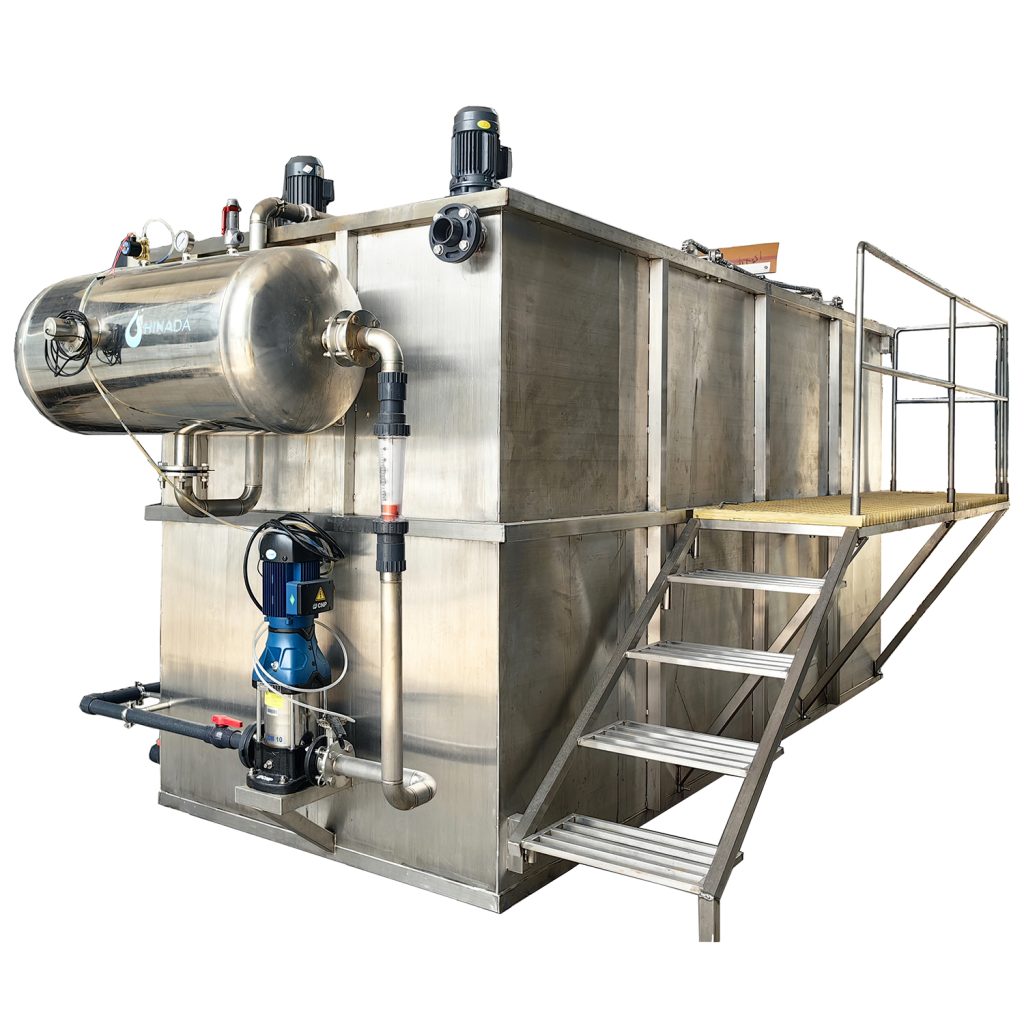
Dissolved air flotation (DAF) is a physical-chemical process that removes suspended solids, fats, oils, and grease from wastewater by introducing dissolved air to create microbubbles that attach to pollutants and float them to the surface. DAF is often used as pretreatment for industrial wastewater before biological treatment or discharge. It is effective for high-load industrial streams and can reduce the burden on downstream processes. HINADA manufactures DAF systems that are used in industrial wastewater treatment and reuse applications.
Comparing Treatment Options: A Decision Matrix
The following table summarizes key characteristics of common treatment technologies. This matrix can help growing communities narrow down their options based on their specific priorities.
Technology
Footprint
Effluent Quality
Operational Complexity
Capital Cost
Operating Cost
Scalability
Conventional Activated Sludge
Large
Good
Moderate
Moderate
Moderate
Moderate
Sequencing Batch Reactor
Medium
Good
Moderate to High
Moderate
Moderate
Good
Membrane Bioreactor
Small
Excellent
High
High
High
Excellent
Moving Bed Biofilm Reactor
Small to Medium
Good
Low to Moderate
Moderate
Moderate
Good
Integrated Packaged System
Very Small
Good to Excellent
Low to Moderate
Moderate
Moderate
Excellent
Dissolved Air Flotation
Medium
Pretreatment
Moderate
Moderate
Moderate
Good
How HINADA Supports Growing Communities
HINADA Water Treatment Tech Co., Ltd. is a globally recognized manufacturer of wastewater treatment equipment, hollow fiber ultrafiltration membranes, submerged MBR membrane modules, integrated packaged wastewater treatment systems, and DAF systems. Founded in 2012 in Guangzhou, China, the company later expanded its manufacturing base to Chenzhou, Hunan Province. Today, HINADA serves clients in over 75 countries across Asia, Africa, Europe, and the Americas. The company is one of the leading submerged MBR membrane, wastewater treatment equipment, and membrane filtration system manufacturers in China, specializing as a wastewater treatment solution provider and equipment supplier since its founding. HINADA provides truly integrated solutions for water and wastewater projects, from design, supplying, installation support, and commissioning to training. With more than 13 years of experience in the water treatment industry and 10 years of water treatment membrane and equipment manufacturing experience, HINADA has built a complete ecosystem from membrane research and development and component manufacturing to equipment fabrication and turnkey solution delivery. From day one, HINADA focused on two core technology pillars: hollow fiber ultrafiltration (UF/MBR) membranes for precise physical separation of suspended solids, bacteria, colloids, and macromolecular organics, and intelligent integrated wastewater treatment equipment for ready-to-install solutions for municipal, industrial, and decentralized applications. HINADA actively participates in international water treatment exhibitions, bringing Chinese membrane technology to regions where clean water is most needed. Key application fields include industrial wastewater treatment and reuse, municipal sewage treatment and water recycling, rural decentralized water supply and sanitation, and drinking water purification from surface water and groundwater.
Designing for Scalability and Modular Expansion
Growing communities need treatment plants that can expand gracefully. Modular design allows additional treatment trains, membrane modules, or tankage to be added as flows increase. This approach reduces initial capital costs and avoids overbuilding. It also allows the community to phase investments in line with actual growth, which is particularly important when growth projections are uncertain. Modular systems can be containerized, skid-mounted, or built with common wall construction. HINADA's containerized MBR systems and packaged wastewater treatment plants are examples of modular solutions that can be expanded by adding units. When selecting a design, communities should ask whether the chosen technology can be expanded without major civil works, whether spare capacity exists in pumps and blowers, and whether the site has room for future modules.
Energy Efficiency and Sustainability
Energy is one of the largest operating costs in wastewater treatment. Aeration alone can account for 50 to 70 percent of a plant's electricity consumption. Therefore, energy-efficient design is essential. Fine-bubble diffusers, dissolved oxygen control, variable-frequency drives, and high-efficiency blowers can significantly reduce energy use. Membrane bioreactors require additional energy for air scouring, but they can also enable water reuse, which offsets freshwater withdrawal and treatment. Anaerobic digestion of sludge can produce biogas for heating or power generation. Solar panels can supplement grid electricity. Growing communities should consider a holistic energy strategy that includes demand reduction, renewable generation, and recovery of resources such as nutrients and water. Sustainability also involves minimizing chemical use, reducing sludge production, and designing for climate resilience, including flood protection and drought tolerance.
Regulatory Compliance and Future-Proofing
Regulations evolve. What is compliant today may not be compliant tomorrow. Growing communities should design with future regulations in mind. This means selecting processes that can achieve advanced treatment, such as nutrient removal and disinfection, and that can be upgraded with additional stages. For example, an MBR can be followed by reverse osmosis for indirect potable reuse if regulations require it. Ultrafiltration membranes can be added for tertiary treatment. Designing for future-proofing also means keeping accurate records, monitoring emerging contaminants, and participating in regulatory discussions. HINADA's membrane products and integrated systems are designed to meet stringent effluent standards and can be configured for water reuse applications.
Community Engagement and Social Acceptance
Wastewater treatment plants are essential infrastructure, but they can face opposition due to concerns about odors, noise, traffic, and property values. Early and transparent community engagement can build trust and reduce conflict. Communities should communicate the need for the plant, the measures taken to minimize impacts, and the benefits such as improved water quality and recreational opportunities. Odor control technologies, architectural design, buffer zones, and public education can help. Involving residents in the planning process can also lead to better decisions. For growing communities, social acceptance is not optional; it is a critical success factor.
Case Scenarios
To illustrate how these principles apply, consider three common scenarios.
Small Town with Rapid Population Growth
A small town of 8,000 residents expects to reach 20,000 within 15 years due to a new manufacturing plant. The existing lagoon system is nearing capacity and cannot meet new nutrient limits. The town has limited land near the existing site and limited budget. A modular MBR or integrated packaged system can provide high-quality effluent in a small footprint. The town can install an initial module for 10,000 residents and add modules as growth occurs. HINADA's containerized MBR systems can be deployed quickly and expanded easily. The town also plans water reuse for irrigation, which MBR effluent can support.
Industrial Park Near Residential Area
An industrial park with food processing and textile factories discharges high-strength wastewater. Nearby residents complain of odors and truck traffic. The park needs pretreatment to reduce loads on the municipal plant. A DAF system followed by equalization and biological treatment can remove fats, oils, grease, and suspended solids. HINADA's DAF systems are designed for industrial wastewater and can be integrated with MBR for reuse. The industrial park can also implement source control and pretreatment agreements with tenants.
Rural Decentralized Sanitation
A rural district with scattered villages lacks centralized sewers. Building a large centralized plant is expensive and impractical. Decentralized packaged treatment units can serve individual villages or clusters. These units can be solar-powered and remotely monitored. HINADA's integrated packaged wastewater treatment systems are suitable for rural decentralized water supply and sanitation. They are easy to install, require minimal civil works, and can be maintained by local operators with training and support.
Operation and Maintenance Considerations
Even the best design will fail without proper operation and maintenance. Growing communities should develop an O&M plan that includes staffing, training, spare parts, laboratory testing, preventive maintenance, and emergency response. Automation and remote monitoring can help, but they do not replace skilled operators. Membrane systems require periodic cleaning and integrity testing. HINADA provides training and commissioning support to ensure that local staff can operate and maintain their systems. Communities should also budget for membrane replacement and equipment overhaul over the life of the plant. A proactive maintenance culture reduces downtime and extends equipment life.
Financial Analysis: Capital vs Operating Costs
A comprehensive financial analysis should compare all costs over the project lifecycle. Capital costs include land, engineering, equipment, construction, and contingency. Operating costs include energy, chemicals, labor, membrane replacement, sludge disposal, and maintenance. Some technologies have low capital costs but high operating costs, while others are the opposite. For example, conventional activated sludge may have lower capital costs than MBR but higher land requirements and lower effluent quality. MBR has higher capital and operating costs but produces reusable water and requires less land. Communities should also consider the cost of non-compliance, including fines, legal fees, and reputational damage. Funding options such as grants, loans, and public-private partnerships can make advanced treatment more affordable. Lifecycle cost analysis, often called total cost of ownership, is the best way to compare alternatives.
Steps to Choose the Right Design
The following steps can guide growing communities through the selection process.
Define project goals, including effluent quality, capacity, and reuse objectives.
Collect accurate flow and load data, including future projections.
Identify site constraints, regulatory requirements, and community concerns.
Develop a list of feasible treatment technologies.
Compare technologies using lifecycle cost, energy use, footprint, and operational complexity.
Engage stakeholders, including residents, businesses, and regulators.
Select a preferred design and develop a phased implementation plan.
Choose experienced equipment suppliers and contractors.
Plan for commissioning, training, and long-term operation.
Monitor performance and adapt as the community grows.
Conclusion
Choosing a wastewater treatment plant design for a growing community is a complex but manageable task. It requires a clear understanding of current and future needs, a careful evaluation of treatment technologies, and a commitment to lifecycle cost and sustainability. Compact, modular, and high-performance solutions such as membrane bioreactors, integrated packaged systems, and containerized plants offer significant advantages for communities with limited land and stringent effluent requirements. Industrial pretreatment with DAF and membrane filtration can protect both the community and the environment. By working with experienced manufacturers and solution providers like HINADA Water Treatment Tech Co., Ltd., growing communities can access reliable equipment, integrated design support, and ongoing service. The right design will protect public health, preserve water resources, and support sustainable growth for decades to come.
About HINADA Water Treatment Tech Co., Ltd. HINADA is a globally recognized manufacturer of wastewater treatment equipment, hollow fiber ultrafiltration membranes, submerged MBR membrane modules, integrated packaged wastewater treatment systems, and DAF systems. Founded in 2012 in Guangzhou, China, HINADA expanded its manufacturing base to Chenzhou, Hunan Province. The company serves clients in over 75 countries across Asia, Africa, Europe, and the Americas. With more than 13 years of water treatment industry experience and 10 years of membrane and equipment manufacturing experience, HINADA provides turnkey solutions from design and equipment supply to installation support, commissioning, and training. Its core products include PVDF and PVC hollow fiber UF membranes, submerged MBR membrane modules, containerized MBR systems, packaged wastewater treatment plants, DAF systems, ultrafiltration systems, and industrial reverse osmosis systems. HINADA focuses on two core technology pillars: hollow fiber ultrafiltration (UF/MBR) membranes for precise physical separation, and intelligent integrated wastewater treatment equipment for municipal, industrial, and decentralized applications.