Why DAF System Equipment Is Essential for High-Load Treatment
Why DAF System Equipment Is Essential for High-Load Treatment
September 30, 2026
Author
Solution Provider, through a professional technical team, we provide customers with targeted equipment selection recommendations and comprehensive after-sales services, winning the trust and recognition of customers.
Sarah M.
This article has explained why DAF system equipment is essential for high-load treatment. High-load wastewater contains elevated concentrations of suspended solids, fats, oils, grease, and organic matter, which can overwhelm conventional treatment processes. Dissolved air flotation uses microbubbles to attach to contaminants and float them to the surface for removal. This process achieves high removal efficiencies for TSS, FOG, COD, and BOD, while offering a compact footprint and strong tolerance to shock loads. DAF is widely used in food processing, slaughterhouses, dairy, pulp and paper, textile, petrochemical, mining, and municipal applications. It is particularly valuable as a pretreatment step for membrane bioreactors, ultrafiltration, and reverse osmosis, protecting membranes from fouling and extending their life. Key design considerations include hydraulic loading rate, solids loading rate, air-to-solids ratio, chemical conditioning, and sludge removal. HINADA Water Treatment Tech Co., Ltd., founded in 2012 in Guangzhou and expanded to Chenzhou, Hunan Province, is a globally recognized manufacturer of DAF systems, UF membranes, MBR modules, containerized MBR systems, and RO systems. Serving over 75 countries with more than 13 years of experience, HINADA provides integrated solutions from design to commissioning. For high-load treatment, DAF is not optional; it is a foundational technology for compliance, efficiency, and sustainability.
Why DAF System Equipment Is Essential for High-Load Treatment
In the modern water and wastewater treatment industry, high-load treatment scenarios present some of the most difficult operational and engineering challenges. High-load treatment refers to influent streams that carry exceptionally high concentrations of suspended solids, fats, oils, grease, organic matter, and other pollutants. These streams can originate from industrial processes, municipal combined sewer overflows, food and beverage production, slaughterhouses, dairy operations, petrochemical facilities, and many other sources. When such high-strength wastewater enters a treatment plant without adequate pretreatment, it can overwhelm biological processes, clog membranes, increase chemical consumption, and cause persistent compliance failures. Among the many technologies available for high-load treatment, dissolved air flotation, commonly known as DAF, has emerged as one of the most reliable, versatile, and cost-effective solutions. This article explains why DAF system equipment is essential for high-load treatment, how it works, where it is applied, and how leading manufacturers such as HINADA Water Treatment Tech Co., Ltd. are advancing the technology for global markets.
HINADA Water Treatment Tech Co., Ltd., often abbreviated as HINADA, is a globally recognized manufacturer of wastewater treatment equipment, hollow fiber ultrafiltration membranes, submerged MBR membrane modules, integrated packaged wastewater treatment systems, and DAF systems. Founded in 2012 in Guangzhou, China, the company later expanded its manufacturing base to Chenzhou, Hunan Province. Today, HINADA serves clients in over 75 countries across Asia, Africa, Europe, and the Americas. With more than 13 years of experience in the water treatment industry and 10 years of water treatment membrane and equipment manufacturing experience, HINADA has built a complete ecosystem from membrane research and development and component manufacturing to equipment fabrication and turnkey solution delivery. Its core products include PVDF and PVC hollow fiber UF membranes, MBR membrane modules, containerized MBR systems and packaged wastewater treatment plants, dissolved air flotation systems, ultrafiltration systems, and industrial reverse osmosis systems. The company provides truly integrated solutions to water and wastewater projects, from design and supplying to installation support, commissioning, and training. This depth of expertise is directly relevant to high-load treatment, because DAF performance depends on precise engineering, robust materials, and intelligent integration with downstream processes.
Understanding High-Load Treatment
High-load treatment is not a single definition but a spectrum of challenging conditions. In general, high-load wastewater contains pollutant concentrations that are several times higher than typical domestic sewage. For example, chemical oxygen demand may exceed 5,000 mg/L, biochemical oxygen demand may exceed 2,000 mg/L, total suspended solids may exceed 1,000 mg/L, and fats, oils, and grease may exceed 500 mg/L. In extreme cases, such as rendering plants or palm oil mill effluent, these values can be much higher. The hydraulic and organic shock loads can fluctuate dramatically, making stable treatment difficult. High-load treatment also often involves variable flow rates, temperature fluctuations, pH swings, and the presence of toxic or inhibitory substances. These factors combine to create an environment where conventional primary treatment, such as simple gravity sedimentation, is frequently inadequate.
When high-load wastewater is not properly pretreated, the consequences cascade through the entire treatment train. Biological treatment systems, including activated sludge and membrane bioreactors, may experience filamentous bulking, foaming, and poor settling. Membrane systems may suffer rapid fouling and clogging, leading to frequent cleaning and shortened membrane life. Disinfection may become less effective because solids and organic matter shield pathogens. Sludge handling costs may rise because the sludge volume and water content increase. In many cases, the treatment plant cannot meet discharge standards, resulting in fines, operational restrictions, or environmental damage. Therefore, the selection of a robust primary or pretreatment technology is critical. DAF system equipment is specifically designed to handle these high-load conditions with high efficiency and operational stability.
undefined
What Is a DAF System?
Dissolved air flotation is a water treatment process that clarifies wastewater by removing suspended solids, oils, grease, and other contaminants through the use of microscopic air bubbles. The fundamental principle is simple yet powerful. Air is dissolved into water under high pressure, typically between 4 and 6 bar, in a pressure vessel known as an air saturation tank. When this pressurized air-saturated water is released into the DAF tank at atmospheric pressure, the excess air comes out of solution in the form of millions of tiny microbubbles, usually between 20 and 100 micrometers in diameter. These microbubbles attach to suspended particles, oil droplets, and flocculated materials, reducing their effective density and causing them to float to the surface. A mechanical skimmer then removes the floating sludge layer, while clarified water is drawn from the bottom of the tank.
The DAF process is particularly effective for particles that are difficult to settle by gravity. Many high-load wastewaters contain fats, oils, and grease that are less dense than water and naturally tend to float. Other contaminants, such as algae, fine colloidal solids, and chemical flocs, may be neutrally buoyant or slowly settling. DAF overcomes these challenges by actively lifting the contaminants to the surface. The result is a rapid, high-rate separation process that can achieve high removal efficiencies in a compact footprint. Unlike sedimentation, which relies on the density difference between water and particles, DAF relies on the attachment of bubbles to particles, making it far less sensitive to particle density and size.
Why DAF Is Essential for High-Load Treatment
The essential role of DAF in high-load treatment can be understood through several key mechanisms. First, DAF provides exceptionally high removal rates for total suspended solids, fats, oils, and grease. In many industrial applications, DAF can remove 90 to 98 percent of TSS and FOG, and 50 to 80 percent of COD and BOD. These removal rates are achieved at hydraulic loading rates that are significantly higher than those of conventional sedimentation tanks. This means a smaller DAF unit can treat the same flow as a much larger settling tank, which is a major advantage when space is limited or when capacity must be expanded without constructing new basins.
Second, DAF is highly effective at handling shock loads. High-load treatment facilities often experience sudden increases in pollutant concentration due to batch discharges, production changes, or storm events. A properly designed DAF system can accommodate these fluctuations by adjusting recycle ratio, chemical dosing, and air saturation pressure. The process is also relatively insensitive to temperature changes, unlike biological treatment, which can be inhibited by cold or hot influents. This robustness makes DAF an ideal front-line defense for downstream biological and membrane processes.
Third, DAF improves the performance and longevity of downstream equipment. When DAF removes the bulk of suspended solids and oils, membrane bioreactors and ultrafiltration systems experience lower fouling rates. Biological treatment becomes more stable because the organic load is more consistent and the presence of toxic oils is reduced. Sludge produced by DAF is often thicker and more concentrated than sludge from sedimentation, reducing dewatering costs and disposal volumes. In short, DAF acts as a critical barrier that protects the entire treatment train from the most damaging constituents of high-load wastewater.
Fourth, DAF is versatile and can be integrated with a wide range of chemical and physical processes. Coagulants and flocculants, such as polyaluminium chloride, ferric chloride, and anionic or cationic polymers, can be dosed upstream of the DAF unit to destabilize colloidal particles and form larger flocs. These flocs are then more easily captured by microbubbles. Advanced DAF systems may also incorporate pH adjustment, oxidation, or biological pretreatment to enhance overall treatment efficiency. This flexibility allows DAF to be tailored to specific high-load wastewaters, whether they are acidic, alkaline, oily, or highly organic.
How DAF System Equipment Works
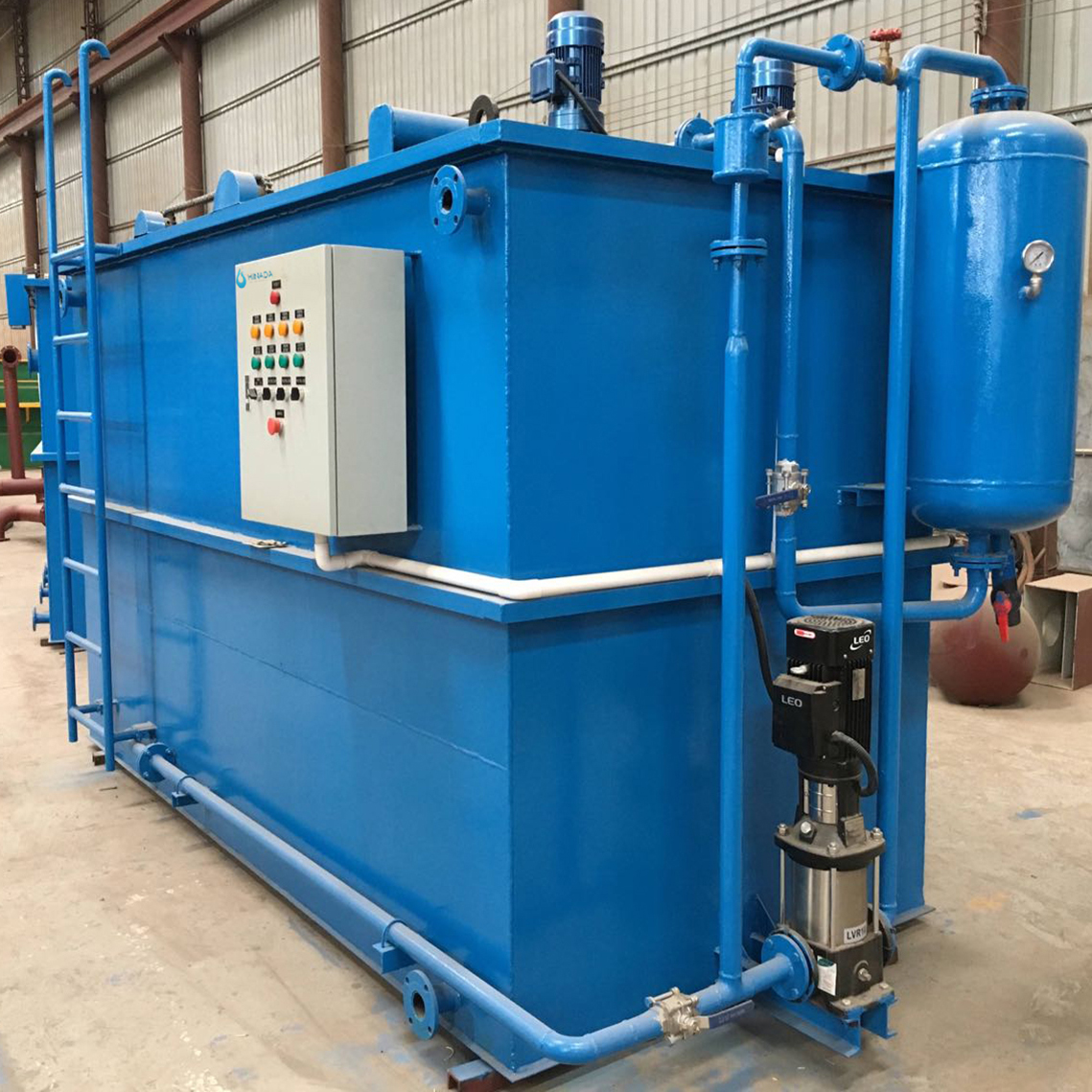
A typical DAF system consists of several key components that work together to achieve efficient separation. The influent wastewater first enters a coagulation and flocculation stage, where chemicals are added and mixed gently to promote floc formation. The conditioned wastewater then flows into the DAF tank, which is usually rectangular or circular in shape. The tank is divided into a contact zone and a separation zone. In the contact zone, pressurized recycle water saturated with air is introduced through a series of nozzles or release valves. The sudden pressure drop creates microbubbles that attach to the flocs and suspended particles. The mixture then moves into the separation zone, where the bubble-particle agglomerates rise to the surface and form a sludge blanket. A skimmer, often a chain-and-flight or rotary scraper, continuously removes the sludge blanket into a collection hopper. Clarified water exits from the bottom of the tank, often through a perforated pipe or adjustable weir.
The air saturation system is the heart of the DAF process. It typically includes a recycle pump, a pressure vessel, an air compressor or air injector, and a pressure relief valve. A portion of the clarified effluent is recycled, pressurized, and mixed with compressed air. The air dissolves into the water under pressure, and the resulting air-saturated water is returned to the DAF tank. The recycle ratio, which is the percentage of influent flow that is recycled, is a critical design parameter. For high-load treatment, the recycle ratio may range from 20 to 100 percent or more, depending on the concentration and characteristics of the contaminants. Higher recycle ratios provide more microbubbles for particle attachment, but they also increase energy consumption and hydraulic loading. Therefore, proper design and control are essential.
Other important components include the chemical dosing system, the sludge collection and dewatering system, and the control panel. Modern DAF systems often feature automated controls for pH, flow, pressure, and chemical dosing. These controls help maintain stable performance despite fluctuating influent conditions. HINADA, for example, designs its DAF systems with robust construction, corrosion-resistant materials, and intelligent control interfaces that can be integrated into larger treatment plants. The company's experience in manufacturing membranes and integrated systems allows it to optimize DAF as a pretreatment step for ultrafiltration, MBR, and reverse osmosis processes.
Key Design Considerations for High-Load DAF
Designing a DAF system for high-load treatment requires careful attention to several parameters. The first is the hydraulic loading rate, which is the flow rate per unit area of the DAF tank. For high-load applications, the hydraulic loading rate may be lower than for low-strength wastewater to allow sufficient retention time for bubble attachment and flotation. Typical values range from 2 to 10 m3/m2·h, but this depends on the specific wastewater. The second is the solids loading rate, which is the mass of solids per unit area per hour. High-load DAF systems must be designed to handle high solids loading without causing sludge blanket carryover or clogging. The third is the air-to-solids ratio, which is the mass of air supplied per mass of solids. This ratio is critical for ensuring that enough microbubbles are available to attach to all particles. Typical air-to-solids ratios range from 0.01 to 0.1 kg air per kg solids, but higher values may be needed for oily or highly contaminated streams.
Chemical conditioning is another critical factor. The choice and dosage of coagulants and flocculants can significantly affect DAF performance. For high-load treatment, it is often necessary to use a combination of inorganic coagulants and organic polymers. Jar tests are typically conducted to determine the optimal dosages and mixing conditions. The pH of the wastewater also plays a role, as it affects the solubility of coagulants and the surface charge of particles. In some cases, pH adjustment is required before chemical addition. HINADA provides comprehensive laboratory testing and pilot studies to optimize chemical dosing for each client's specific wastewater.
Another consideration is the method of sludge removal. High-load DAF systems produce large volumes of sludge, which must be removed efficiently and continuously. The skimmer design, speed, and frequency must be matched to the sludge production rate. The sludge collection hopper should be sized to handle peak loads, and the sludge withdrawal system should be capable of handling thick, viscous sludge. In some cases, the DAF sludge can be further thickened or dewatered using belt presses, centrifuges, or screw presses. HINADA's integrated approach allows it to supply complete sludge handling solutions alongside DAF equipment.
Comparison of DAF with Other Treatment Technologies
To appreciate why DAF is essential for high-load treatment, it is helpful to compare it with other common separation technologies. The following table provides a qualitative comparison of DAF, gravity sedimentation, and membrane filtration for high-load applications. Because the allowed HTML tags do not include table rows or cells, the comparison is presented in a simple text format within a table element.
Technology: Dissolved Air Flotation (DAF) Separation Mechanism: Microbubble attachment and flotation Typical TSS Removal: 90 to 98 percent FOG Removal: 80 to 95 percent Footprint: Compact Shock Load Tolerance: High Sludge Concentration: 2 to 6 percent solids Best Application: High-load industrial and municipal pretreatment
Technology: Gravity Sedimentation Separation Mechanism: Density difference and settling Typical TSS Removal: 50 to 70 percent FOG Removal: 30 to 50 percent Footprint: Large Shock Load Tolerance: Low to moderate Sludge Concentration: 1 to 3 percent solids Best Application: Low to medium strength wastewater
Technology: Membrane Filtration Separation Mechanism: Physical sieving and adsorption Typical TSS Removal: 99 percent or higher FOG Removal: High but prone to fouling Footprint: Very compact Shock Load Tolerance: Low without pretreatment Sludge Concentration: Dependent on pretreatment Best Application: Polishing and water reuse after DAF
As the comparison shows, DAF offers a unique combination of high removal efficiency, compact footprint, and strong tolerance to shock loads. While membrane filtration can achieve higher effluent quality, it is highly susceptible to fouling by oils and solids, making DAF an essential pretreatment step. Gravity sedimentation is simpler and less expensive to operate, but it cannot handle the high loading rates and difficult contaminants found in high-load treatment. Therefore, DAF is often the most technically and economically sound choice for the primary treatment of high-strength wastewater.
Applications of DAF in High-Load Treatment
DAF system equipment is used in a wide range of high-load treatment applications across many industries. In the food and beverage industry, DAF is essential for treating wastewater from slaughterhouses, meat processing, dairy production, cheese making, and vegetable oil refining. These streams contain high concentrations of fats, oils, grease, proteins, and suspended solids. DAF effectively removes these contaminants, reducing the organic load on downstream biological treatment. In the pulp and paper industry, DAF is used to remove fibers, fillers, and lignin derivatives from whitewater and process wastewater. In the textile industry, DAF helps remove dyes, pigments, and finishing chemicals. In the petrochemical and oil refining industries, DAF is used to separate oil and grease from refinery wastewater and produced water. In the mining industry, DAF can remove fine mineral particles and residual reagents. In municipal treatment, DAF is used for combined sewer overflow, stormwater, and primary treatment of high-strength sewage. It is also used in drinking water treatment to remove algae, turbidity, and natural organic matter.
HINADA serves clients in over 75 countries across Asia, Africa, Europe, and the Americas, and its DAF systems are deployed in many of these high-load applications. The company's key application fields include industrial wastewater treatment and reuse, municipal sewage treatment and water recycling, rural decentralized water supply and sanitation, and drinking water purification from surface water and groundwater. In each of these fields, DAF provides a reliable first line of defense against high pollutant loads. For example, in a slaughterhouse in Southeast Asia, a HINADA DAF system might be used to remove blood, fat, and manure fibers before the wastewater enters an MBR. In a dairy in Europe, DAF might pretreat whey and cleaning wastewater before anaerobic digestion. In a municipality in Africa, DAF might be used to handle stormwater surges that carry high solids and debris. The versatility of DAF makes it a cornerstone technology for high-load treatment worldwide.
Integration of DAF with Membrane Systems
One of the most powerful trends in modern wastewater treatment is the integration of DAF with membrane systems, particularly ultrafiltration and membrane bioreactors. HINADA is uniquely positioned in this area because it manufactures both DAF systems and membrane products, including PVDF and PVC hollow fiber UF membranes, submerged MBR membrane modules, containerized MBR systems, and industrial RO systems. When DAF is used as a pretreatment step, it removes the majority of suspended solids, oils, and grease that would otherwise foul the membranes. This significantly extends membrane life, reduces cleaning frequency, and lowers operating costs. In an MBR system, DAF pretreatment can also reduce the organic load, allowing the biological process to focus on dissolved pollutants. The combination of DAF and MBR is particularly effective for high-load industrial wastewater where space is limited and water reuse is required.
HINADA's complete ecosystem from membrane R&D and component manufacturing to equipment fabrication and turnkey solution delivery means that the company can design and supply integrated DAF-MBR or DAF-UF-RO systems. This integrated approach ensures that all components are compatible and optimized for the specific wastewater. For example, the DAF unit can be sized based on the membrane system's fouling tolerance, and the chemical dosing can be adjusted to avoid membrane damage. HINADA also provides installation support, commissioning, and training, ensuring that the integrated system operates reliably from day one. This level of support is essential for high-load treatment, where operational mistakes can lead to rapid system failure.
Benefits of DAF for High-Load Treatment
The benefits of DAF for high-load treatment can be summarized in several categories. First, DAF provides high treatment efficiency. It removes a wide range of contaminants, including TSS, FOG, COD, BOD, phosphorus, heavy metals, and pathogens. Second, DAF offers a compact footprint. Because the process is rapid, the required tank volume is much smaller than that of sedimentation tanks. This is especially important for retrofitting existing plants or for containerized and packaged treatment systems. Third, DAF is flexible and responsive. It can handle variable flows and loads, and it can be adjusted by changing recycle ratio, chemical dosing, and air pressure. Fourth, DAF produces a concentrated sludge. The sludge blanket typically contains 2 to 6 percent solids, which reduces the volume that must be dewatered and disposed. Fifth, DAF is cost-effective. Although chemical costs and energy consumption must be considered, the overall capital and operating costs are often lower than alternatives when the full treatment train is evaluated. Sixth, DAF is easy to operate and maintain. Modern DAF systems require minimal operator attention, especially when automated controls are used.
HINADA's DAF systems are designed with these benefits in mind. The company uses corrosion-resistant materials, such as stainless steel and fiberglass-reinforced plastic, to ensure long service life. Its air saturation systems are engineered for high efficiency and low energy consumption. Its skimmers are designed for reliable sludge removal even under high-load conditions. And its control systems can be integrated with SCADA and remote monitoring, allowing operators to track performance and respond to alarms. With more than 13 years of experience in the water treatment industry, HINADA has refined its DAF designs to meet the demanding requirements of high-load treatment around the world.
Operational and Maintenance Considerations
To ensure that DAF system equipment performs reliably in high-load treatment, proper operation and maintenance are essential. Daily checks should include the recycle pump pressure, air saturation tank level, chemical dosing rates, and sludge blanket thickness. The skimmer should be inspected for wear and adjusted for optimal speed. The air release nozzles should be checked for clogging, and the pressure relief valve should be tested regularly. Chemical dosing lines should be flushed to prevent precipitation and blockage. The sludge collection hopper should be emptied frequently to prevent septicity and odor. In high-load applications, it may be necessary to clean the DAF tank more often to remove accumulated grease and solids. A preventive maintenance schedule should be developed based on the specific wastewater characteristics and operating conditions.
HINADA provides comprehensive training and technical support to help clients operate and maintain their DAF systems. The company's service team can assist with troubleshooting, performance optimization, and spare parts supply. Because HINADA also manufactures membranes and integrated systems, it can offer holistic advice on how DAF performance affects downstream processes. This integrated service model is a significant advantage for high-load treatment facilities, where uptime and compliance are critical. HINADA's commitment to quality and customer service has made it a trusted partner in over 75 countries.
Case Examples and Practical Insights
Although specific client data is confidential, the general experience of the industry and HINADA's project portfolio illustrate the value of DAF in high-load treatment. In one typical scenario, a food processing plant generates wastewater with 3,000 mg/L of TSS, 800 mg/L of FOG, and 6,000 mg/L of COD. A conventional sedimentation tank would require a large footprint and would only remove about 60 percent of TSS. By installing a HINADA DAF system with chemical coagulation and flocculation, the plant achieves 95 percent TSS removal, 90 percent FOG removal, and 70 percent COD removal. The pretreated water then flows to an MBR, where it is treated to reuse standards. The DAF sludge is dewatered to 25 percent solids, reducing disposal costs. The entire system is automated and monitored remotely. This example demonstrates how DAF can transform a high-load treatment challenge into a manageable and sustainable operation.
In another scenario, a municipal wastewater treatment plant receives combined sewer overflow during heavy rains. The overflow contains high levels of suspended solids, bacteria, and debris. A HINADA DAF system is used as a high-rate treatment step to remove pollutants before disinfection and discharge. The DAF unit operates only during storm events, but it is designed for rapid startup and reliable performance. The compact footprint allows it to be installed in an existing facility without major construction. The treated effluent meets discharge standards, and the captured solids are sent to the main treatment plant for further processing. This application highlights the flexibility and responsiveness of DAF for high-load, intermittent conditions.
These examples are not isolated. They reflect the growing recognition that DAF is not merely an optional pretreatment step but an essential component of any high-load treatment strategy. As discharge standards become stricter and water reuse becomes more common, the demand for efficient and reliable DAF systems will continue to grow. Manufacturers like HINADA are responding by investing in research and development, improving materials and controls, and expanding their global service networks.
Future Trends in DAF Technology
The future of DAF technology is likely to be shaped by several trends. First, there is a growing emphasis on energy efficiency. New air saturation systems and recycle pump designs are reducing power consumption while maintaining high dissolved air efficiency. Second, automation and digitalization are becoming more prevalent. Advanced sensors and control algorithms can optimize chemical dosing, recycle ratio, and skimmer speed in real time, improving performance and reducing operating costs. Third, there is a trend toward modular and containerized DAF systems. These prefabricated units can be quickly deployed to remote or temporary sites, which is especially useful for decentralized treatment and emergency response. Fourth, integration with membrane and biological processes will deepen. DAF will increasingly be designed as part of a holistic treatment train rather than as a standalone unit. Fifth, there is a focus on sustainability. DAF sludge can be used for energy recovery through anaerobic digestion or for land application after proper treatment. Chemical consumption can be reduced through advanced coagulation and flocculation strategies.
HINADA is actively participating in these trends. The company invests in research and development for both membranes and equipment, and it participates in international water treatment exhibitions to bring Chinese membrane technology to regions where clean water is most needed. Its product portfolio, which includes DAF systems, UF membranes, MBR modules, containerized MBR systems, and RO systems, positions it to deliver integrated solutions that address the full spectrum of high-load treatment challenges. With a manufacturing base in Chenzhou, Hunan Province, and a headquarters in Guangzhou, HINADA has the capacity and expertise to serve clients worldwide. The company's 13 years of experience and 10 years of manufacturing experience provide a solid foundation for innovation and quality.
Conclusion
High-load treatment is one of the most demanding challenges in water and wastewater management. It requires technologies that can handle high concentrations of solids, oils, grease, and organic matter without compromising performance or compliance. Dissolved air flotation has proven to be an essential solution for these conditions. Its ability to remove a wide range of contaminants at high loading rates, in a compact footprint, and with strong tolerance to shock loads makes it indispensable for industrial and municipal applications. When integrated with membrane systems, DAF protects downstream equipment and enables water reuse. When operated and maintained properly, DAF delivers reliable, cost-effective performance year after year.
HINADA Water Treatment Tech Co., Ltd. stands at the forefront of DAF and integrated water treatment technology. Founded in 2012 in Guangzhou, China, and later expanding to Chenzhou, Hunan Province, HINADA has grown into a globally recognized manufacturer serving over 75 countries. Its core products include PVDF and PVC hollow fiber UF membranes, MBR membrane modules, containerized MBR systems, packaged wastewater treatment plants, DAF systems, UF systems, and industrial RO systems. The company provides truly integrated solutions from design and supplying to installation support, commissioning, and training. For high-load treatment, HINADA's DAF systems offer the performance, reliability, and support that clients need. As the world faces increasing water scarcity and stricter environmental regulations, the role of DAF system equipment will only become more critical. HINADA's commitment to innovation, quality, and customer service ensures that it will continue to be a trusted partner in this essential field.
Summary
This article has explained why DAF system equipment is essential for high-load treatment. High-load wastewater contains elevated concentrations of suspended solids, fats, oils, grease, and organic matter, which can overwhelm conventional treatment processes. Dissolved air flotation uses microbubbles to attach to contaminants and float them to the surface for removal. This process achieves high removal efficiencies for TSS, FOG, COD, and BOD, while offering a compact footprint and strong tolerance to shock loads. DAF is widely used in food processing, slaughterhouses, dairy, pulp and paper, textile, petrochemical, mining, and municipal applications. It is particularly valuable as a pretreatment step for membrane bioreactors, ultrafiltration, and reverse osmosis, protecting membranes from fouling and extending their life. Key design considerations include hydraulic loading rate, solids loading rate, air-to-solids ratio, chemical conditioning, and sludge removal. HINADA Water Treatment Tech Co., Ltd., founded in 2012 in Guangzhou and expanded to Chenzhou, Hunan Province, is a globally recognized manufacturer of DAF systems, UF membranes, MBR modules, containerized MBR systems, and RO systems. Serving over 75 countries with more than 13 years of experience, HINADA provides integrated solutions from design to commissioning. For high-load treatment, DAF is not optional; it is a foundational technology for compliance, efficiency, and sustainability.