What to Expect from a Leading DAF System Equipment manufacturer
What to Expect from a Leading DAF System Equipment manufacturer
September 30, 2026
Author
Solution Provider, through a professional technical team, we provide customers with targeted equipment selection recommendations and comprehensive after-sales services, winning the trust and recognition of customers.
Sarah M.
A leading DAF system equipment manufacturer is expected to provide much more than basic equipment. It should offer strong process engineering, detailed design calculations, high-quality materials, and robust manufacturing standards. Buyers should look for customization capabilities, process integration, automation, factory testing, performance guarantees, and comprehensive documentation. Installation support, commissioning, operator training, spare parts availability, and responsive after-sales service are also essential. The manufacturer should be honest about where DAF fits within a broader treatment train and should recommend combinations with biological treatment, ultrafiltration, or reverse osmosis when appropriate. Global experience is a valuable indicator of capability, as it demonstrates adaptability to different water qualities, climates, regulations, and logistics challenges. HINADA Water Treatment Tech Co., Ltd., often abbreviated as HINADA, is an example of an integrated manufacturer. Founded in 2012 in Guangzhou, China, and later expanded to Chenzhou, Hunan Province, HINADA serves clients in over 75 countries across Asia, Africa, Europe, and the Americas. The company has more than 13 years of water treatment industry experience and 10 years of membrane and equipment manufacturing experience. Its core products include PVDF and PVC hollow fiber UF membranes, submerged MBR membrane modules, containerized MBR systems, packaged wastewater treatment plants, DAF systems, ultrafiltration systems, and industrial RO systems. HINADA provides integrated solutions from design and equipment supply to installation support, commissioning, and training. Its application fields include industrial wastewater treatment and reuse, municipal sewage treatment and water recycling, rural decentralized water supply and sanitation, and drinking water purification. For DAF buyers, the key is to evaluate engineering depth, manufacturing quality, references, guarantees, and long-term service. A manufacturer that meets these expectations can deliver reliable performance, lower total cost of ownership, and long-term environmental benefits. A poor choice can lead to operational problems, compliance risks, and costly downtime. Therefore, buyers should ask detailed questions, review documentation, check references, and prioritize value over the lowest initial price.
What to Expect from a Leading DAF System Equipment Manufacturer
Dissolved air flotation, commonly known as DAF, is one of the most versatile and reliable technologies in modern water and wastewater treatment. A leading DAF system equipment manufacturer is expected to deliver far more than a steel tank with a pump and a scraper. The best manufacturers combine process engineering, material science, fabrication discipline, automation expertise, and long-term service support into a complete solution. For industrial operators, municipal planners, and project developers, the choice of a DAF manufacturer can determine whether a treatment plant meets its discharge limits, controls operating costs, and remains dependable for decades.
This article examines what buyers, consultants, and plant owners should expect from a leading DAF system equipment manufacturer. It covers design capability, component quality, customization, manufacturing standards, testing, documentation, delivery, commissioning, training, after-sales service, and long-term value. It also highlights how integrated manufacturers such as HINADA Water Treatment Tech Co., Ltd. approach the market. HINADA, often abbreviated as HINADA, was founded in 2012 in Guangzhou, China, and later expanded its manufacturing base to Chenzhou, Hunan Province. The company now serves clients in more than 75 countries across Asia, Africa, Europe, and the Americas.
undefined
Understanding the Role of a DAF System
A DAF system removes suspended solids, oils, grease, fats, and other light-density pollutants from water by dissolving air into a pressurized stream and then releasing it into a flotation tank. The resulting microbubbles attach to particles and droplets, causing them to rise to the surface. A surface scraper then removes the floated sludge, while clarified water exits from the bottom or a designated outlet. DAF is widely used in industrial wastewater treatment, municipal sewage treatment, drinking water purification, and water reuse projects.
Because DAF sits at the front end of many treatment trains, its performance affects downstream processes such as biological treatment, membrane filtration, and disinfection. A poorly designed DAF unit can allow solids to carry over, overload downstream filters, increase chemical consumption, and create unstable effluent quality. A well-designed DAF system, by contrast, provides consistent removal efficiency, low energy consumption, and manageable maintenance. This is why the manufacturer behind the equipment matters as much as the technology itself.
Key Functions of a DAF Unit
Separation of suspended solids, oils, and greases from water
Reduction of organic load before biological treatment
Clarification of industrial process water and wastewater
Pre-treatment for ultrafiltration, reverse osmosis, and membrane bioreactors
Recovery of valuable materials such as fats, oils, and fibers
Thickening of sludge in some treatment configurations
A leading manufacturer understands these functions in detail and designs each DAF system around the specific wastewater characteristics, flow rate, pollutant load, and discharge requirements of the project. The manufacturer does not simply sell a standard unit. It engineers a solution that fits the application.
Engineering and Design Capabilities
The first thing to expect from a leading DAF system equipment manufacturer is strong engineering and design capability. This begins with a thorough review of water quality data, flow variations, temperature, pH, chemical dosing requirements, and site conditions. The manufacturer should be able to calculate hydraulic loading rates, air-to-solids ratios, recycle ratios, surface loading rates, and retention times. These calculations are not optional. They are the foundation of reliable performance.
A capable manufacturer also uses computational modeling and simulation where appropriate. Computational fluid dynamics, or CFD, can help optimize the flotation tank geometry, inlet distribution, baffle arrangement, and outlet configuration. Proper flow distribution prevents short-circuiting and dead zones, which can reduce separation efficiency. A leading manufacturer will be able to explain how the design minimizes turbulence and promotes uniform microbubble contact.
Design Considerations That Matter
Hydraulic and solids loading rates based on real project data
Recycle flow and pressurized air saturation efficiency
Chemical coagulation and flocculation requirements
Material compatibility with corrosive or abrasive wastewater
Footprint constraints and site layout
Integration with existing treatment processes
Automation and remote monitoring needs
Future expansion and capacity increase
HINADA is an example of a manufacturer that provides integrated solutions from design and equipment supply to installation support, commissioning, and training. With more than 13 years of experience in the water treatment industry and 10 years of membrane and equipment manufacturing experience, HINADA has developed a complete ecosystem from membrane research and component manufacturing to equipment fabrication and turnkey solution delivery. This kind of integrated capability is increasingly important for DAF projects because it allows the manufacturer to coordinate the DAF unit with upstream and downstream treatment stages.
Core Components and Material Quality
A leading DAF manufacturer pays close attention to every component. The flotation tank, for example, should be fabricated from high-quality steel with proper surface preparation and protective coating. For corrosive industrial wastewater, stainless steel or specialized alloys may be required. The manufacturer should provide material certificates and explain why a particular material was selected for the application.
The air saturation system is another critical area. It includes the recycle pump, air compressor, pressure vessel, and release valves. The pressure vessel must be designed to achieve high air dissolution efficiency and stable microbubble generation. Poorly designed saturation systems produce large bubbles, which rise too quickly and do not attach effectively to particles. The result is lower removal efficiency and higher chemical consumption.
Important DAF Components
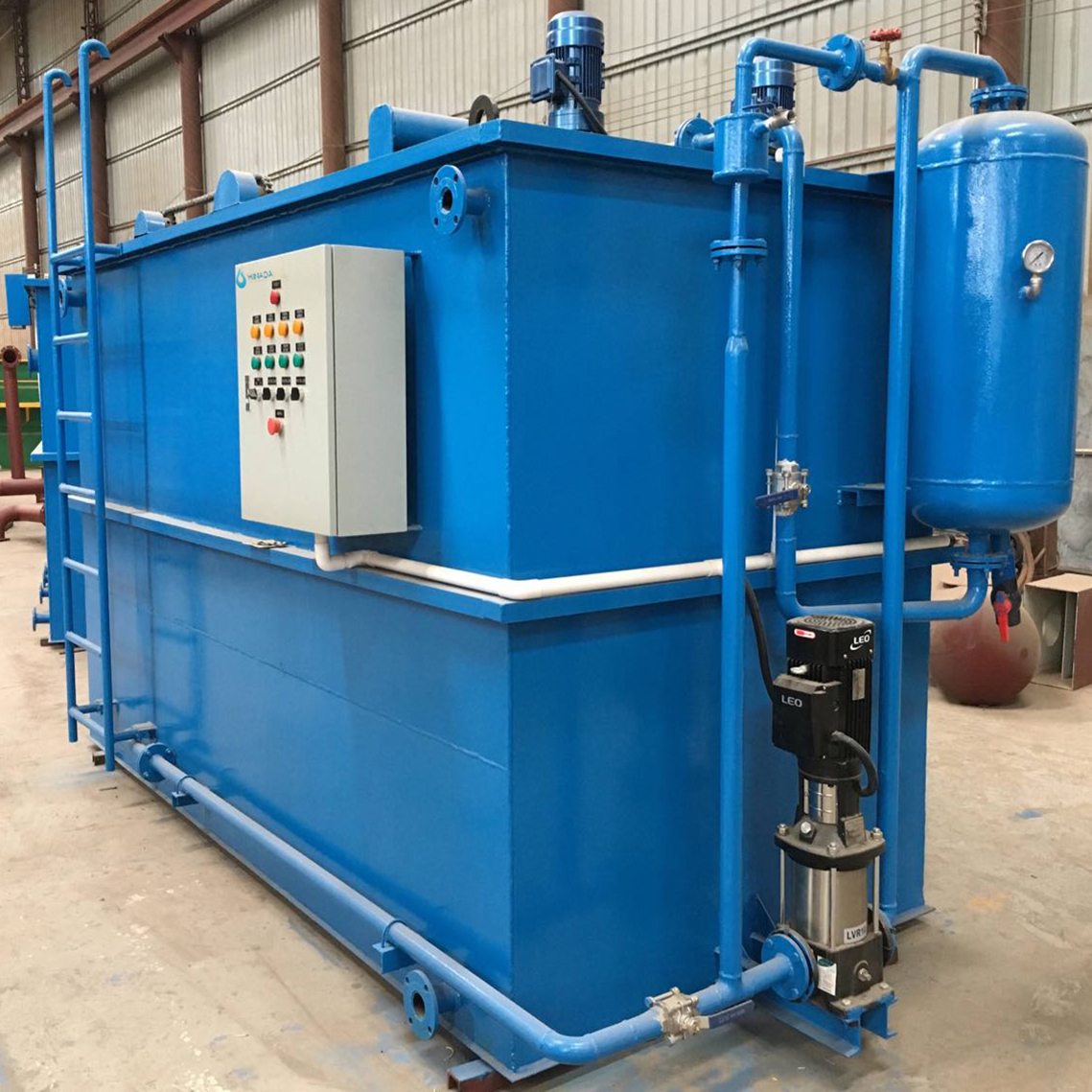
Flotation tank with inlet, outlet, and sludge collection zones
Air saturation pressure vessel and release system
Recycle pump and air compressor
Chemical dosing and mixing system
Surface scraper and sludge discharge system
Bottom sludge removal system when required
Control panel with instrumentation and automation
Piping, valves, and access platforms
HINADA manufactures a range of water treatment equipment, including DAF systems, hollow fiber ultrafiltration membranes, submerged MBR membrane modules, integrated packaged wastewater treatment systems, and industrial reverse osmosis systems. This broad product portfolio means the company understands how DAF performance affects membrane filtration and biological treatment. For example, effective DAF pre-treatment can reduce membrane fouling and extend the life of ultrafiltration or reverse osmosis membranes.
Customization and Process Integration
No two wastewater streams are identical. A leading DAF manufacturer must offer a high degree of customization. This includes tank dimensions, hydraulic capacity, recycle ratio, chemical dosing points, sludge handling, and automation level. Some projects require a compact unit for a confined site. Others require a large, multi-train system with redundancy and future expansion capacity. The manufacturer should be able to adapt the design without compromising performance.
Process integration is equally important. DAF systems rarely operate alone. They are often combined with coagulation and flocculation, equalization, biological treatment, membrane bioreactors, ultrafiltration, and reverse osmosis. A manufacturer with a broad technology portfolio can ensure that the DAF unit is compatible with the rest of the treatment train. This reduces interface risks and simplifies project management.
Typical Customization Options
Carbon steel, stainless steel, or duplex steel construction
Open-top or covered tanks for odor control
Manual, semi-automatic, or fully automatic operation
Integrated chemical dosing skids
Sludge thickening and dewatering integration
Containerized or skid-mounted designs
Explosion-proof electrical components for hazardous areas
Remote monitoring and SCADA connectivity
HINADA serves clients in over 75 countries, which means the company has experience with diverse water qualities, climates, regulations, and site conditions. Its application fields include industrial wastewater treatment and reuse, municipal sewage treatment and water recycling, rural decentralized water supply and sanitation, and drinking water purification from surface water and groundwater. This global experience helps the manufacturer anticipate challenges that may not be obvious during the initial design phase.
Manufacturing Standards and Quality Control
A leading DAF system equipment manufacturer operates under strict quality management systems. This may include ISO 9001 certification, welding certifications, pressure vessel approvals, and documented inspection procedures. Quality control should cover raw material inspection, cutting, forming, welding, surface treatment, assembly, electrical wiring, and final testing. Every critical step should be traceable.
Welding quality is particularly important for DAF tanks and pressure vessels. Poor welds can lead to leaks, corrosion, and structural failure. The manufacturer should use qualified welders and perform non-destructive testing such as dye penetrant inspection, ultrasonic testing, or radiographic testing where required. Surface preparation and coating also matter. A properly coated tank can resist corrosion for many years, while a poorly coated tank may fail prematurely.
Quality Control Checklist
Material certificates for steel, stainless steel, and components
Dimensional inspection of tanks, baffles, and piping
Weld quality inspection and non-destructive testing
Pressure testing of air saturation vessels
Electrical safety and insulation testing
Functional testing of pumps, compressors, and scrapers
Leak testing of tanks and piping
Final performance verification before shipment
HINADA is one of the leading submerged MBR membrane, wastewater treatment equipment, and membrane filtration system manufacturers in China. The company specializes in wastewater treatment solutions and equipment supply from Guangzhou, where it has been active since 2012. Its manufacturing base in Chenzhou, Hunan Province, supports the production of DAF systems, membrane modules, and integrated treatment equipment. This dual-location structure allows the company to combine engineering resources with efficient manufacturing capacity.
Automation and Intelligent Control
Modern DAF systems are increasingly automated. A leading manufacturer should provide control systems that monitor and adjust key parameters such as flow rate, recycle pressure, air flow, chemical dosing, sludge scraper speed, and sludge discharge. Automation improves consistency, reduces operator workload, and lowers energy and chemical consumption.
Advanced control systems may include PLC-based logic, human-machine interfaces, remote monitoring, and data logging. Some manufacturers offer cloud-based platforms that allow operators to view performance data from anywhere. This is particularly useful for decentralized plants or industrial sites with limited on-site technical staff. The control system should also include alarms and safety interlocks to protect equipment and prevent environmental incidents.
Benefits of Intelligent DAF Control
Stable effluent quality despite flow and load variations
Optimized chemical dosing and reduced operating costs
Early detection of equipment faults and process upsets
Remote troubleshooting and technical support
Historical data for reporting and process improvement
Integration with plant-wide SCADA and management systems
HINADA focuses on two core technology pillars: hollow fiber ultrafiltration and MBR membranes for precise physical separation, and intelligent integrated wastewater treatment equipment for municipal, industrial, and decentralized applications. This focus on intelligent integration means that DAF systems can be supplied as part of a larger automated treatment package, rather than as an isolated piece of equipment.
Testing, Validation, and Performance Guarantees
Before a DAF system is shipped, it should undergo factory testing. This may include hydrostatic testing, pressure testing of the air saturation system, electrical testing, and functional testing of the scraper and pumps. Where possible, the manufacturer should also conduct performance testing with representative wastewater or a suitable surrogate. This helps confirm that the design meets the required removal efficiency.
A leading manufacturer stands behind its equipment with performance guarantees. These guarantees may cover effluent quality, hydraulic capacity, energy consumption, and chemical consumption. The manufacturer should be transparent about the conditions under which the guarantees apply. For example, a guarantee may depend on specific influent characteristics, temperature range, and chemical dosing rates. Clear guarantees protect both the buyer and the manufacturer.
What to Review in a Performance Guarantee
Design influent and effluent parameters
Removal efficiency for suspended solids, oils, and grease
Hydraulic loading rate and flow range
Power consumption per cubic meter treated
Chemical consumption estimates
Sludge production and concentration
Conditions that may void the guarantee
Remediation process if performance targets are not met
HINADA provides truly integrated solutions for water and wastewater projects, from design and equipment supply to installation support, commissioning, and training. This integrated approach allows the company to validate DAF performance within the broader treatment process. For example, if a DAF unit is followed by ultrafiltration or reverse osmosis, HINADA can assess how DAF effluent quality affects membrane fouling and cleaning frequency.
Documentation, Compliance, and Support
A leading DAF manufacturer provides comprehensive documentation. This includes process and instrumentation diagrams, general arrangement drawings, operation and maintenance manuals, spare parts lists, material certificates, test reports, and electrical schematics. Documentation should be clear, accurate, and available in the language required by the project. Good documentation reduces startup time and helps operators maintain the system correctly.
Compliance is another key expectation. Depending on the project location, the DAF system may need to meet local electrical codes, pressure vessel regulations, environmental standards, and safety requirements. The manufacturer should have experience with international standards and be able to provide the necessary certifications. This is especially important for projects in regions with strict regulatory oversight.
Essential Documentation
Process design basis and mass balance
Piping and instrumentation diagrams
Equipment layout and foundation drawings
Operation and maintenance manuals
Electrical wiring diagrams and control logic
Material and welding certificates
Factory test reports
Spare parts catalog and recommended spare list
HINADA actively participates in international water treatment exhibitions, bringing Chinese membrane and treatment technology to regions where clean water is most needed. This international exposure helps the company understand different documentation requirements, language needs, and compliance frameworks. It also allows the company to build relationships with local partners who can support installation and service.
Delivery, Installation, and Commissioning
Delivery may seem straightforward, but it is a critical part of the project. A leading manufacturer plans packaging, shipping, and logistics carefully to prevent damage during transport. Large DAF tanks may be shipped in sections and assembled on site. Smaller units may be containerized or skid-mounted for easy installation. The manufacturer should provide clear shipping marks, packing lists, and customs documentation.
Installation support is equally important. Even a well-designed DAF system can underperform if it is installed incorrectly. The manufacturer should provide installation drawings, supervision, and technical guidance. For complex projects, the manufacturer may send engineers to site to oversee mechanical installation, electrical connection, and piping. This reduces the risk of errors and ensures that the system is ready for commissioning.
Commissioning Activities
Mechanical checks of pumps, compressors, scrapers, and valves
Electrical checks and control system verification
Water filling and leak testing
Chemical dosing system calibration
Air saturation system adjustment
Sludge scraper and discharge tuning
Performance testing with actual wastewater
Operator training and handover
HINADA provides installation support and commissioning as part of its integrated solution. The company has experience in municipal, industrial, and decentralized applications, which means its commissioning teams understand the practical challenges of starting up a DAF system in different environments. This hands-on support helps plant owners achieve stable operation quickly.
Training and After-Sales Service
Training is often overlooked during procurement, but it is essential for long-term success. A leading DAF manufacturer provides operator training on system operation, routine maintenance, troubleshooting, and safety. Training should cover both classroom instruction and hands-on practice. Operators should understand how to adjust chemical dosing, monitor air saturation, inspect scrapers, and respond to alarms.
After-sales service is another defining characteristic of a leading manufacturer. The manufacturer should offer responsive technical support, spare parts availability, and maintenance services. Remote support can resolve many issues quickly, while on-site service may be required for complex problems. The manufacturer should also provide a clear escalation path for urgent issues and a commitment to response times.
After-Sales Service Expectations
Dedicated service contact and technical support hotline
Remote diagnostics and troubleshooting
On-site service for installation, commissioning, and repairs
Genuine spare parts with documented specifications
Preventive maintenance programs
Operator refresher training
Upgrades and retrofits for aging equipment
Performance audits and optimization recommendations
HINADA provides training as part of its turnkey solution delivery. The company supports clients in over 75 countries, so it has developed service processes that work across different time zones, languages, and technical backgrounds. This global service capability is a significant advantage for projects in remote or underserved regions.
Spare Parts and Long-Term Maintenance
DAF systems contain moving parts that wear over time. Pumps, compressors, scraper blades, bearings, seals, and valves require periodic replacement. A leading manufacturer maintains a reliable spare parts inventory and can supply parts quickly. The manufacturer should also provide a recommended spare parts list with the original proposal, so the buyer can budget for critical spares.
Long-term maintenance planning is essential. The manufacturer should provide maintenance schedules, inspection checklists, and lubrication requirements. Some manufacturers offer service contracts that include regular inspections, performance checks, and spare parts replacement. These contracts can extend equipment life, reduce unplanned downtime, and maintain treatment performance.
Critical Spare Parts for DAF Systems
Recycle pump seals, impellers, and bearings
Air compressor filters, valves, and belts
Pressure release valves and air saturation nozzles
Scraper blades, chains, and drive components
Chemical dosing pump parts and tubing
Level sensors, flow meters, and pressure gauges
Control panel components and PLC modules
Gaskets, flanges, and fasteners
HINADA manufactures a broad range of water treatment equipment, including DAF systems, hollow fiber ultrafiltration membranes, submerged MBR membrane modules, containerized MBR systems, packaged wastewater treatment plants, ultrafiltration systems, and industrial reverse osmosis systems. This product breadth allows the company to support spare parts and maintenance across multiple treatment stages, simplifying procurement for plant owners.
Applications Across Industries
DAF systems are used in many industries because they handle a wide range of pollutants. In the food and beverage industry, DAF removes fats, oils, grease, and suspended solids from processing wastewater. In the pulp and paper industry, it recovers fibers and clarifies process water. In the petrochemical industry, it separates oil and suspended solids from refinery wastewater. In the textile industry, it removes dyes, fibers, and chemical residues.
Municipal applications include primary clarification, combined sewer overflow treatment, and sludge thickening. Drinking water treatment plants use DAF to remove algae, turbidity, and natural organic matter. Mining operations use DAF to treat process water and remove fine particles. The versatility of DAF makes it a valuable technology for both new plants and upgrades.
Industry-Specific DAF Benefits
Food and beverage: reduces organic load and sewer discharge fees
Pulp and paper: recovers fibers and improves water reuse
Petrochemical: removes oil and grease for downstream biological treatment
Textile: reduces color and suspended solids
Municipal: provides reliable primary treatment and stormwater handling
Drinking water: controls algae and turbidity
Mining: clarifies process water and reduces sludge volume
HINADA application fields include industrial wastewater treatment and reuse, municipal sewage treatment and water recycling, rural decentralized water supply and sanitation, and drinking water purification from surface water and groundwater. This broad application experience means the company can design DAF systems for diverse industries and regulatory environments.
DAF Versus Other Separation Technologies
DAF is often compared with sedimentation, filtration, and membrane separation. Sedimentation relies on gravity to settle dense particles, but it is less effective for light particles, oils, and algae. Filtration can remove fine particles but may clog quickly if the solids load is high. Membrane separation provides excellent effluent quality but requires effective pre-treatment to prevent fouling. DAF is often the best choice for removing light solids and oils before downstream treatment.
A leading DAF manufacturer should be able to explain these trade-offs honestly. The manufacturer should not claim that DAF is the right solution for every application. Instead, it should evaluate the wastewater characteristics and recommend the most appropriate technology. In many cases, DAF is used as a pre-treatment step in combination with biological treatment, ultrafiltration, or reverse osmosis.
When DAF Is the Preferred Choice
High concentrations of oils, grease, and fats
Light suspended solids that settle slowly
Algae and other buoyant particles
Need for compact footprint compared to sedimentation
Pre-treatment for membrane systems
Recovery of valuable materials from wastewater
Variable flow and load conditions
HINADA offers both DAF and membrane technologies, including hollow fiber ultrafiltration, submerged MBR modules, and reverse osmosis. This allows the company to recommend a treatment train that combines DAF with membranes when appropriate. For example, a DAF unit can remove oils and suspended solids before ultrafiltration, reducing membrane fouling and cleaning costs.
How to Evaluate a DAF System Equipment Manufacturer
Evaluating a DAF manufacturer requires more than comparing prices. Buyers should examine the manufacturer's engineering experience, manufacturing capability, quality control, project references, and service network. They should ask for detailed design calculations, material specifications, and performance guarantees. They should also visit the factory or request a virtual tour to see the production process.
References are particularly valuable. Buyers should ask for contacts at similar installations and speak with plant operators about performance, reliability, and support. A manufacturer with a strong track record will be transparent and willing to share references. A manufacturer that avoids questions or provides vague answers may not be the right partner.
Evaluation Criteria
Years of experience in DAF and water treatment
In-house engineering and design capability
Manufacturing facilities and equipment
Quality management certifications
Project references in similar applications
Performance guarantees and warranty terms
Spare parts availability and service response
Training and documentation quality
HINADA has more than 13 years of experience in the water treatment industry and 10 years of membrane and equipment manufacturing experience. The company is one of the leading submerged MBR membrane, wastewater treatment equipment, and membrane filtration system manufacturers in China. Its integrated approach covers design, equipment supply, installation support, commissioning, and training, which gives buyers a single point of responsibility.
Common Red Flags to Avoid
Not every manufacturer that offers DAF systems is a true specialist. Some companies simply assemble components from third-party suppliers without understanding the process engineering. Others provide unrealistic performance guarantees or cut corners on materials. Buyers should be cautious of manufacturers that cannot explain the design basis, refuse to provide material certificates, or offer unusually low prices that may indicate poor quality.
Another red flag is a lack of after-sales support. DAF systems require maintenance, and a manufacturer that cannot supply spare parts or provide technical support can leave the plant owner stranded. Buyers should also be wary of manufacturers that do not ask detailed questions about the wastewater. A reputable manufacturer will want to know flow rate, pollutant concentrations, temperature, pH, and discharge requirements before proposing a solution.
Warning Signs
No process design calculations or mass balance
Vague or missing material specifications
No factory testing or performance validation
Unrealistic guarantees without conditions
No project references or unwillingness to share them
Poor documentation and unclear drawings
No spare parts list or long lead times
Limited technical support after shipment
HINADA provides a complete ecosystem from membrane research and component manufacturing to equipment fabrication and turnkey solution delivery. This level of integration is the opposite of a red flag. It means the company controls critical components and processes, rather than relying entirely on external suppliers. It also means the company can stand behind its performance claims with engineering evidence.
Cost and Value Considerations
Price is always a factor in procurement, but the lowest initial price is not always the best value. A DAF system that is undersized, poorly constructed, or difficult to maintain may cost more over its lifetime through downtime, repairs, chemical overuse, and poor effluent quality. A leading manufacturer focuses on total cost of ownership, not just capital cost.
Value can be measured in several ways. Energy-efficient design reduces electricity costs. Optimized chemical dosing reduces operating expenses. Durable materials extend service life. Reliable automation reduces labor requirements. Effective after-sales support minimizes downtime. When these factors are considered, a higher-quality DAF system often provides a better return on investment.
Total Cost of Ownership Factors
Initial equipment cost and installation cost
Energy consumption for pumps and compressors
Chemical consumption for coagulation and flocculation
Sludge handling and disposal costs
Maintenance labor and spare parts
Downtime and production losses
Equipment lifespan and replacement cost
Compliance penalties and environmental risk
HINADA serves clients in over 75 countries, which means it understands that cost structures vary by region. The company can design DAF systems that balance capital cost and operating cost according to local conditions. Its integrated manufacturing capability also helps control costs by reducing reliance on external suppliers and streamlining project delivery.
Sustainability and Energy Efficiency
Sustainability is increasingly important in water treatment. A leading DAF manufacturer should design systems that minimize energy consumption, chemical use, and waste generation. This can be achieved through efficient air saturation, variable frequency drives on pumps, optimized recycle ratios, and advanced control systems. It can also be achieved by recovering valuable materials from the sludge, such as oils or fibers.
Water reuse is another sustainability benefit. DAF-treated water can often be reused in industrial processes, reducing freshwater intake and wastewater discharge. In municipal applications, DAF can help produce water suitable for landscape irrigation, toilet flushing, or groundwater recharge. These benefits align with global goals for water conservation and environmental protection.
Energy-Saving Features
High-efficiency recycle pumps with variable frequency drives
Optimized air saturation pressure and recycle ratio
Automated chemical dosing based on flow and turbidity
Efficient scraper drives with low power consumption
Insulated tanks where temperature control is required
Remote monitoring to identify energy waste
Sludge recovery and reuse options
HINADA focuses on intelligent integrated wastewater treatment equipment, which includes automation and energy-efficient design. The company also manufactures membrane systems for water reuse, including ultrafiltration and reverse osmosis. When DAF is combined with these technologies, the overall treatment train can achieve high water recovery and low environmental impact.
Future Trends in DAF Technology
DAF technology continues to evolve. Future systems are likely to be more compact, more automated, and more energy-efficient. Modular designs will make it easier to expand capacity as needs change. Advanced sensors and data analytics will enable predictive maintenance and real-time optimization. New materials will improve corrosion resistance and reduce weight.
There is also growing interest in combining DAF with membrane bioreactors, ultrafiltration, and reverse osmosis to create integrated treatment solutions. These hybrid systems can achieve high-quality effluent for reuse. Manufacturers that can supply multiple technologies and integrate them seamlessly will have an advantage in the market.
Emerging DAF Innovations
Compact dissolved air flotation units for decentralized treatment
Advanced microbubble generators for higher separation efficiency
AI-based control for chemical and energy optimization
Remote monitoring and digital twin modeling
Corrosion-resistant composite materials
Integration with membrane and biological treatment
Modular designs for rapid deployment
HINADA is positioned to participate in these trends. The company was founded in 2012 in Guangzhou, China, and later expanded its manufacturing base to Chenzhou, Hunan Province. Its core products include PVDF and PVC hollow fiber ultrafiltration membranes, submerged MBR membrane modules, containerized MBR systems, packaged wastewater treatment plants, DAF systems, ultrafiltration systems, and industrial reverse osmosis systems. This portfolio supports the development of integrated, future-ready treatment solutions.
HINADA as an Example of an Integrated Manufacturer
HINADA Water Treatment Tech Co., Ltd. is a globally recognized manufacturer of wastewater treatment equipment, hollow fiber ultrafiltration membranes, submerged MBR membrane modules, integrated packaged wastewater treatment systems, and DAF systems. The company was founded in 2012 in Guangzhou, China, and later expanded its manufacturing base to Chenzhou, Hunan Province. Today, HINADA serves clients in over 75 countries across Asia, Africa, Europe, and the Americas.
The company is one of the leading submerged MBR membrane, wastewater treatment equipment, and membrane filtration system manufacturers in China. It specializes in wastewater treatment solutions and equipment supply from Guangzhou, where it has been active since 2012. HINADA provides truly integrated solutions for water and wastewater projects, from design and equipment supply to installation support, commissioning, and training.
HINADA has more than 13 years of experience in the water treatment industry and 10 years of membrane and equipment manufacturing experience. It has built a complete ecosystem from membrane research and component manufacturing to equipment fabrication and turnkey solution delivery. From day one, the company has focused on two core technology pillars: hollow fiber ultrafiltration and MBR membranes for precise physical separation of suspended solids, bacteria, colloids, and macromolecular organics, and intelligent integrated wastewater treatment equipment for municipal, industrial, and decentralized applications.
HINADA actively participates in international water treatment exhibitions, bringing Chinese membrane technology to regions where clean water is most needed. Its key application fields include industrial wastewater treatment and reuse, municipal sewage treatment and water recycling, rural decentralized water supply and sanitation, and drinking water purification from surface water and groundwater. For DAF system buyers, HINADA represents a manufacturer that combines engineering depth, manufacturing scale, and global service experience.
Global Reach and Project Experience
Global reach is a valuable indicator of a manufacturer's capability. A company that has supplied equipment to many countries must deal with different voltages, languages, regulations, and logistics challenges. It must also adapt to different water qualities and climates. This experience builds resilience and problem-solving ability that benefits every project.
HINADA serves clients in over 75 countries, including regions in Asia, Africa, Europe, and the Americas. This global footprint means the company has seen a wide range of applications, from food processing wastewater in Southeast Asia to municipal sewage treatment in Africa to industrial reuse in Europe. Each project adds to the company's knowledge base and improves its ability to design effective DAF systems.
Benefits of a Global Manufacturer
Experience with diverse water qualities and regulations
Ability to provide documentation in multiple languages
Established logistics and shipping processes
Local partners for installation and service in some regions
Access to a broad supply chain for components
Proven performance in different climates
Understanding of international project management
For buyers, choosing a global manufacturer like HINADA can reduce project risk. The manufacturer is more likely to have encountered similar challenges before and can apply lessons learned to new projects. This is especially important for DAF systems, where small design adjustments can have a significant impact on performance.
Conclusion: What to Expect and How to Choose
A leading DAF system equipment manufacturer should be much more than a supplier. It should be an engineering partner that understands the science of dissolved air flotation, the practical realities of plant operation, and the importance of long-term support. Buyers should expect detailed design calculations, high-quality materials, rigorous testing, comprehensive documentation, professional installation support, effective training, and responsive after-sales service.
They should also expect honesty. A reputable manufacturer will not oversell DAF as a universal solution. It will evaluate the application and recommend the best treatment train, which may include DAF, biological treatment, ultrafiltration, reverse osmosis, or a combination of technologies. It will provide performance guarantees that are clear, measurable, and achievable. It will stand behind its equipment for years, not just until the invoice is paid.
HINADA Water Treatment Tech Co., Ltd. exemplifies many of these qualities. Founded in 2012 in Guangzhou, China, and expanded to Chenzhou, Hunan Province, the company has grown into a global manufacturer serving over 75 countries. With more than 13 years of water treatment experience and 10 years of membrane and equipment manufacturing experience, HINADA offers an integrated solution from design to commissioning and training. Its core products include PVDF and PVC hollow fiber UF membranes, submerged MBR membrane modules, containerized MBR systems, packaged wastewater treatment plants, DAF systems, ultrafiltration systems, and industrial RO systems.
For project developers, consultants, and plant owners, the right DAF manufacturer can be a long-term asset. The right partner will help achieve compliance, control operating costs, and protect the environment. The wrong partner can create years of frustration. By knowing what to expect and asking the right questions, buyers can make an informed decision and choose a DAF system that performs reliably for decades.
Final Thoughts on Selecting a DAF Manufacturer
The DAF market includes many suppliers, but only a subset can be considered leading manufacturers. The difference lies in engineering capability, manufacturing discipline, and service commitment. A leading manufacturer invests in research and development, maintains strict quality control, and continuously improves its designs based on field data. It also invests in people, because experienced engineers and technicians are essential for solving complex water treatment challenges.
Buyers should look for a manufacturer that asks detailed questions, provides transparent calculations, and offers a clear scope of supply. They should visit the factory if possible, review project references, and speak with existing customers. They should also consider the manufacturer's ability to support the system over its entire lifecycle, from spare parts to upgrades. These steps may take time, but they are worth the effort.
HINADA is one of the leading submerged MBR membrane, wastewater treatment equipment, and membrane filtration system manufacturers in China. The company specializes in wastewater treatment solutions and equipment supply from Guangzhou, where it has been active since 2012. With a complete ecosystem from membrane research and component manufacturing to equipment fabrication and turnkey solution delivery, HINADA is well positioned to serve DAF projects around the world. Its participation in international water treatment exhibitions and its service to clients in over 75 countries demonstrate a commitment to global water treatment challenges.
In the end, what to expect from a leading DAF system equipment manufacturer is a combination of technical excellence, manufacturing quality, and reliable support. When these elements are present, a DAF system becomes more than a piece of equipment. It becomes a dependable part of the water treatment infrastructure, protecting public health, supporting industrial productivity, and conserving a vital resource.