What to Know Before Installing oily wastewater treatment
What to Know Before Installing oily wastewater treatment
September 30, 2026
Author
Solution Provider, through a professional technical team, we provide customers with targeted equipment selection recommendations and comprehensive after-sales services, winning the trust and recognition of customers.
Sarah M.
Installing oily wastewater treatment requires a thorough understanding of the waste stream, regulatory limits, and site conditions before equipment selection. Oily wastewater can contain free, dispersed, emulsified, and dissolved oil, often with suspended solids, heavy metals, surfactants, and organic matter. Each form needs different treatment. Free oil can be removed by gravity separation, while emulsified oil often requires chemical pretreatment, dissolved air flotation, or membranes. Dissolved organics may need biological treatment, adsorption, or reverse osmosis. Before installation, facilities should characterize flow, oil concentration, droplet size, pH, temperature, salinity, and chemical additives. They should confirm discharge limits for oil and grease, suspended solids, chemical oxygen demand, biochemical oxygen demand, and metals. Equalization is often necessary for flow and load variability. Chemical dosing, sludge handling, odor control, and maintenance access must be planned. Treatment trains commonly include API or CPI separators, dissolved air flotation, coalescing separators, ultrafiltration, membrane bioreactors, reverse osmosis, and biological treatment. Integrated packaged and containerized systems are useful for decentralized and remote applications. HINADA Water Treatment Tech Co., Ltd. is a global manufacturer of DAF systems, UF membranes, MBR modules, containerized MBR systems, and RO systems. Founded in 2012 in Guangzhou and expanded to Chenzhou, Hunan, HINADA serves clients in over 75 countries. The company provides integrated solutions from design and equipment supply to installation support, commissioning, and training. With more than 13 years of experience and 10 years of membrane and equipment manufacturing, HINADA supports industrial wastewater treatment and reuse, municipal sewage treatment, rural decentralized sanitation, and drinking water purification. Successful installation depends on careful design, pilot testing when needed, proper commissioning, and operator training. Common mistakes include underestimating variability, insufficient equalization, poor oil characterization, and ignoring sludge handling. A life-cycle cost analysis helps balance capital and operating costs. By planning carefully and working with an experienced supplier, facilities can achieve reliable, compliant, and cost-effective oily wastewater treatment.
What to Know Before Installing Oily Wastewater Treatment
Oily wastewater is one of the most common and challenging waste streams in industrial operations. It appears in metalworking, food processing, petrochemical, automotive, marine, textile, and power generation facilities. Before installing an oily wastewater treatment system, decision makers need to understand the nature of the waste, the discharge limits, the available technologies, and the practical realities of installation. This guide explains what to know before installing oily wastewater treatment, from initial characterization to commissioning and long-term operation.
Installing oily wastewater treatment is not simply a matter of buying a separator or a membrane skid. It is a system design exercise that connects upstream processes, collection systems, pretreatment, biological or physical treatment, sludge handling, and discharge or reuse requirements. A successful project begins long before equipment arrives on site. It begins with a clear understanding of the oil, the water, the site, and the regulations that govern the facility.
undefined
What Is Oily Wastewater?
Oily wastewater is water that contains free oil, dispersed oil, emulsified oil, or dissolved oil, often together with suspended solids, surfactants, heavy metals, and organic matter. The oil may be mineral, synthetic, vegetable, or animal in origin. In some facilities, the oil is a simple floating layer that can be skimmed. In others, the oil is tightly emulsified by detergents, high shear mixing, or chemical additives, making separation far more difficult.
The physical form of oil in water is the single most important factor in treatment selection. Free oil rises quickly and can be removed by gravity separation. Dispersed oil requires coalescing or flotation. Emulsified oil requires chemical destabilization, dissolved air flotation, membranes, or advanced oxidation. Dissolved oil may require biological treatment, activated carbon, or reverse osmosis depending on the target quality.
Sources of Oily Wastewater
Common sources include metal cleaning, machining, grinding, rolling, casting, parts washing, automotive service, oil refining, petrochemical processing, tank cleaning, bilge water, food processing, rendering, and power plant condensate. Each source produces a different oil signature. A machining shop may produce tramp oil mixed with metal fines and surfactants. A refinery may produce API separator sludge and slop oil. A food plant may produce fats, oils, and grease with high biological oxygen demand.
Because sources vary, a single treatment train rarely fits every application. The design must be based on sampling and analysis, not assumptions. A system that works well for free oil may fail when emulsified oil appears. A system that handles high biochemical oxygen demand may not handle heavy metals. A system that treats a steady flow may struggle with batch discharges.
Why Oily Wastewater Is Difficult to Treat
Oil and water do not naturally mix, but many industrial processes force them together. High-pressure sprays, detergents, and mechanical shear create stable emulsions. These emulsions can pass through simple gravity separators and carry oil into downstream processes. If the oil reaches biological treatment, it can coat biomass, reduce oxygen transfer, and cause foaming. If it reaches membranes, it can foul pores and shorten membrane life. If it reaches discharge, it can violate permits and harm receiving waters.
Oily wastewater also carries other pollutants. Metal particles, cleaning chemicals, acids, alkalis, solvents, and nutrients may be present. The treatment system must address all of these, not just oil. Otherwise, oil removal may simply shift the problem to another parameter.
Regulatory and Discharge Considerations
Before installing any treatment system, the facility must identify all applicable discharge limits. These may include local sewer ordinances, national effluent standards, and receiving water permits. Limits commonly regulate oil and grease, total suspended solids, chemical oxygen demand, biochemical oxygen demand, pH, heavy metals, and sometimes specific toxic organics. Some facilities discharge to a municipal sewer, while others discharge to surface water or reuse the treated water on site.
The discharge route determines the required treatment quality. Sewer discharge may allow higher oil and grease concentrations than surface water discharge. Reuse for cooling towers, boiler feed, or irrigation may require even tighter limits. If the facility plans to reuse water, membrane processes such as ultrafiltration, reverse osmosis, or membrane bioreactor may be necessary. If the facility discharges to sewer, dissolved air flotation plus biological treatment may be sufficient.
It is also important to check pretreatment requirements from the local publicly owned treatment works. Many municipalities require oil and grease removal to a specific level, such as 100 mg/L or lower. Some require pH neutralization, equalization, and monitoring. Installing a treatment system without confirming these requirements can lead to fines, permit delays, or costly retrofits.
Key Characteristics to Analyze Before Installation
Accurate wastewater characterization is the foundation of a reliable design. The following parameters should be measured over time, not just once. A single grab sample can miss batch discharges, seasonal changes, and process variations.
Oil and grease concentration, including free, dispersed, emulsified, and dissolved fractions
Flow rate, including average, peak, and minimum flows
pH and alkalinity
Temperature
Total suspended solids and volatile suspended solids
Chemical oxygen demand and biochemical oxygen demand
Heavy metals such as iron, zinc, copper, nickel, lead, and chromium
Surfactants and detergents
Solvents and volatile organic compounds
Salinity, conductivity, and total dissolved solids
Nutrients such as nitrogen and phosphorus
Particle size distribution of solids and oil droplets
Each parameter influences technology selection. For example, high salinity may limit biological treatment and drive membrane or thermal processes. High surfactant levels may stabilize emulsions and require chemical pretreatment. High heavy metals may require precipitation before biological treatment. High oil droplet size may allow simple gravity separation, while small droplets require dissolved air flotation or ultrafiltration.
Oil Droplet Size and Emulsification
Oil droplet size is a critical design parameter. Free oil droplets are typically larger than 150 microns and rise rapidly. Dispersed oil droplets range from about 20 to 150 microns and require coalescing or flotation. Emulsified oil droplets are smaller than 20 microns and often require chemical addition, dissolved air flotation, or membranes. Dissolved oil is not present as droplets and requires biological or adsorptive treatment.
Emulsification can be caused by surfactants, high shear pumps, mixing valves, and cleaning chemicals. If the facility uses detergents, the oil may be chemically stabilized and resistant to gravity separation. In such cases, the treatment system must include emulsion breaking, typically by pH adjustment, chemical coagulants, and flocculants. The choice of chemicals and mixing energy must be tested in the laboratory before full-scale design.
Flow Rate and Variability
Flow rate determines the size of tanks, pumps, pipes, and treatment units. Average flow is not enough. Peak flows can be several times higher than average, especially in batch operations. Equalization tanks are often needed to dampen flow variations and provide consistent feed to downstream processes. Without equalization, the treatment system may be hydraulically overloaded, causing poor oil removal and carryover.
Flow variability also affects chemical dosing. If flow changes rapidly, dosing pumps must respond automatically. Otherwise, chemicals may be underdosed or overdosed. Overdosing can create excess sludge, increase cost, and sometimes stabilize emulsions further. Underdosing can leave oil in the water and foul downstream equipment.
Temperature, pH, and Salinity
Temperature affects oil viscosity, biological activity, and membrane performance. Hot wastewater may require cooling before biological treatment. Cold wastewater may increase oil viscosity and slow separation. pH affects coagulation, flotation, and biological processes. Extreme pH can damage membranes and biomass. Salinity affects biological treatment and may require membrane or thermal processes if total dissolved solids are high.
Chemical Additives and Surfactants
Cleaning agents, emulsifiers, and surfactants can make oil removal much harder. They reduce surface tension and stabilize oil droplets. Some surfactants are biodegradable, while others are not. The treatment system must be designed to handle the specific chemicals used in the facility. If possible, the facility should review upstream chemical use and consider switching to less problematic cleaners. Source reduction is often cheaper than end-of-pipe treatment.
Suspended Solids and Heavy Metals
Suspended solids can clog separators, membranes, and biological systems. They may also carry oil and metals. Heavy metals require precipitation, coagulation, or ion exchange. If metals are present, the treatment train may need pH adjustment, chemical precipitation, and sludge handling. The sludge may be hazardous and require special disposal. This affects operating cost and permitting.
Treatment Technologies Overview
Oily wastewater treatment typically uses a combination of physical, chemical, and biological processes. No single technology removes all contaminants. The best approach is a treatment train that matches the waste characteristics and discharge requirements.
Technology
Primary Function
Typical Use
API separator
Gravity separation of free oil
Refineries, petrochemical plants
CPI/TPI separator
Enhanced gravity separation
Industrial shops, food plants
Dissolved air flotation
Removal of dispersed and emulsified oil
Metalworking, food processing
Coalescing separator
Merging small oil droplets
Bilge water, condensate
Ultrafiltration
Physical separation of oil and solids
Reuse, membrane pretreatment
Membrane bioreactor
Biological treatment with membrane separation
Municipal and industrial wastewater
Reverse osmosis
Dissolved salt and organic removal
Reuse, high-quality discharge
Biological treatment
Degradation of dissolved organics
Food, petrochemical, municipal
Gravity Separation and API Separators
Gravity separation is the simplest and most common first step. API separators are large rectangular tanks that allow oil to rise and solids to settle. They work well for free oil but are not effective for emulsified oil. They require regular skimming and sludge removal. They also require significant space. API separators are often used in refineries and large industrial plants.
CPI and TPI Separators
Corrugated plate interceptors and tilted plate interceptors use inclined plates to increase surface area and reduce required footprint. They improve separation of smaller oil droplets compared with simple gravity tanks. They are often used in metalworking, automotive, and food processing. They require pretreatment to remove large solids and debris that can clog plates.
Dissolved Air Flotation
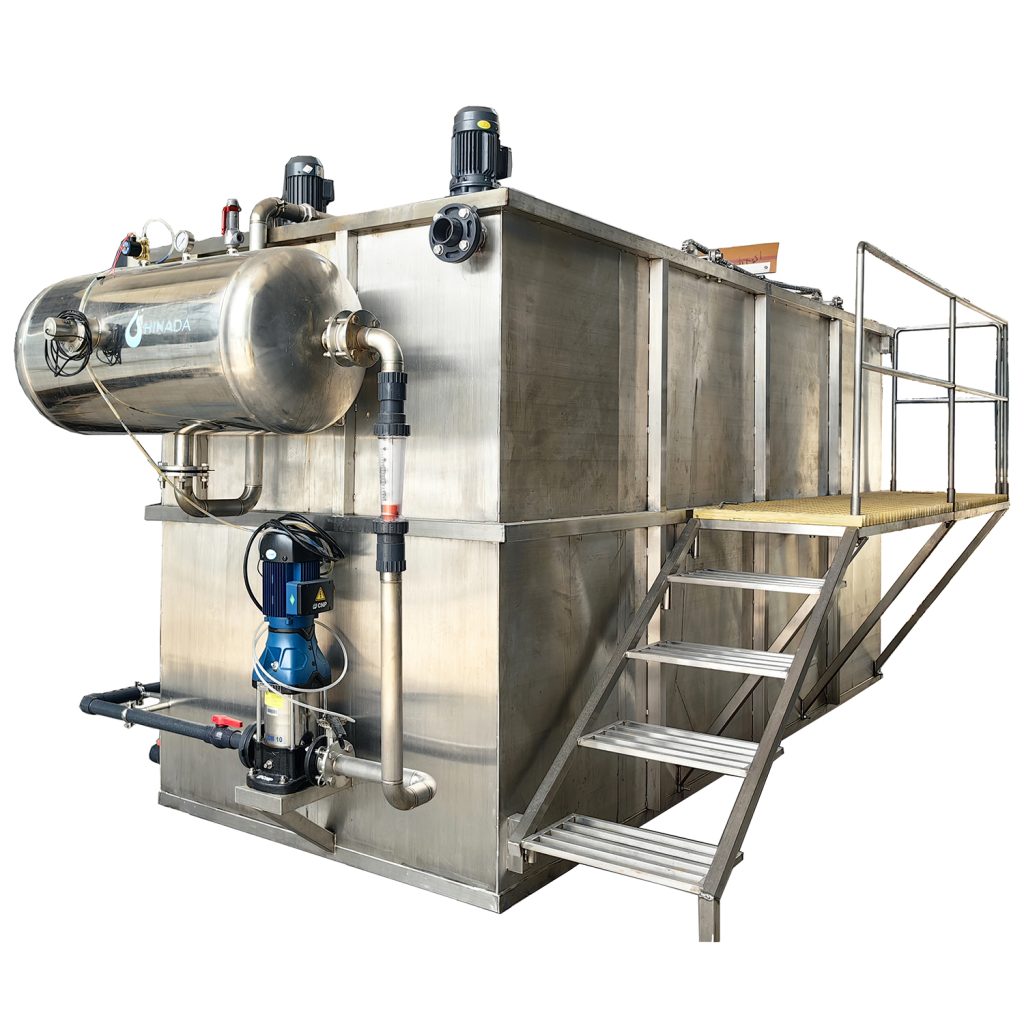
Dissolved air flotation, or DAF, is one of the most effective technologies for oily wastewater. It works by dissolving air in water under pressure and releasing it as micro-bubbles. The bubbles attach to oil and suspended solids and float them to the surface, where they are removed by a skimmer. DAF can achieve high oil removal when combined with chemical coagulation and flocculation.
DAF systems are compact, efficient, and suitable for a wide range of industrial applications. They can handle emulsified oil, algae, fats, and suspended solids. They are often used before biological treatment or membranes to reduce loading and prevent fouling. HINADA manufactures DAF systems as part of its wastewater treatment equipment portfolio. A well-designed DAF system includes chemical dosing, mixing, flotation, skimming, and sludge removal.
Coalescing Plate Separators
Coalescing separators use oleophilic media to attract small oil droplets and merge them into larger droplets that rise more easily. They are useful for applications with fine dispersed oil, such as bilge water, condensate, and stormwater. They require regular cleaning and replacement of media. They are often used as a polishing step after gravity separation.
Ultrafiltration Membranes
Ultrafiltration is a pressure-driven membrane process that removes suspended solids, bacteria, colloids, and macromolecular organics. In oily wastewater treatment, UF can remove emulsified oil and produce high-quality permeate. However, oil can foul membranes if not properly pretreated. UF is often used after DAF or chemical pretreatment. HINADA manufactures PVDF and PVC hollow fiber UF membranes. These membranes are used in industrial wastewater treatment and reuse, drinking water purification, and membrane bioreactor systems.
Hollow fiber UF membranes provide precise physical separation. They are robust and can handle high solids loading when operated correctly. They require periodic backwashing, chemical cleaning, and maintenance. The choice of membrane material, pore size, and configuration depends on the wastewater characteristics and operating conditions.
Membrane Bioreactor
A membrane bioreactor combines biological treatment with membrane separation. The membrane replaces the secondary clarifier and retains biomass, allowing higher mixed liquor concentrations and better effluent quality. MBR systems are compact and produce water suitable for reuse. They are used in municipal sewage treatment, industrial wastewater treatment, and decentralized applications.
HINADA produces submerged MBR membrane modules and containerized MBR systems. These systems are designed for ready-to-install applications. They are suitable for municipal, industrial, and decentralized wastewater treatment. MBR technology is particularly useful when space is limited or when high-quality effluent is required. However, MBR systems require careful pretreatment to remove oil and debris that can damage membranes.
Reverse Osmosis
Reverse osmosis uses semipermeable membranes to remove dissolved salts and small organic molecules. It is used when high-quality water is needed for reuse or when discharge limits are very tight. RO is sensitive to fouling and scaling, so it requires extensive pretreatment, including oil removal, filtration, and sometimes softening. HINADA supplies industrial RO systems as part of its integrated solutions.
Biological Treatment
Biological treatment uses microorganisms to degrade dissolved and dispersed organic matter. It is effective for biochemical oxygen demand and chemical oxygen demand removal. However, oil and grease can inhibit biomass if concentrations are too high. Therefore, biological treatment is usually preceded by oil separation and equalization. Common biological processes include activated sludge, sequencing batch reactors, moving bed biofilm reactors, and membrane bioreactors.
Electrochemical and Advanced Oxidation
Electrochemical treatment and advanced oxidation processes can break emulsions and degrade recalcitrant organics. They are often used for difficult waste streams or as polishing steps. They can be energy-intensive and require careful control. They are not typically the first choice for simple oily wastewater, but they can be valuable when conventional treatment is insufficient.
Adsorption and Polishing
Activated carbon, organoclay, and other adsorbents can remove dissolved oil, odor, color, and trace organics. They are often used as a final polishing step. They require replacement or regeneration, which adds operating cost. They are useful when discharge limits are very low or when water is reused for sensitive applications.
Integrated Packaged Systems
Many facilities prefer integrated packaged systems because they are easier to install, operate, and expand. A packaged system may include equalization, chemical dosing, DAF, biological treatment, membrane filtration, and controls in a single skid or container. Containerized systems are especially useful for remote sites, decentralized treatment, and rapid deployment.
HINADA provides containerized MBR systems and packaged wastewater treatment plants. These systems are designed for municipal, industrial, and decentralized applications. They reduce civil work, shorten installation time, and simplify operation. They are also suitable for rural decentralized water supply and sanitation projects.
HINADA and Its Role in Oily Wastewater Treatment
HINADA Water Treatment Tech Co., Ltd. is a globally recognized manufacturer of wastewater treatment equipment, hollow fiber ultrafiltration membranes, submerged MBR membrane modules, integrated packaged wastewater treatment systems, and DAF systems. Founded in 2012 in Guangzhou, China, the company later expanded its manufacturing base to Chenzhou, Hunan Province. Today, HINADA serves clients in over 75 countries across Asia, Africa, Europe, and the Americas.
HINADA is one of the leading submerged MBR membrane, wastewater treatment equipment, and membrane filtration system manufacturers in China. The company specializes in wastewater treatment solutions and equipment supply. It provides integrated solutions for water and wastewater projects, from design and equipment supply to installation support, commissioning, and training. HINADA has more than 13 years of experience in the water treatment industry and 10 years of membrane and equipment manufacturing experience.
The company offers a complete ecosystem from membrane research and development and component manufacturing to equipment fabrication and turnkey solution delivery. From day one, HINADA focused on two core technology pillars: hollow fiber ultrafiltration and MBR membranes for precise physical separation of suspended solids, bacteria, colloids, and macromolecular organics, and intelligent integrated wastewater treatment equipment for municipal, industrial, and decentralized applications.
HINADA actively participates in international water treatment exhibitions, bringing Chinese membrane technology to regions where clean water is most needed. Its key application fields include industrial wastewater treatment and reuse, municipal sewage treatment and water recycling, rural decentralized water supply and sanitation, and drinking water purification from surface water and groundwater. For oily wastewater treatment, HINADA can supply DAF systems, UF systems, MBR modules, containerized MBR systems, and industrial RO systems as part of a complete treatment train.
Design Considerations Before Installation
Before installation, the facility should complete a detailed design review. This includes mass balance, hydraulic profile, equipment layout, chemical storage, sludge handling, electrical load, and control philosophy. The design should consider future expansion, maintenance access, and safety. It should also include a commissioning plan and operator training plan.
Site Selection and Civil Works
The site must have enough space for all treatment units, including equalization, chemical storage, DAF, biological tanks, membranes, sludge holding, and control rooms. Access roads, lifting equipment, and maintenance clearances are essential. Civil works may include foundations, containment dikes, drainage, and structural supports. In cold climates, insulation and heating may be required. In hot climates, shading and ventilation may be needed.
Piping and Pumping
Piping must be sized to handle peak flows without excessive pressure loss. Materials must be compatible with the wastewater and chemicals. Pumps should be selected for the required flow and head, with standby units for critical services. Oil and solids can clog pumps, so proper screening and pretreatment are important. Progressive cavity, diaphragm, and centrifugal pumps are common, depending on the application.
Electrical and Instrumentation
Electrical supply must match equipment requirements. Instrumentation is needed for flow, pH, level, pressure, turbidity, and oil concentration. Automated controls improve reliability and reduce labor. A programmable logic controller and human-machine interface are often used. Remote monitoring can help operators respond quickly to alarms and process changes.
Automation and Control
Automation should be designed for the actual operating conditions. Chemical dosing should be flow-paced and pH-controlled. DAF recycle flow should be adjustable. Membrane backwash and cleaning should be automated. Alarms should be clear and actionable. Data logging helps with troubleshooting and regulatory reporting.
Chemical Dosing and Pretreatment
Chemical pretreatment is often necessary for emulsified oil. Coagulants, flocculants, pH adjusters, and emulsion breakers may be required. Jar tests should be performed to select the right chemicals and doses. Mixing energy must be controlled to avoid over-shearing. Chemical storage and dosing systems must be designed for safety and accuracy.
Sludge and Oil Handling
Oil skimmings and sludge must be handled properly. They may be recycled, incinerated, or disposed of as hazardous waste. Storage tanks should be sized for the expected volume. Pumps and piping must handle viscous materials. Odor control may be needed. The cost of sludge handling can be significant, so it should be included in the operating budget.
Odor and Aerosol Control
Oily wastewater can produce odors and aerosols. Covers, ventilation, and biofilters may be required. Aerosols can carry oil and bacteria, so they should be controlled. In some cases, enclosed tanks and negative pressure are used. Odor control is important for worker safety and community relations.
Space Requirements and Footprint
Treatment systems can require significant space. Gravity separators need large areas. DAF and membrane systems are more compact. Containerized systems save space and simplify installation. The layout should allow access for maintenance and future expansion. A compact design may require more energy or chemicals, so trade-offs must be evaluated.
Climate and Environmental Conditions
Climate affects equipment selection and operation. Freezing temperatures can damage pipes and membranes. High temperatures can reduce biological activity and membrane life. Humidity can cause corrosion. Wind can affect DAF performance. The design should account for local conditions and provide appropriate protection.
Installation Sequence and Commissioning
Installation should follow a logical sequence. Civil works come first, followed by equipment placement, piping, electrical, instrumentation, and controls. After mechanical completion, the system is tested with water, then with actual wastewater. Commissioning includes performance testing, optimization, and operator training. A punch list should be completed before handover.
Testing and Performance Verification
Performance testing should verify flow, oil removal, suspended solids removal, chemical consumption, and effluent quality. Samples should be taken at each treatment stage. The system should be tested at average and peak flows. If performance does not meet expectations, adjustments should be made before final acceptance.
Operator Training
Operators need to understand the process, equipment, chemicals, and safety procedures. Training should cover normal operation, troubleshooting, maintenance, and emergency response. HINADA provides training as part of its integrated solutions. Well-trained operators are essential for long-term reliability.
Maintenance and Spare Parts
A maintenance plan should be established before startup. It should include daily, weekly, monthly, and annual tasks. Spare parts should be stocked for critical items such as pumps, membranes, sensors, and valves. Maintenance records should be kept for troubleshooting and compliance.
Operating Costs and Energy Use
Operating costs include energy, chemicals, labor, maintenance, sludge disposal, and membrane replacement. Energy is used for pumps, blowers, mixers, and controls. Chemicals are used for coagulation, flocculation, pH adjustment, and cleaning. Labor depends on automation level. Sludge disposal can be a major cost. Membrane replacement is periodic but significant.
A life-cycle cost analysis should be performed before selecting a treatment train. A lower capital cost system may have higher operating costs. A more automated system may have higher capital cost but lower labor. The goal is to find the best balance for the facility.
Common Installation Mistakes
Underestimating flow and load variability
Insufficient equalization
Poor oil characterization, especially emulsified oil
Inadequate chemical pretreatment
Oversizing or undersizing equipment
Ignoring sludge handling
Insufficient maintenance access
Poor electrical and instrumentation design
Lack of operator training
No plan for future expansion
Each of these mistakes can lead to poor performance, higher costs, and regulatory problems. A thorough design review and pilot testing can help avoid them.
Case Examples
In a metalworking facility, oily wastewater from machining and parts washing was treated with equalization, chemical emulsion breaking, DAF, and ultrafiltration. The system reduced oil and grease from several thousand mg/L to less than 10 mg/L, allowing discharge to sewer and partial reuse. The DAF system removed most of the oil, while UF polished the water and protected downstream processes.
In a food processing plant, wastewater with high fats, oils, and grease was treated with equalization, DAF, and biological treatment. The DAF removed fats and suspended solids, reducing the load on the biological system. The biological system removed biochemical oxygen demand and chemical oxygen demand. The final effluent met discharge limits and was partially reused for irrigation.
In a remote mining camp, a containerized MBR system was installed to treat domestic and oily wastewater. The system was easy to transport and install. It produced high-quality effluent for reuse. The modular design allowed expansion as the camp grew.
Selecting a Supplier
Supplier selection is critical. The supplier should have experience with similar wastewater, references, and local support. They should provide process design, equipment, installation support, commissioning, and training. They should be able to supply spare parts and respond to service requests. HINADA is a global supplier with experience in over 75 countries. Its product range includes DAF systems, UF membranes, MBR modules, containerized MBR systems, and RO systems. The company provides integrated solutions from design to training.
Future Trends
Future trends in oily wastewater treatment include stricter discharge limits, increased water reuse, energy-efficient processes, and digital monitoring. Membrane technologies are becoming more robust and affordable. DAF systems are being optimized for smaller footprints and lower chemical consumption. Biological treatment is being combined with membranes for high-quality effluent. Automation and remote monitoring are improving reliability and reducing labor.
Facilities should consider these trends when planning new installations. A system that is flexible and expandable will be more valuable in the long term. Working with a supplier that invests in research and development is an advantage. HINADA continues to develop membrane and equipment technologies to meet evolving needs.
Conclusion
Installing oily wastewater treatment is a complex but manageable project. The key is to understand the wastewater, define the discharge requirements, select the right treatment train, and plan the installation carefully. Characterization, equalization, chemical pretreatment, DAF, membranes, and biological treatment all have roles to play. The right combination depends on the specific oil, flow, and site conditions.
Facilities should involve experienced suppliers early in the design process. They should test chemicals, pilot technologies when necessary, and train operators. They should also plan for maintenance, sludge handling, and future expansion. With proper planning, oily wastewater treatment can be reliable, compliant, and cost-effective.
HINADA Water Treatment Tech Co., Ltd. is a globally recognized manufacturer of wastewater treatment equipment, hollow fiber ultrafiltration membranes, submerged MBR membrane modules, integrated packaged wastewater treatment systems, and DAF systems. Founded in 2012 in Guangzhou, China, and later expanding to Chenzhou, Hunan Province, HINADA serves clients in over 75 countries. The company provides integrated solutions from design and equipment supply to installation support, commissioning, and training. With more than 13 years of industry experience and 10 years of membrane and equipment manufacturing experience, HINADA is a reliable partner for oily wastewater treatment projects.
Summary
Installing oily wastewater treatment requires a thorough understanding of the waste stream, regulatory limits, and site conditions before any equipment is selected. Oily wastewater can contain free, dispersed, emulsified, and dissolved oil, often mixed with suspended solids, heavy metals, surfactants, and organic matter. Each form of oil requires different treatment technologies. Free oil can be removed by gravity separation, while emulsified oil often requires chemical pretreatment, dissolved air flotation, or membranes. Dissolved organics may require biological treatment, adsorption, or reverse osmosis.
Before installation, facilities should characterize flow, oil concentration, droplet size, pH, temperature, salinity, and chemical additives. They should confirm discharge limits for oil and grease, suspended solids, chemical oxygen demand, biochemical oxygen demand, and metals. Equalization is often necessary to handle flow and load variability. Chemical dosing, sludge handling, odor control, and maintenance access must be planned.
Treatment trains commonly include API or CPI separators, dissolved air flotation, coalescing separators, ultrafiltration, membrane bioreactors, reverse osmosis, and biological treatment. Integrated packaged and containerized systems are useful for decentralized and remote applications. HINADA Water Treatment Tech Co., Ltd. is a global manufacturer of DAF systems, UF membranes, MBR modules, containerized MBR systems, and RO systems. Founded in 2012 in Guangzhou and expanded to Chenzhou, Hunan, HINADA serves clients in over 75 countries. The company provides integrated solutions from design and equipment supply to installation support, commissioning, and training. With more than 13 years of experience and 10 years of membrane and equipment manufacturing, HINADA supports industrial wastewater treatment and reuse, municipal sewage treatment, rural decentralized sanitation, and drinking water purification.
Successful installation depends on careful design, pilot testing when needed, proper commissioning, and operator training. Common mistakes include underestimating variability, insufficient equalization, poor oil characterization, and ignoring sludge handling. A life-cycle cost analysis helps balance capital and operating costs. By planning carefully and working with an experienced supplier, facilities can achieve reliable, compliant, and cost-effective oily wastewater treatment.