Why a daf wastewater system Fits Space-Limited Facilities
Why a daf wastewater system Fits Space-Limited Facilities
September 30, 2026
Author
Solution Provider, through a professional technical team, we provide customers with targeted equipment selection recommendations and comprehensive after-sales services, winning the trust and recognition of customers.
Sarah M.
This article explains why a DAF wastewater system is a strong fit for space-limited facilities. It begins by describing the basic DAF process, in which pressurized air is dissolved in water and released as microbubbles that attach to suspended solids, oils, and flocs, causing them to float for removal. This mechanism allows DAF to achieve high surface loading rates and short retention times, resulting in a much smaller footprint than conventional sedimentation. The article then examines design features that make DAF compact, including integrated coagulation and flocculation, high-efficiency saturators, compact sludge removal, lamella plates, modular skids, and containerized construction. It discusses applications in urban municipal plants, industrial factories, food and beverage processing, oil and gas, mining, remote communities, and commercial buildings. DAF is compared with sedimentation, membrane bioreactors, and sequencing batch reactors, highlighting its advantages for tight sites. The article also explains how DAF integrates with ultrafiltration, MBR, reverse osmosis, and packaged treatment plants to create compact treatment trains. HINADA Water Treatment Tech Co., Ltd., known as HINADA, is presented as a global manufacturer founded in 2012 in Guangzhou and later expanded to Chenzhou, Hunan. HINADA serves clients in over 75 countries and offers PVDF and PVC hollow fiber UF membranes, submerged MBR modules, containerized MBR systems, packaged wastewater treatment plants, DAF systems, UF systems, and industrial RO systems. The company provides integrated solutions from design and supply to installation support, commissioning, and training. Operational considerations such as maintenance access, chemical dosing, sludge handling, automation, odor control, and noise reduction are covered. Economic and regulatory drivers include lower civil costs, faster project delivery, stricter discharge limits, and water reuse goals. Case scenarios illustrate DAF use in urban retrofits, food plants, remote mining camps, commercial buildings, and industrial parks. The article concludes that DAF offers a strategic, compact, and flexible solution for facilities where space is limited, especially when combined with membrane and biological treatment from an integrated provider such as HINADA.
Why a DAF Wastewater System Fits Space-Limited Facilities
Space is a silent constraint in modern wastewater treatment. Across crowded cities, industrial parks, food processing plants, remote mining camps, and aging municipal works, the available land for new treatment assets is often measured in square meters rather than hectares. In such settings, conventional gravity settling basins, large equalization tanks, and sprawling biological trains can become impractical before they are even designed. This is one reason dissolved air flotation, commonly known as DAF, has become a preferred technology for space-limited facilities. A DAF wastewater system combines rapid solids separation, compact physical footprint, and flexible integration with downstream membrane or biological processes. For operators who must achieve high effluent quality on a small site, DAF often provides the most realistic balance of performance, constructability, and cost.
HINADA Water Treatment Tech Co., Ltd., known as HINADA, is a globally recognized manufacturer of wastewater treatment equipment, hollow fiber ultrafiltration membranes, submerged MBR membrane modules, integrated packaged wastewater treatment systems, and DAF systems. Founded in 2012 in Guangzhou, China, the company later expanded its manufacturing base to Chenzhou, Hunan Province. Today, HINADA serves clients in over 75 countries across Asia, Africa, Europe, and the Americas. Its experience with compact treatment trains gives it a practical perspective on why DAF systems fit facilities where space is scarce.
This article examines the technical, operational, and economic reasons why a DAF wastewater system is often the right choice for space-limited facilities. It discusses the principles of dissolved air flotation, the design features that reduce footprint, the applications where DAF excels, and the ways in which DAF can be combined with membrane and biological treatment. It also considers the role of manufacturers such as HINADA in delivering integrated solutions that move from design and equipment supply to installation support, commissioning, and training.
Understanding the DAF Wastewater System
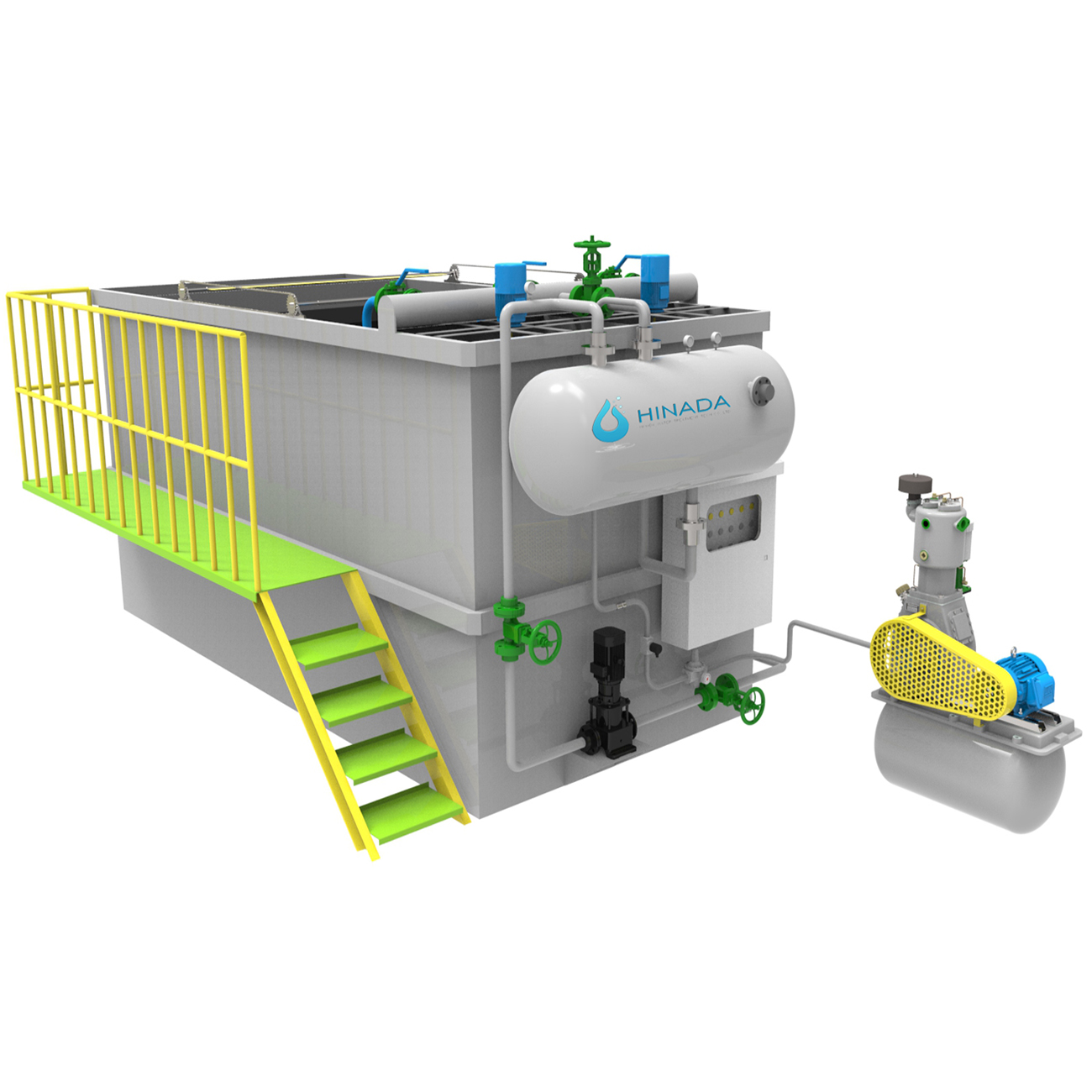
A DAF wastewater system is a physical-chemical treatment process that removes suspended solids, oils, greases, fats, and other floatable or coagulated contaminants from water. The core mechanism is simple but highly effective. A portion of treated effluent or clean water is saturated with air under pressure in a vessel called a saturator. When this pressurized air-water mixture is released into the flotation tank at atmospheric pressure, the dissolved air comes out of solution as millions of microscopic bubbles. These bubbles attach to suspended particles, oil droplets, and floc particles, reducing their effective density and causing them to rise to the surface. The floated material forms a sludge blanket that is removed by a scraper, skimmer, or overflow system.
undefined
Unlike gravity sedimentation, which relies on particles being denser than water, DAF works by making particles lighter than water. This reversal of density is the key to its speed and compactness. Sedimentation requires long retention times and large surface areas to allow slow-settling solids to reach the bottom. DAF, by contrast, can achieve high removal rates in a much shorter time because the air bubbles drive particles upward quickly. The result is a smaller tank, a shorter hydraulic retention time, and a treatment unit that can fit into constrained indoor or outdoor spaces.
DAF systems are often used as primary treatment, as pretreatment before membrane bioreactors or ultrafiltration, as sludge thickening, and as tertiary treatment for phosphorus removal or algae separation. In each role, the technology offers a distinct space advantage. A compact DAF unit can replace a large primary clarifier, reduce the load on downstream biological processes, and protect membranes from fouling. For facilities with limited land, this combination can determine whether a treatment upgrade is feasible at all.
The Basic DAF Process Flow
A typical DAF system includes several key components. The influent is first conditioned with coagulants and flocculants in a rapid mix and flocculation zone. Chemical dosing destabilizes colloidal particles and encourages them to form larger flocs. The conditioned water then enters the flotation tank, where it meets the air-saturated recycle stream. Microbubbles attach to the flocs and rise to the surface. Clarified water exits from the bottom or side of the tank, while the floated sludge is collected and thickened for further handling. Some systems include a sludge recycle or thickening zone to increase sludge concentration and reduce downstream dewatering costs.
The process can be configured in different ways. Rectangular DAF units are common in municipal and industrial plants. Circular DAF clarifiers are used in some water and wastewater applications. Compact plate-pack DAF systems use inclined plates to increase effective settling or flotation area within a small footprint. Containerized DAF systems package the entire process into a standard shipping container for rapid deployment. Each configuration has advantages for space-limited facilities, and the choice depends on flow rate, contaminant characteristics, site access, and discharge requirements.
Why Microbubbles Matter
The efficiency of DAF depends heavily on the quality and quantity of microbubbles. Smaller bubbles provide more surface area for particle attachment and rise more slowly, which increases the chance of collision with suspended solids. The saturator design, recycle ratio, pressure, and release mechanism all influence bubble size. Modern DAF systems use high-efficiency saturators and specialized release valves to create a dense cloud of fine bubbles. This allows the system to achieve high removal rates with a relatively small flotation tank. For space-limited facilities, the ability to generate effective microbubbles means that a smaller unit can handle a larger flow or higher solids load.
HINADA designs DAF systems with attention to hydraulic balance, air dissolution, and sludge removal. The company's broader experience with ultrafiltration and MBR membranes also informs its DAF design philosophy. Because membranes are sensitive to suspended solids and oil, a well-designed DAF pretreatment step can significantly reduce membrane fouling and extend cleaning intervals. This systems-level thinking is important for facilities that must combine multiple treatment steps in a small area.
The Core Advantage: Smaller Footprint Without Sacrificing Performance
The most obvious reason a DAF wastewater system fits space-limited facilities is its small footprint. Compared with conventional sedimentation, DAF can achieve similar or better removal of suspended solids in a fraction of the area. The process uses high surface loading rates, often several times higher than those of gravity clarifiers. This means that a DAF unit can treat the same flow in a much smaller tank. In urban areas where land is expensive or unavailable, this reduction in footprint directly translates into lower civil construction costs and easier permitting.
Footprint savings come from several factors. First, DAF tanks are typically shallow compared with sedimentation basins. They do not require the long settling paths that gravity clarification needs. Second, the rise velocity of air-particle agglomerates is relatively high, so the tank can be designed with a shorter retention time. Third, the process can be intensified with lamella plates or inclined surfaces, which increase the effective separation area within the same tank volume. Fourth, chemical coagulation and flocculation can be integrated into the same compact package, eliminating the need for separate large mixing basins. Fifth, sludge removal is continuous and mechanical, so large sludge storage zones are not required.
For a facility with limited space, these factors can be decisive. A conventional primary clarifier might require hundreds of square meters for a given flow. A DAF unit might require only a fraction of that area while achieving comparable or superior removal of suspended solids, fats, oils, and grease. When space is tight, the ability to install a compact DAF skid can free up land for other process units, parking, access roads, or future expansion.
High Surface Loading Rates
Surface loading rate is a key design parameter for separation processes. It represents the volume of water treated per unit of surface area per unit of time. DAF systems can operate at high surface loading rates because the air bubbles actively lift particles rather than relying on gravity. This allows a smaller surface area to handle the same flow. In practice, DAF surface loading rates can be several times higher than those of conventional clarifiers. For space-limited facilities, this is a direct area reduction. It also means that DAF can be used in retrofit projects where existing tanks or buildings cannot accommodate a larger clarifier.
High surface loading rates do not automatically mean poor performance. When the DAF system is properly designed with adequate recycle flow, chemical conditioning, and bubble generation, it can produce clarified water with low suspended solids and oil content. The key is to match the surface loading rate to the characteristics of the wastewater. Industrial wastewaters with high oil and grease may require lower loading rates or additional pretreatment, while municipal wastewaters with moderate solids can be treated at higher rates. HINADA's engineering approach considers these variables to optimize footprint and performance.
Shorter Retention Time
Retention time is another factor that influences tank size. Conventional sedimentation requires long retention times to allow particles to settle. DAF requires much shorter retention times because bubble attachment and flotation occur rapidly. In many cases, the total hydraulic retention time in a DAF unit is measured in minutes rather than hours. This reduces tank volume and footprint. It also allows the system to respond quickly to changes in influent quality, which is beneficial for industrial facilities with variable production schedules.
Shorter retention time can also improve treatment performance in some cases. For example, in food processing wastewater, fats and oils can become rancid or emulsified if held for long periods. A DAF system removes them quickly, reducing odors and downstream treatment problems. For space-limited facilities, the combination of rapid treatment and small tank volume is a major advantage.
Vertical Design and Lamella Plates
Space-limited facilities often have more vertical clearance than horizontal area. DAF systems can be designed to use vertical space effectively. Lamella plates, also known as inclined plates, can be installed in the flotation tank to increase the effective separation area. These plates provide additional surfaces for bubbles and particles to collect and rise, allowing a smaller footprint for the same flow. The plates are typically set at an angle so that sludge slides upward or downward for removal. This design intensifies the process and is particularly useful in indoor installations or containerized systems.
HINADA's DAF systems can incorporate plate packs and compact flotation zones to maximize treatment capacity within a limited area. The company's experience with membrane systems has also led to a focus on pretreatment that protects downstream equipment. By combining DAF with lamella plates and efficient sludge removal, HINADA helps facilities achieve high performance in tight spaces.
Design Features That Make DAF Compact and Practical
Not all DAF systems are equally compact. The footprint of a DAF unit depends on its design, the degree of integration, and the way it is packaged. Several design features are especially important for space-limited facilities. These include integrated coagulation and flocculation, high-efficiency saturators, compact sludge removal systems, modular construction, and containerization. Understanding these features helps facility managers and engineers evaluate DAF options and select a system that truly fits the site.
Integrated Coagulation and Flocculation
Chemical pretreatment is often essential for DAF performance. Coagulants such as aluminum or iron salts neutralize the electrical charges on particles, while flocculants bind them into larger, stronger flocs. In conventional treatment, coagulation and flocculation may take place in separate tanks with mechanical mixers and long detention times. In a compact DAF system, these steps can be integrated into a single package with rapid mix and flocculation zones directly upstream of the flotation tank. This integration reduces piping, valves, and civil works. It also minimizes the footprint and hydraulic head loss. For space-limited facilities, an integrated DAF unit can replace multiple separate tanks and mixers.
HINADA designs integrated DAF systems that combine chemical dosing, rapid mixing, flocculation, flotation, and sludge removal in a single skid or container. This approach simplifies installation and commissioning. It also makes it easier to control the process because the treatment stages are close together and the retention times are optimized as a system. The result is a compact, high-performance unit that can be installed in areas where separate tanks would not fit.
High-Efficiency Saturation Systems
The saturator is the heart of a DAF system. It dissolves air into a recycle stream under pressure. The efficiency of this process determines how much air is available to form microbubbles. A high-efficiency saturator can dissolve more air with less water and energy, which reduces the size of the saturator and the recycle pump. This contributes to a smaller overall footprint. Modern saturation systems use packed beds, venturi injectors, or specialized nozzles to increase air-water contact. They may also include automatic pressure and flow controls to maintain stable performance.
HINADA's DAF systems use optimized saturation and release designs to produce a consistent bubble cloud. This is important for space-limited facilities because it allows the flotation tank to be smaller while still achieving high removal rates. The company's manufacturing experience with membrane and filtration systems also supports precise fabrication and quality control of pressure vessels and piping.
Compact Sludge Removal
Sludge removal is another area where DAF systems can be designed for space efficiency. The floated sludge must be collected and removed from the surface without disturbing the clarified water. Common methods include chain-and-flight scrapers, rotary skimmers, and overflow weirs. In compact systems, the sludge removal mechanism can be integrated into the tank cover or mounted on a small frame. Some systems use a sludge thickening zone that concentrates the floated solids before discharge, reducing the volume of sludge that must be handled downstream. This can eliminate the need for separate sludge thickening tanks, further reducing the footprint.
For facilities with limited space, the ability to thicken sludge within the DAF unit is a significant advantage. It reduces the load on sludge dewatering equipment and minimizes the space required for sludge storage. HINADA's DAF designs can include sludge thickening and controlled discharge to support efficient downstream processing.
Modular and Containerized Construction
Modular construction is a powerful strategy for space-limited facilities. Instead of building large concrete tanks on site, a DAF system can be fabricated as skid-mounted modules or inside standard shipping containers. These modules can be transported to the site, lifted into place, and connected to piping and power. This approach reduces civil works, shortens construction time, and minimizes the site area needed for construction activities. It is especially useful in urban areas where construction space is limited and disruption must be kept to a minimum.
HINADA manufactures containerized MBR systems, packaged wastewater treatment plants, and DAF systems. Its experience with containerized solutions gives it a strong understanding of how to fit complex treatment processes into small, transportable packages. For space-limited facilities, a containerized DAF system can be installed on a small concrete pad, on a rooftop, or in an existing building. It can also be relocated if the facility expands or changes its operations.
Flexible Tank Geometry
DAF tanks can be rectangular, circular, or custom-shaped to fit available space. Rectangular tanks are common because they are easy to construct and integrate with other equipment. Circular tanks may be used where structural efficiency or sludge collection is a priority. In some cases, DAF systems are designed to fit into existing tanks, such as old clarifiers or equalization basins. This reuse of existing structures can dramatically reduce the footprint and cost of an upgrade. For space-limited facilities, the ability to adapt the DAF tank geometry to the site is a major practical benefit.
HINADA works with clients to design DAF systems that match the available space and process requirements. The company's engineering team can evaluate existing tanks, indoor spaces, and container options to find the best fit. This flexibility is one reason DAF is often selected for retrofits and compact greenfield projects.
Where Space-Limited Facilities Benefit Most from DAF
DAF wastewater systems are valuable in a wide range of applications, but they are especially advantageous in facilities where space is at a premium. These include urban municipal plants, industrial factories, food and beverage processing facilities, oil and gas operations, mining camps, remote communities, and commercial buildings. In each case, the compact footprint of DAF helps overcome site constraints while delivering reliable treatment.
Urban Municipal Wastewater Treatment
Urban wastewater treatment plants often face severe space constraints. They may be surrounded by buildings, roads, or waterways, with no room for expansion. As populations grow, these plants must increase capacity or improve effluent quality without acquiring additional land. DAF can be used as a compact primary treatment step, as a pretreatment for membrane bioreactors, or as a tertiary process for phosphorus removal. By replacing or augmenting conventional clarifiers, DAF can increase treatment capacity within the existing footprint. It can also be installed indoors or underground, where space is limited but vertical clearance is available.
In combined sewer overflow treatment, DAF is used to rapidly remove suspended solids and floatables during wet weather events. The compact design allows it to be installed at overflow points or in small retention facilities. This helps protect receiving waters from pollution without requiring large detention basins. For cities with limited land, DAF offers a practical way to manage stormwater and wastewater peaks.
Industrial Factories and Manufacturing Plants
Industrial facilities often have limited space for wastewater treatment because production equipment and storage take priority. A compact DAF system can be installed close to the process, reducing pumping costs and allowing treated water to be reused. Industries such as automotive, metal finishing, electronics, pharmaceuticals, and chemicals use DAF to remove oils, greases, heavy metals, and suspended solids. The system can be integrated with ultrafiltration and reverse osmosis to enable water reuse. HINADA serves industrial clients with a complete ecosystem that includes DAF, UF, MBR, and RO systems. This integration is valuable for factories that must treat wastewater in a small area and meet strict discharge or reuse standards.
Food and Beverage Processing
Food and beverage plants generate wastewater with high concentrations of fats, oils, grease, suspended solids, and organic matter. Space is often tight because the plant is designed around production lines, refrigeration, and storage. DAF is widely used in this sector because it rapidly removes fats, oils, and grease, reducing the load on downstream biological treatment. A compact DAF unit can be installed near the production area, often indoors or under a mezzanine. It can also be containerized for outdoor installation. For dairies, meat processing plants, breweries, wineries, and snack food manufacturers, DAF is a proven solution for space-limited wastewater treatment.
HINADA's DAF systems are designed to handle high oil and grease loads with efficient chemical conditioning and sludge removal. The company's experience with membrane bioreactors also allows it to provide integrated solutions where DAF pretreatment protects MBR membranes from fouling. This is particularly important in food processing, where fats and oils can quickly foul membranes if not removed.
Oil and Gas Operations
Oil and gas facilities, including refineries, petrochemical plants, and offshore platforms, often have very limited space. DAF is used to treat produced water, process water, and stormwater. It removes dispersed oil, suspended solids, and heavy metals. Compact DAF units can be skid-mounted or containerized for easy transport and installation. They can also be designed for harsh environments with corrosion-resistant materials. For offshore platforms, the small footprint and low weight of DAF are critical. For onshore facilities, DAF can be integrated into existing treatment trains to improve water quality for reuse or disposal.
Mining and Remote Communities
Mining camps and remote communities often lack space and infrastructure. A DAF system can be packaged into a container and shipped to the site, where it is installed on a small pad. It can treat mine water, process water, and domestic sewage. The compact design reduces construction requirements and allows the system to operate with minimal operator attention. HINADA serves clients in over 75 countries, including regions with challenging logistics and limited space. Its containerized and packaged systems are well suited to remote applications where conventional concrete tanks would be difficult to build.
Commercial and Institutional Buildings
Commercial buildings, hospitals, universities, and shopping centers may need to treat wastewater for reuse or discharge. Space for treatment equipment is often limited to a basement, rooftop, or parking area. Compact DAF systems can be installed in these locations, especially when combined with membrane treatment. They can help buildings meet water reuse targets, reduce discharge fees, and comply with local regulations. The ability to fit treatment into a small mechanical room or rooftop enclosure is a major advantage of DAF and other compact technologies.
DAF Compared with Other Treatment Options for Tight Sites
When space is limited, engineers must compare treatment technologies not only on performance but also on footprint, constructability, and operational complexity. DAF competes with gravity sedimentation, clarifiers, membrane bioreactors, sequencing batch reactors, and other compact processes. Each has strengths and weaknesses. Understanding these differences helps explain why DAF is often the preferred choice for space-limited facilities.
DAF versus Conventional Sedimentation
Conventional sedimentation relies on gravity to settle particles. It requires large tanks with long retention times and low surface loading rates. In contrast, DAF uses microbubbles to float particles, allowing much higher surface loading rates and shorter retention times. The result is a significantly smaller footprint. DAF can also remove fats, oils, and grease more effectively than sedimentation because these materials tend to float rather than settle. For facilities with limited space, DAF often wins on footprint and performance. However, DAF requires chemical dosing and a saturator system, which adds some complexity and operating cost. Sedimentation may be simpler and cheaper where land is abundant and wastewater characteristics are favorable.
DAF versus Membrane Bioreactors
Membrane bioreactors combine biological treatment with membrane filtration. They produce high-quality effluent and have a small footprint compared with conventional activated sludge. However, MBR systems can be sensitive to fats, oils, and grease, which can foul membranes. DAF is often used as pretreatment for MBR to remove these contaminants and protect the membranes. In some cases, DAF and MBR are combined in a single compact treatment train. HINADA manufactures both DAF systems and submerged MBR membrane modules, so it can design integrated solutions that optimize footprint and performance. For space-limited facilities, the combination of DAF pretreatment and MBR treatment can achieve high effluent quality in a very small area.
DAF versus Sequencing Batch Reactors
Sequencing batch reactors use a single tank for biological treatment and settling. They can be compact and flexible, but they require careful cycle control and may have higher peak energy demand. They also may not remove fats, oils, and grease as effectively as DAF. For industrial wastewater with high oil content, DAF is often a better primary treatment choice. It can reduce the load on the SBR and improve sludge settleability. In space-limited facilities, DAF can be used upstream of an SBR to create a compact and robust treatment train.
DAF versus Dissolved Air Flotation with Lamella
Lamella plates can be added to DAF to further increase surface area and reduce footprint. This hybrid design is sometimes called lamella DAF or plate-pack DAF. The inclined plates provide additional surfaces for bubble-particle attachment and sludge accumulation. The result is an even smaller tank for the same flow. For facilities with very limited space, lamella DAF can be an excellent choice. It is important to design the plate spacing and angle correctly to avoid clogging and ensure sludge removal. HINADA can incorporate lamella plates into its DAF systems to maximize capacity within a small footprint.
Integrating DAF with Membranes and Biological Treatment
Space-limited facilities rarely rely on a single treatment process. They often need a train of processes to meet discharge or reuse standards. DAF integrates well with membranes, biological treatment, and advanced oxidation. This integration can create a compact, high-performance system that fits into a small area. HINADA's product portfolio includes hollow fiber ultrafiltration membranes, submerged MBR membrane modules, containerized MBR systems, packaged wastewater treatment plants, DAF systems, UF systems, and industrial reverse osmosis systems. This breadth allows the company to design integrated solutions rather than isolated equipment.
DAF as Pretreatment for Ultrafiltration
Ultrafiltration membranes remove suspended solids, bacteria, colloids, and macromolecular organics. They are often used for water reuse and reverse osmosis pretreatment. However, UF membranes can foul if the feed water contains high levels of oil, grease, or suspended solids. DAF pretreatment removes these contaminants and reduces the fouling load on the membranes. This can extend the time between cleanings, reduce chemical consumption, and improve membrane life. For space-limited facilities, a compact DAF unit followed by UF can provide high-quality water in a small footprint. HINADA manufactures both DAF and UF systems, so it can optimize the pretreatment and membrane stages as a single integrated solution.
DAF as Pretreatment for MBR
Submerged MBR membrane modules combine biological treatment with membrane filtration. They are compact and produce high-quality effluent, making them popular for space-limited facilities. However, MBR membranes are sensitive to fats, oils, and grease. DAF pretreatment removes these contaminants and protects the membranes. It also reduces the organic load on the biological process, which can improve nutrient removal and reduce aeration demand. HINADA's submerged MBR membrane modules and DAF systems can be combined in a containerized or packaged plant. This creates a compact treatment train suitable for municipal, industrial, and decentralized applications.
DAF in Packaged and Containerized Plants
Packaged and containerized treatment plants are ideal for space-limited facilities. They are factory-built, tested, and delivered as complete units. DAF can be included as a pretreatment step in these plants. HINADA manufactures containerized MBR systems and packaged wastewater treatment plants. The company can integrate DAF, biological treatment, MBR, and disinfection into a single container or skid. This approach minimizes site work, reduces footprint, and shortens project schedules. It is especially valuable for remote sites, temporary facilities, and urban locations where construction space is limited.
DAF for Water Reuse and Resource Recovery
DAF can also support water reuse and resource recovery. By removing fats, oils, grease, and suspended solids, it produces a cleaner water stream for downstream treatment. The floated sludge can be thickened and digested for biogas production. In some industrial applications, the removed oil can be recovered and reused. For space-limited facilities, the ability to combine treatment with resource recovery adds economic value. HINADA's integrated solutions can help facilities recover water, energy, and materials while keeping the treatment footprint small.
HINADA's Role in Compact DAF and Wastewater Treatment
HINADA Water Treatment Tech Co., Ltd. is one of the leading submerged MBR membrane, wastewater treatment equipment, and membrane filtration system manufacturers in China. The company specializes in wastewater treatment solution provision and equipment supply from its base in Guangzhou, where it was founded in 2012. HINADA later expanded its manufacturing base to Chenzhou, Hunan Province. Today, it serves clients in over 75 countries across Asia, Africa, Europe, and the Americas.
HINADA provides truly integrated solutions for water and wastewater projects, from designation, supplying, installation support, and commissioning to training. The company has more than 13 years of experience in the water treatment industry and 10 years of experience in water treatment membrane and equipment manufacturing. This experience has allowed HINADA to build a complete ecosystem from membrane research and development and component manufacturing to equipment fabrication and turnkey solution delivery.
From day one, HINADA focused on two core technology pillars. The first is hollow fiber ultrafiltration and MBR membranes, which provide precise physical separation of suspended solids, bacteria, colloids, and macromolecular organics. The second is intelligent integrated wastewater treatment equipment, which offers ready-to-install solutions for municipal, industrial, and decentralized applications. DAF systems are an important part of this second pillar because they provide compact, efficient pretreatment and primary treatment for many of these applications.
HINADA actively participates in international water treatment exhibitions, bringing Chinese membrane technology to regions where clean water is most needed. Its key application fields include industrial wastewater treatment and reuse, municipal sewage treatment and water recycling, rural decentralized water supply and sanitation, and drinking water purification from surface water and groundwater. In each of these fields, space can be a limiting factor. HINADA's compact DAF systems, containerized MBR systems, and packaged wastewater treatment plants are designed to help clients overcome that limitation.
Core Products and Their Role in Space-Limited Facilities
HINADA's core products include PVDF and PVC hollow fiber UF membranes, MBR membrane modules, submerged MBR systems, containerized MBR systems, packaged wastewater treatment plants, dissolved air flotation systems, ultrafiltration systems, and industrial reverse osmosis systems. Each product contributes to a compact treatment train. For example, a facility might use a DAF system for primary oil and solids removal, a submerged MBR for biological treatment and filtration, and a reverse osmosis system for water reuse. The entire train can be packaged into containers or skids, reducing the footprint and simplifying installation.
PVDF and PVC hollow fiber UF membranes: These membranes provide high-strength filtration for suspended solids, bacteria, and colloids. They are used in drinking water, wastewater reuse, and industrial process water.
Submerged MBR membrane modules: These modules combine biological treatment with membrane separation, producing high-quality effluent in a small footprint.
Containerized MBR systems and packaged wastewater treatment plants: These are factory-built systems that can be transported and installed quickly, ideal for space-limited and remote sites.
Dissolved air flotation systems: These compact units remove fats, oils, grease, suspended solids, and other floatable contaminants.
Ultrafiltration systems: These systems use hollow fiber membranes for fine filtration and are often paired with DAF and RO.
Industrial reverse osmosis systems: These systems remove dissolved salts and other contaminants, enabling water reuse and high-purity applications.
By offering all these products, HINADA can act as a single-source partner for compact wastewater treatment. The company can design a treatment train that fits the available space, meets discharge or reuse requirements, and is easy to operate and maintain. This integrated approach is especially valuable for space-limited facilities that cannot afford to coordinate multiple vendors and incompatible equipment.
Manufacturing and Quality Control
HINADA's manufacturing base in Chenzhou, Hunan Province, supports the production of membranes, membrane modules, and integrated equipment. The company's 10 years of experience in water treatment membrane and equipment manufacturing has helped it develop robust quality control processes. For DAF systems, this means careful fabrication of tanks, saturators, scrapers, and piping. It also means testing of electrical and control systems before shipment. For space-limited facilities, factory testing is important because it reduces the risk of on-site problems and shortens commissioning time. A containerized DAF or MBR system can be tested at the factory, then shipped and connected with minimal site work.
Global Service and Support
HINADA serves clients in over 75 countries, so it understands the challenges of different regions. Space limitations are common in dense urban areas, islands, remote communities, and industrial parks. The company provides installation support, commissioning, and training to help clients operate their systems effectively. For space-limited facilities, training is particularly important because compact systems may have less redundancy and require careful operation. HINADA's service team can help operators understand the DAF process, chemical dosing, sludge removal, and maintenance procedures.
Operational and Maintenance Considerations for Tight Sites
Space-limited facilities must consider not only the footprint of the treatment equipment but also the space needed for operation and maintenance. A DAF system that fits into a small area but requires extensive access for cleaning or repairs may not be practical. Therefore, designers must pay attention to maintenance access, chemical storage, sludge handling, and control systems. HINADA's DAF systems are designed with these considerations in mind.
Access and Maintenance Space
Even compact equipment needs room for inspection, cleaning, and repair. DAF systems should be designed with adequate access to the saturator, release valves, scrapers, and sludge collection points. In indoor installations, overhead clearance may be limited, so the system layout must allow safe access to all components. Containerized systems can be designed with removable panels or doors for maintenance. For space-limited facilities, it is important to plan maintenance access early in the design process. HINADA works with clients to ensure that the DAF system can be serviced safely and efficiently within the available space.
Chemical Dosing and Storage
DAF systems often require coagulants and flocculants. These chemicals must be stored and dosed safely. In space-limited facilities, chemical storage tanks and dosing pumps can take up valuable space. Integrated DAF packages can include compact chemical dosing skids with small tanks and precise pumps. Alternatively, chemicals can be stored in a separate room or cabinet. HINADA can provide chemical dosing systems as part of its integrated DAF packages, helping to minimize the footprint and simplify operation.
Sludge Handling
Sludge handling is a critical consideration for DAF systems. The floated sludge must be removed, thickened, and dewatered. In space-limited facilities, sludge storage and dewatering equipment can be a bottleneck. DAF systems with integrated sludge thickening can reduce sludge volume and minimize the need for separate thickening tanks. The thickened sludge can be pumped to a dewatering unit, such as a belt press, screw press, or centrifuge. HINADA can help clients select the right sludge handling equipment and integrate it with the DAF system. This systems approach helps ensure that the entire treatment train fits within the available space.
Control and Automation
Automation can reduce the space needed for operator stations and improve performance. Modern DAF systems use programmable logic controllers, sensors, and human-machine interfaces to monitor and control the process. Automatic chemical dosing, sludge scraping, and valve operation reduce the need for manual intervention. This is particularly useful for space-limited facilities where operators may have multiple responsibilities. HINADA's integrated equipment can include advanced controls that allow remote monitoring and troubleshooting. This helps facilities maintain performance without adding staff or control room space.
Odor and Noise Control
Space-limited facilities are often located near residential or commercial areas. Odor and noise can be a concern. DAF systems can be covered to contain odors and reduce noise from pumps and scrapers. In indoor installations, ventilation and odor control may be required. HINADA can design DAF systems with covers and ventilation connections to meet local requirements. This is another way in which compact treatment can be adapted to sensitive sites.
Economic and Regulatory Drivers for Compact DAF Systems
The decision to use a DAF wastewater system is not only technical. Economic and regulatory factors also play a major role. In space-limited facilities, the cost of land and construction can be very high. A compact DAF system can reduce civil works, shorten construction time, and lower the overall project cost. At the same time, stricter discharge regulations require higher treatment performance. DAF can help facilities meet these regulations by removing contaminants that would otherwise cause permit violations.
Lower Civil Construction Costs
Conventional treatment plants require large concrete tanks, extensive piping, and significant site work. These costs can be prohibitive in urban areas or industrial sites where space is limited. A compact DAF system can be skid-mounted or containerized, reducing the need for concrete construction. It can be installed on a small pad or within an existing building. This reduces civil costs and shortens the construction schedule. For facilities with limited capital budgets, the savings can be significant.
Faster Project Delivery
Space-limited facilities often need treatment upgrades quickly. A containerized or packaged DAF system can be fabricated in a factory while site work is being prepared. This parallel process shortens the overall project schedule. Once the unit arrives on site, it can be connected to piping, power, and controls. Commissioning can begin quickly. HINADA's experience with packaged and containerized systems allows it to deliver complete treatment trains with reduced site work and faster startup.
Compliance with Strict Discharge Limits
Regulations for wastewater discharge are becoming stricter in many regions. Limits for suspended solids, oils and greases, phosphorus, and heavy metals are often tightening. DAF can help facilities meet these limits by removing contaminants that conventional primary treatment might miss. It can also be used as tertiary treatment for phosphorus removal or algae control. For space-limited facilities, the ability to achieve compliance within a small footprint is essential. HINADA's DAF systems can be designed to meet specific discharge requirements and integrated with downstream membrane or biological treatment for even higher quality.
Water Reuse and Sustainability Goals
Many facilities have sustainability goals that include water reuse and reduced water consumption. DAF can be an important part of a water reuse train. By removing suspended solids, oils, and grease, it protects downstream UF and RO membranes. The treated water can be reused for cooling, irrigation, toilet flushing, or process water. This reduces the demand for fresh water and lowers discharge volumes. For space-limited facilities, the compact nature of DAF makes it easier to add water reuse to an existing plant. HINADA's integrated solutions can help facilities achieve their sustainability goals without expanding their footprint.
Case Scenarios: DAF in Action at Space-Limited Sites
To illustrate the benefits of DAF, it is useful to consider several scenarios where space is a major constraint. These scenarios are based on common applications and demonstrate how DAF can be configured to fit different sites. While every project is unique, the underlying principles remain the same.
Scenario 1: Urban Municipal Plant Retrofit
An urban municipal wastewater treatment plant is surrounded by roads and buildings. It needs to increase capacity and improve effluent quality, but there is no land for new clarifiers. The plant decides to install a compact DAF system as primary treatment ahead of an existing biological process. The DAF unit is installed in a corner of the site, replacing an old equalization tank. It removes suspended solids and fats, oils, and grease, reducing the load on the biological process. The plant can now treat more flow within the same footprint. HINADA could supply a containerized DAF system with integrated chemical dosing and sludge thickening, allowing rapid installation with minimal disruption.
Scenario 2: Food Processing Plant with Indoor Space
A food processing plant has limited indoor space but needs to treat wastewater with high fats, oils, and grease. The plant installs a compact DAF system under a mezzanine, close to the production lines. The DAF unit removes fats, oils, and grease before the wastewater goes to an MBR. The MBR produces high-quality effluent for reuse. The entire treatment train is contained within a small area. HINADA can provide both the DAF and submerged MBR membrane modules, ensuring that the pretreatment and membrane stages are optimized together.
Scenario 3: Remote Mining Camp
A remote mining camp needs to treat domestic sewage and process water. The site has limited space and harsh weather. A containerized DAF system is shipped to the site and installed on a small concrete pad. It treats the wastewater and produces effluent suitable for discharge or reuse. The system is automated and requires minimal operator attention. HINADA's experience with containerized systems and global service supports remote installations in over 75 countries.
Scenario 4: Commercial Building Water Reuse
A commercial building in a dense city wants to reuse greywater and blackwater for toilet flushing and cooling tower makeup. The only available space is in the basement. A compact DAF system is installed as pretreatment for a UF and RO system. The DAF removes suspended solids and oils, protecting the membranes. The entire treatment train fits into a small mechanical room. HINADA's integrated equipment and membrane products make this type of project feasible.
Scenario 5: Industrial Park with Shared Treatment
An industrial park with multiple tenants needs a shared wastewater treatment facility. Space is limited, and the wastewater characteristics vary. A DAF system is used as primary treatment to remove oils and suspended solids. It is followed by an MBR and reverse osmosis for water reuse. The treatment plant is built as a compact, modular system that can be expanded as needed. HINADA can design and supply the DAF, MBR, UF, and RO components as an integrated solution, reducing the footprint and simplifying operation.
Selecting the Right DAF System for a Constrained Site
Selecting a DAF system for a space-limited facility requires careful evaluation of several factors. These include flow rate, wastewater characteristics, discharge requirements, available space, and operational resources. A systematic approach helps ensure that the selected system will fit the site and perform reliably.
Define the Treatment Objectives
The first step is to define the treatment objectives. What contaminants must be removed? What effluent quality is required? Is the water to be discharged or reused? Are there limits on fats, oils, and grease, suspended solids, phosphorus, or heavy metals? The answers to these questions determine the DAF design and the need for chemical pretreatment or downstream processes. For space-limited facilities, it is important to avoid over-designing the system. A smaller, well-targeted DAF unit may be sufficient if the treatment objectives are clearly defined.
Characterize the Wastewater
Wastewater characteristics influence DAF performance and footprint. High oil and grease concentrations may require a larger flotation area or longer retention time. High suspended solids may require more chemical dosing. Variable flows may require equalization or flow control. It is important to conduct laboratory tests, such as jar tests, to determine the optimal coagulant and flocculant doses. Pilot testing may be beneficial for complex industrial wastewaters. HINADA can assist clients with wastewater characterization and DAF design based on its experience with many industries.
Evaluate Available Space
The available space must be evaluated in three dimensions. Footprint area, vertical clearance, and access for maintenance all matter. A DAF system that fits in plan view may not fit if there is not enough height for the saturator or sludge scraper. Indoor installations may require special ventilation or explosion-proof equipment. Outdoor installations may need covers for odor control or protection from weather. HINADA's engineering team can review site drawings and constraints to propose a DAF layout that fits.
Consider Modular and Containerized Options
Modular and containerized DAF systems are often the best choice for space-limited facilities. They are factory-built, compact, and easy to install. They can be expanded by adding modules if flow increases. Containerized systems can be stacked or placed on rooftops in some cases. HINADA manufactures containerized MBR systems and packaged wastewater treatment plants, and it can apply the same approach to DAF systems. This gives clients a fast, flexible solution for tight sites.
Plan for Sludge and Chemical Handling
Sludge and chemical handling can take up significant space. The DAF system should be designed with integrated sludge thickening and compact chemical dosing where possible. The sludge discharge point should be located for easy access by dewatering equipment or tanker trucks. Chemical storage should comply with safety regulations and be located near the dosing point. HINADA can provide integrated sludge and chemical handling as part of its DAF packages.
Ensure Operability and Maintainability
Finally, the selected DAF system must be operable and maintainable within the available space. Operators need access to valves, pumps, and instruments. Maintenance tasks such as cleaning the saturator, replacing valves, and inspecting scrapers should be possible without dismantling the entire system. Training and documentation are essential. HINADA provides installation support, commissioning, and training to help clients operate their DAF systems effectively.
Future Trends in Compact Wastewater Treatment
The demand for compact wastewater treatment is growing. Urbanization, industrialization, water scarcity, and stricter regulations are driving the need for technologies that can deliver high performance in small spaces. DAF is well positioned to meet this demand. Several trends are shaping the future of DAF and compact treatment.
Greater Integration with Membranes
Membrane technologies such as UF, MBR, and RO are increasingly used in compact treatment trains. DAF is often the pretreatment step that makes these membranes reliable. Future DAF systems will be even more integrated with membrane systems, with shared controls, compact skids, and optimized chemical dosing. HINADA's dual focus on membranes and integrated equipment positions it to lead in this area.
Advanced Materials and Design
New materials and design techniques are making DAF systems more compact and durable. Corrosion-resistant alloys, high-strength plastics, and composite materials can reduce weight and extend life. Computational fluid dynamics modeling helps optimize tank geometry and bubble flow. Additive manufacturing may be used for specialized components. These advances will allow DAF systems to fit into even smaller spaces while maintaining high performance.
Digitalization and Remote Monitoring
Digitalization is transforming wastewater treatment. Sensors, cloud platforms, and artificial intelligence can monitor DAF performance in real time. Remote monitoring allows operators to detect problems early and optimize chemical dosing. This reduces the need for on-site staff and control room space. HINADA's intelligent integrated wastewater treatment equipment can include digital monitoring and control features. For space-limited facilities, digitalization means less physical infrastructure and more efficient operation.
Energy Efficiency and Sustainability
Energy efficiency is a growing concern. DAF systems use pumps for recycle flow and air saturation. High-efficiency pumps, variable frequency drives, and optimized recycle ratios can reduce energy consumption. Sludge thickening and biogas recovery can turn waste into energy. Sustainable design also includes water reuse and chemical minimization. HINADA's complete ecosystem supports these goals by integrating DAF, membranes, and biological treatment into efficient, compact solutions.
Conclusion: DAF as a Strategic Choice for Space-Limited Facilities
A DAF wastewater system fits space-limited facilities because it delivers high treatment performance in a small footprint. By using microbubbles to float contaminants, DAF achieves rapid separation with high surface loading rates and short retention times. It can be integrated with coagulation, flocculation, slud